
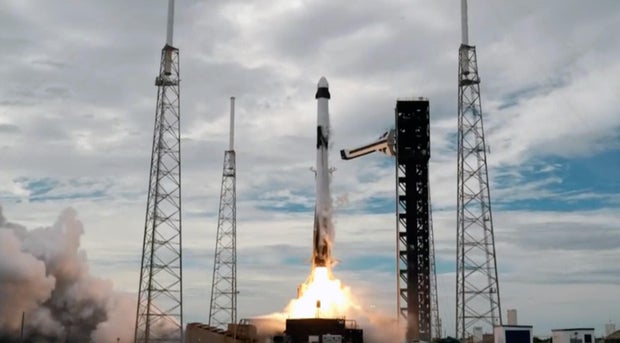
A SpaceX Falcon 9 rocket launched toward the International Space Station on Thursday with two NASA astronauts, a Russian cosmonaut and a Canadian crew member whose family will mark a major milestone on Earth. While astronaut Joshua Kutryk is living aboard the station, his wife is expected to give birth to their third child later this year during her own planned launch-related event.
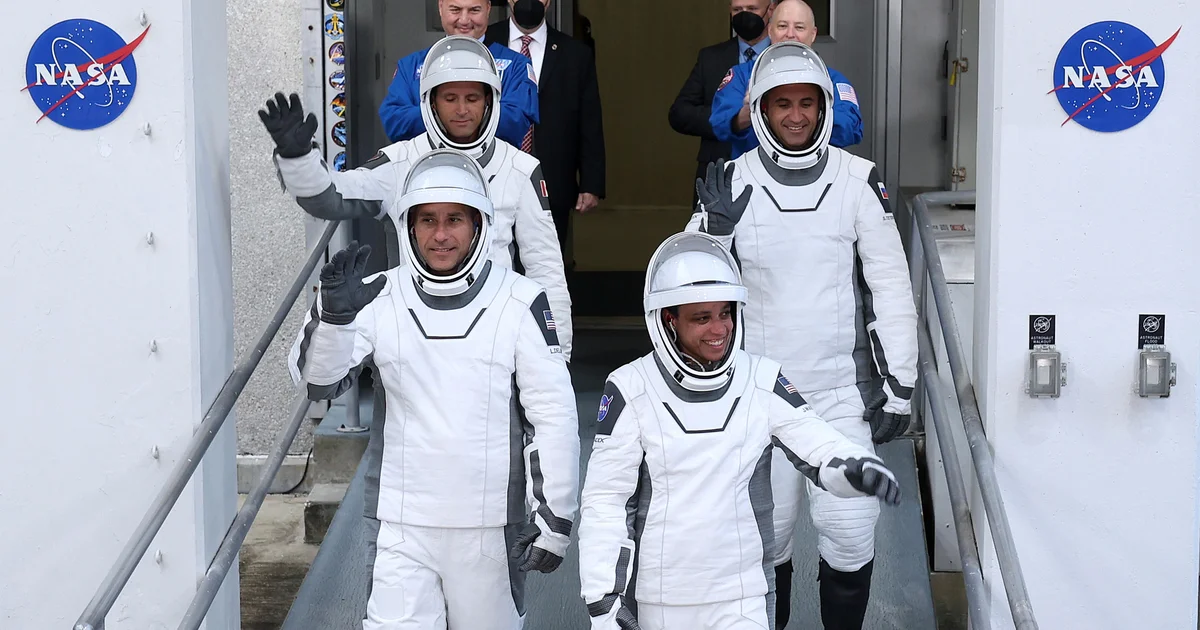
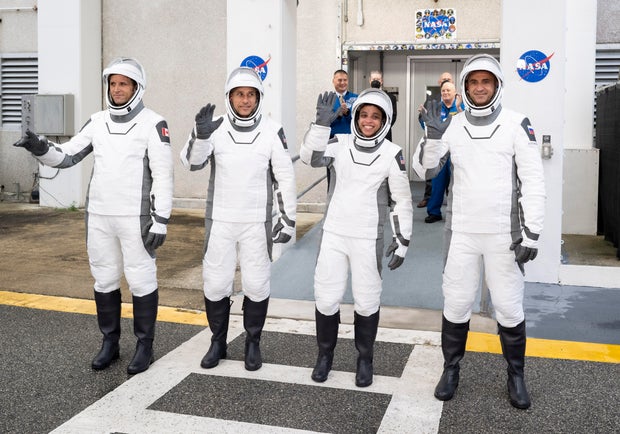
The four astronauts lifted off from Launch Complex 40 at Cape Canaveral Space Force Station at 11:10 a.m. EDT aboard a SpaceX Crew Dragon. Leading Crew-13 was commander Jessica Watkins, joined by pilot Luke Delaney, cosmonaut Sergey Teteryatnikov and Canadian Space Agency astronaut Joshua Kutryk.
Crew-13 had originally been scheduled to launch in mid-September. NASA and SpaceX postponed the mission to replace a valve in the Crew Dragon’s propulsion system.
SpaceX
Watkins, a geologist with a Ph.D., previously traveled to orbit aboard a Crew Dragon in 2022. The other three astronauts are making their first spaceflight, becoming the 296th, 297th and 298th people to reach the ISS. Delaney and Kutryk are former military test pilots, while Teteryatnikov previously served in Russia’s submarine forces before joining the cosmonaut corps.
NASA/Joel Kowsky / Handout / Getty Images
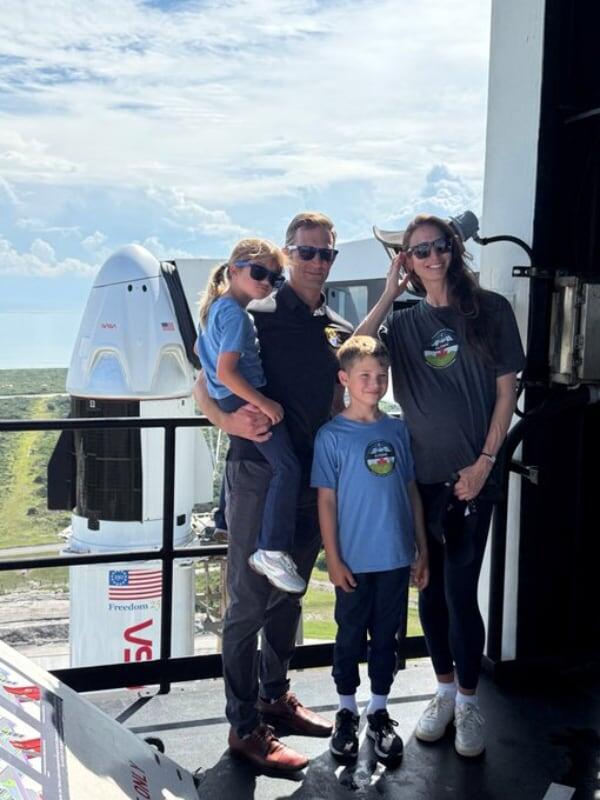
Kutryk and his wife, Heather, already have two children, ages 5 and 7. Their third child is due around Thanksgiving, roughly two months into the Crew-13 mission. That would make them the fourth couple in spaceflight history to welcome a baby while one parent is beyond Earth.
“Leaving these three (plus one on the way) is the hardest thing I’ve ever done,” he wrote in a pre-launch post on X.
“But that has always been the nature of exploration. Words from Fridtjof Nansen, describing his departure for the North Pole, resonate in my mind,” he said. He then quoted Nansen: “‘Behind me lay all I held dear in life. And what lay before me? Happy child, little do you know what life is—how strangely mingled and how full of change… and now, a farewell to home. It was the darkest hour of the whole journey.’”
Joshua Kutryk
Despite President Trump’s recent animosity toward Canada, the Canadian Space Agency remains an important partner in the U.S. space program. Canada provided the robotic arms used to help assemble the space station, while CSA astronaut Jeremy Hansen recently flew around the moon aboard NASA’s Artemis II mission. Kutryk is the 17th Canadian to travel into space.
“When I think about the space station, I hope the legacy is that people see this beacon in the sky going around Earth, one of the most complex things humans have ever, ever created,” Kutryk said. He added that he hopes people recognize both its technological achievement and the science and discoveries taking place there.
“But (I hope) they also see it as sort of this beacon for what we can do when we make good decisions, when we work together and we collaborate and we prioritize things,” he said. “It’s testament to what we’ve done, what we can do, and really to what we hope the generations that follow can do.”
SpaceX
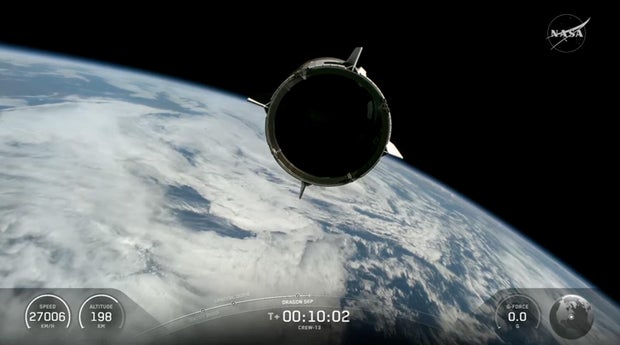
The Falcon 9’s powerful ascent carried the Crew Dragon through the thickest part of Earth’s atmosphere. Once the rocket had done its job, the first stage guided itself back to a precision landing at the Space Force station, while the upper stage continued toward orbit. Minutes later, its engine shut down and the crew capsule separated to begin its journey independently.
“What an epic ride!” Delaney radioed after reaching orbit. “Today, we proudly continue the streak of humans living and working in orbit, building on the legacies of yesterday to pave the way for future of space exploration.” He thanked the NASA, SpaceX and partner teams, along with his family and friends, before adding a message to fellow Marines on Earth: “Semper Fi.”
Flight to space station
As with every crewed and uncrewed mission bound for the International Space Station, the launch was timed to coincide with Earth’s rotation carrying the launch site into the plane of the station’s orbit. That alignment is essential because rockets cannot currently overcome the momentum of an object traveling nearly 5 miles per second and redirect themselves into another orbital plane.
Although the Falcon 9 cannot shift orbital planes after launch, the Crew Dragon can adjust its altitude. It flies lower and faster to close the distance with the station, then climbs higher to reduce its speed as it approaches.
CONTINUE READING: Texts Behind Claims Dolly Parton’s Nephew Wants a $450M Slice
For this mission, Crew Dragon is expected to reach the ISS in about eight hours. The capsule is scheduled to complete an automated docking at the forward port of the station’s Harmony module at 7 p.m.
“I personally am looking forward to returning to the ISS as well as flying on Dragon a second time,” Watkins said. “I’m really looking forward to experiencing those experiences through the eyes of my crewmates.”
The mission schedule includes extensive station maintenance, both inside and outside the orbiting laboratory, along with several spacewalks. The crew will also handle visiting-vehicle capture and stowage operations, conduct scientific research and take part in educational and public outreach.
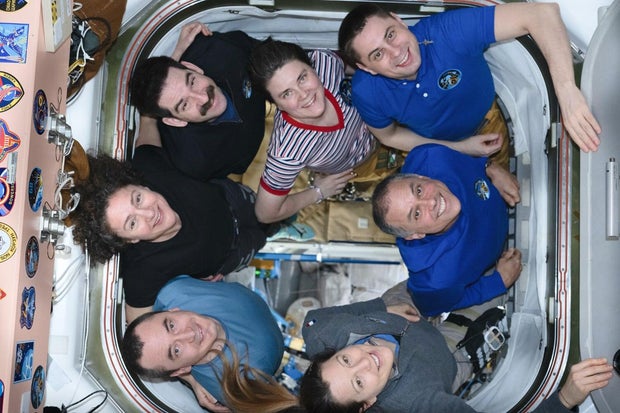
Waiting to greet the new arrivals is the Crew-12 team they are replacing: commander Jessica Meir, pilot Jack Hathaway, European Space Agency astronaut Sophie Adenot and cosmonaut Andrey Fedyaev. The group is completing a 235-day mission that began with a Falcon 9 launch on Feb. 13.
The station is also home to Soyuz MS-29/75S crew members Pyotr Dubrov and Anna Kikina, along with NASA astronaut Anil Menon. They launched aboard a Soyuz 2.1a rocket from Kazakhstan’s Baikonur Cosmodrome on July 14 and are scheduled to spend eight months in orbit before returning to Earth in early April 2027.
NASA
Following a quick crew handover, Meir and her colleagues will train the incoming astronauts on station procedures and daily operations. Crew-12 is then expected to depart aboard its own Crew Dragon, undocking on Oct. 5 before splashing down in the Pacific Ocean off Southern California shortly after noon EDT on Oct. 6.
“I think the thing that I’m looking forward to most is seeing my 3-and-a-half-year-old daughter,” said Meir, a veteran of two spaceflights and seven spacewalks. She also said she was eager to reconnect with the natural world—“feeling the breeze on my face, the wind rustling through the leaves”—after months away from experiences unavailable aboard the space station.
“But I will very, very much miss being weightless all the time and the incredible views that we have.”
Said Hathaway: “Going home and being able to take a nice long hot shower will be very relaxing and very nice. And, of course, I’m looking forward to seeing my family. But a hot shower is near the top of my list.”
Crew 12’s departure will free up the Harmony module’s space-facing port for the arrival of a SpaceX Cargo Dragon on Oct. 13 that will be loaded with crew supplies, science gear, spare parts and two roll-out solar array panels. The Crew 13 fliers also expect to welcome a Northrop Grumman cargo ship in December, along with two Russian Progress freighters in November and February.
NASA
The roll-out solar arrays going up on the next Dragon Cargo ship are the final sets in a major upgrade to the station’s original solar power system that began with initial installations in June 2021. The final two sets will be installed during spacewalks late this month and early November.
But the major goal of the flight, like all NASA missions to the station, is conducting research in the microgravity environment of space. Scores of experiments and technology demonstrations are running at any given moment with fresh studies going up on virtually every flight.
The Crew 13 fliers will face the same challenges.
“During the mission, the crew will help us fight heart disease and Parkinson’s disease by studying human stem cell-derived tissues that will help improve medicine, disease modeling, and pharmaceutical testing,” said Dana Weigel, director of NASA’s low-Earth orbit mission directorate.
“They will also explore crop production that’s important for longer-duration spaceflight missions, and they’ll help us better understand blood flow abnormalities that we see in space, along with testing new diagnostic medical equipment for monitoring crew health. That’s just a couple of the highlights of the research the crew will be doing on board.”
All in all, Hathaway said, the crew is looking forward to an action-packed stay in space.
“For me, between the science, the spacewalks and everything else that the expedition is going to have, it’s looking to be a great time,” Delaney said. “Excited to launch with this crew, join the expedition, and integrate as an extension of NASA and all the ISS team members. So exciting times ahead!”