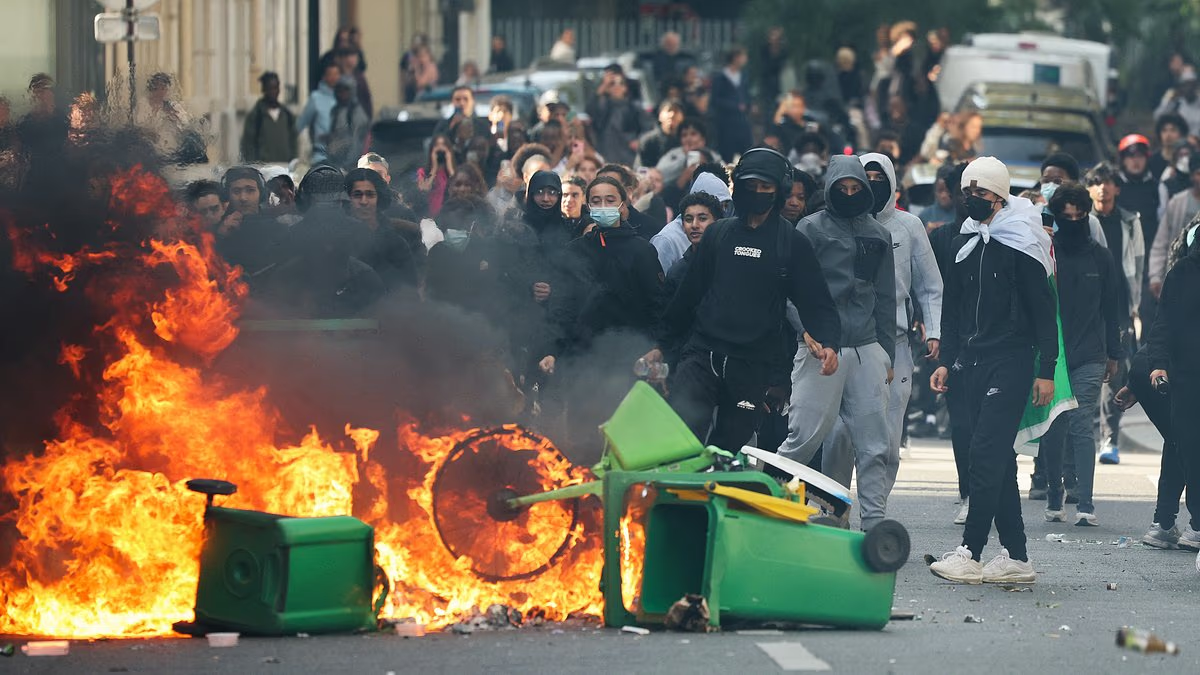

The tear gas has cleared from the streets of Saint Denis, but the damage left behind by the unrest remains. Burnt-out commercial bins, some hurled at police barricades, still litter the roads, alongside the debris from fireworks fired as weapons.
After furious and violent protests broke out at schools in the deprived Paris suburb and spread to towns and cities across France, a fragile calm returned yesterday—at least for the time being.
That pause came at a significant cost. More than 400 schools were shut and pupils told to study from home, a measure reminiscent of the Covid lockdowns. Ministers, caught off guard by the scale of the disorder, were forced into a high-risk response.
The violence has stunned France, a nation with a long tradition of revolution and street protest. What has made the unrest particularly disturbing is the age of many involved: large numbers of the alleged attackers are children, with some reportedly just 14.
In Marseille, a headteacher was covered in petrol while attempting to stop youths from setting his school alight. In the northern city of Lille, a headmaster was struck in the ear by a firework, while another school worker suffered a firework injury to his leg.
Thursday was especially dangerous for law enforcement, with 305 gendarmes injured. Among them was a young female officer who fell while fleeing a masked crowd and was attacked as she lay on the ground.
Some school buildings were destroyed by fire, while fire engines were damaged or blocked to stop crews reaching burning sites. Television footage from Bordeaux showed a firefighter surrounded by flames after an aerosol can exploded outside a school.
One French media report said police were targeted with fireworks, other projectiles and hydrochloric acid. Videos circulating online appeared to show a youth using a lighter and aerosol can as a makeshift flamethrower against a woman. Intelligence officials also said electric scooters were being used to transport fireworks between schools and help suspects evade officers.

Demonstrators set rubbish bins alight as protesting students block a road near Place de la Nation in Paris

French police officers stand in the foreground as demonstrators gather in tear gas during student protests near Kerichen High School in Brest, western France, on October 2

Clashes have spread across France as high school students confront police in an escalating campaign calling for improved education conditions
Images of confrontations between riot police and students have intensified the public anger now spreading across France.
Many people have expressed outrage at what they see as senseless destruction—and at the authorities’ apparent inability to bring the unrest under control.
Much of the criticism has focused on Emmanuel Macron, the politically weakened president whose final period at the Élysée Palace has been overshadowed by disputes over spending reductions and austerity measures.
However, anger has also been directed at the conduct of some police officers. Online footage appeared to show a terrified teenage girl being dragged partly by a large officer who had her in a chokehold.
Another video seemed to capture a baton round being fired at close range towards a masked young man. Claims have since emerged that he sustained a broken jaw and lost several teeth. At least three internal police inquiries have been opened, although prosecutors say the youth had assaulted a female officer first.
Protesters have also alleged that a secondary school pupil lost an eye after being struck by a projectile.
Yet the allegations against police must be considered alongside the severe attacks faced by officers and others. Nearly 2,000 people were arrested on Thursday, as students organised blockades at more than 900 demonstrations.
Near Orleans, south of Paris, a teacher was punched by a teenager who did not attend his school. In Rennes, Brittany, staff at two lycees found their cars vandalised. Overall, 284 people were injured, including a young demonstrator who reportedly suffered serious damage to part of his hand while handling a firework.
The unrest has now moved beyond school gates and into urban centres. Marseille suspended its entire public transport system after drivers were attacked and buses set ablaze, while Strasbourg and Grenoble introduced similar restrictions.
In the Paris region, troubles have erupted even in usually quiet suburbs such as Vanves, where youths in hoods and masks gathered on a roundabout to throw firecrackers at police vehicles.
French citizens horrified by this spreading uprising have taken to social media claiming the country is losing its unifying culture. Others say the fact that many protests erupted in poor quarters, traditionally where immigrants are housed, prove that France is paying the price for open borders.
Damage to schools over the past days is estimated at £850,000.
There are calls for robust action. Eric Ciotti, the right-wing mayor of Nice has called for the benefits of parents of violent school protesters to be withdrawn.

Students pose before burning trash as highschool students demonstrate countrywide over what they denounce as poor learning conditions, near the Lycee Deodat high school in Toulouse, south-western France

A student kicks a burning bin as students for a blockade at the Louis Pasteur middle school, in Strasbourg

A masked student is seen as flames rise from burning barricades in Nancy, France

A demonstrator jumps over a fire during student protests in Saint-Pierre, on the French overseas island of La Reunion
FIND OUT MORE: NYC Deli Honors Nassau Executive Blakeman as He Vows Cheaper Lunches
What is clear is that what began as teenage complaints over what they resent about school has been escalated by far-left activists.
The finger of blame is being pointed at the populist leftist party, France Unbowed, which the government has accused of whipping up disorder, describing it as an ‘organised manoeuvre’.
Its leader Jean-Luc Melenchon, who is expected to face right-wing firebrand Marine Le Pen in a runoff for next year’s presidential election, denied this, saying protests were ‘self-organised’.
To win next April the hard left will need the support of the young and many of those involved in this week’s clashes will be eligible to vote for the first time.
Inconveniently, the mayor of St Denis, Bally Bagayoko, a member of a coalition of the Communist and France Unbowed parties, joined one of the school blockades and described the protest as ‘completely legitimate’. He was carried shoulder high by pupils singing La Marseillaise, the French national anthem.
Back-to-school protests are an annual French ritual, often involving union-led strikes over pay, staffing and class sizes. But what began as frankly petty complaints about restrictions on mobile phone use, long queues for canteens, and inadequate supplies such as toilet paper, dramatically changed.
The first blockade was at the Lycee Saint-Exupery in Creteil, southeast Paris, where pupils complained there were not enough staff or support for children with special needs.
It spread rapidly through poorer Paris suburbs amid anger over more genuine demands such as absent teachers, dilapidated buildings and overcrowded classes, as well as claims of not enough desks and chairs.
Students at the Paul-Eluard school in St Denis complained of classrooms being too hot or too cold and of rats and cockroaches.
At a school not far away in St Ouen a 16-year-old said: ‘At first it was peaceful, but it went too far when about 15 young people who had come from another town took the opportunity to run riot.’
Copycat protests erupted, driven by slick AI-generated posters on TikTok and Snapchat which suggested a degree of planning to the unrest.
Prime Minister Sebastien Lecornu urged government ministers to cancel all trips away from Paris, officially to avoid additional strain on police resources. Some suggested he was afraid that they would become targets too.

A French firefighter extinguishes a fire on the street

French Gendarmes run towards a high school student that pointed a firework launcher at them as protesting students demonstrate in the streets of Bordeaux, south-western France

Protesting students throw items on to burning bins in Lille, northern France
Lecornu also chaired a crisis meeting, after which his office said the school riots had ‘tipped into urban violence’ – a statement of the obvious given the tumult.
Students gathering outside the Suger Lycee in St Denis yesterday held banners reading: ‘8am until 6pm is like prison’.
As they faced off with around 50 armed riot police brandishing shields, a protester called Gilles, 17, told Our News Outlet: ‘Classrooms are dirty, teachers are not always present, and yet we are expected to sit around all day.
‘The conditions are terrible, and yet the government just takes money away, rather than doing something about the deep problems.’
Lycee, or high school students, in France – aged between 15 and 18 – are preparing for the crucial baccalaureat, the equivalent of A-levels, which is a primary requirement for university entry.
Le Bac’ – as it is universally known – is a tough exam, in multiple subject areas and accordingly many individual timetables do indeed stretch from 8am to 6pm – far longer than British state schools, where teaching is roughly from 9am until 3.45pm.
The protests are not confined to the impoverished suburbs (the infamous banlieues). At the exclusive Lycee Henri IV, on the tourist-filled Left Bank of Paris, where past students include the philosopher Jean-Paul Sartre and Emmanuel Macron himself, the front entrance was blockaded by about 50 mainly female students.
An 18-year-old, who asked to be referred to as Mathilde, said: ‘We support all our oppressed brothers and sisters across France, and won’t stop until there is justice for all of them.’
It was this kind of blockade that sparked the infamous Paris riots of 1968, a brutally crushed insurrection that wanted to overthrow the government of General Charles de Gaulle.
The parallels are significant. For the schools unrest comes at a perilous time for Mr Macron. France’s public debt has soared to over £3trillion and swingeing cuts to public services have been ordered.
Meanwhile organisers are calling for a ‘national mobilisation’ next week. And later this month the anti-government gilets jaunes, or yellow vest, protesters who paralysed France in 2018 are holding a rally against Macron’s cuts.
Protesting students may be the spark to a far greater and more dangerous conflagration.
Additional reporting by Peter Allen and Rory Mulholland in Paris.