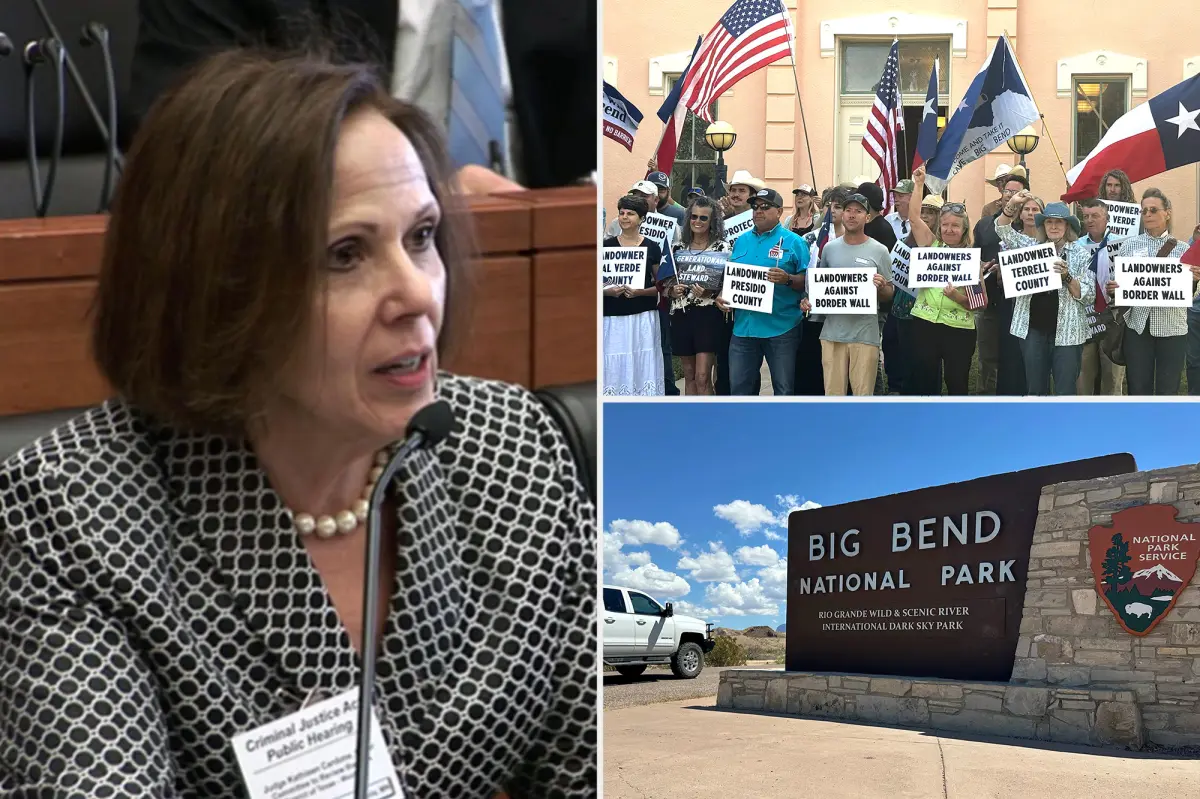

A federal judge in Texas on Friday temporarily halted the Trump administration’s plans to build a border wall and related infrastructure across the state’s Big Bend region, handing opponents of one of President Donald Trump’s signature campaign promises a significant court victory.
Property owners, businesses and conservation groups have joined forces against the projects, which form part of a $46 billion administration effort to fortify the southern border with 30-foot steel barriers, vehicle obstacles, access roads and surveillance equipment.
U.S. District Judge Kathleen Cardone ruled that the plaintiffs were “likely to succeed on the merits of at least one of the claims in suit,” and that they faced serious, irreparable harm without an injunction. She also found that the balance of equities and the public interest favored the challengers.
U.S. Customs and Border Protection defended the planned border construction in a statement issued Friday.
“We stand by our assessment and remain confident in our legal authorities to secure the border while preserving the unique landscape of the Big Bend region,” the agency said. “We are working with the Department of Justice on next steps.”
The Department of Homeland Security did not immediately answer a request for comment.
Cardone’s order covers Big Bend National Park, where strong opposition to the proposed wall previously led the administration to temporarily suspend construction.
Opponents contend that the roughly 500-mile Big Bend region is so isolated and difficult to navigate that its natural terrain already discourages illegal immigration. They also argue that the administration broke the law by issuing broad waivers that allowed it to bypass multiple environmental and other regulations in an effort to accelerate border infrastructure work.
The lawsuit was filed by an environmental group, supporters of a historic church in Ruidosa and a river guide. They argue that the Department of Homeland Security improperly sidestepped safeguards designed to protect the region’s environment, cultural heritage and archaeological sites.
MUST READ: 34 Missing Children Recovered in Three-Day Long Island and NYC Operation
Laiken Jordahl of the Center of Biological Diversity, which filed the lawsuit, described the ruling as a “total victory.”
“The bulldozers are going to be sent packing until she rules on the merits,” Jordahl said. “This is such a historic day for Big Bend and for Texas and the Constitution.”
The ruling came only weeks after the administration installed the first border wall panels in the Big Bend sector in mid-September.
The proposed border wall and infrastructure projects have drawn opposition from both Republicans and Democrats.
Much of the criticism has focused on CBP’s plans for Big Bend National Park, known for its sweeping scenery, limestone formations and exceptionally clear views of the night sky.
The controversy intensified in August, when bulldozers were seen clearing land inside the park. Lawmakers from both parties urged the administration to stop the work, prompting CBP to pause construction. That suspension expired earlier this week. The administration has said it is reconsidering its plans for the park but has not announced a final decision.
Park advocates welcomed Friday’s decision but urged the administration to repair the damage already caused at Big Bend National Park and pursue different approaches to border security.
“Big Bend is no place for border barriers. It’s time for the administration to come to the table with the border communities that know Big Bend best, repair the damage from this ill-conceived project, and find new solutions,” Tiernan Sittenfeld, president and CEO of the National Parks Conservation Association, said in a statement.
The injunction also applies to areas both upstream and downstream from the national park, where CBP has outlined additional border projects that would largely cross privately owned property.
The government has been seeking approval from landowners to conduct surveys and begin construction in those areas. However, in a recent court filing, officials said they were ready to send some disputes to the Justice Department after failing to obtain permission from property owners.