


Static Media
Brad Pitt has been a familiar presence on screen since the 1980s, becoming one of Hollywood’s defining stars after a run of major hits in the 1990s. His filmography has since grown to more than 100 projects. While the quality of those movies varies, each one highlights Pitt’s versatility across a remarkably broad range of genres.
Given the size of his body of work, it may come as a surprise that Pitt has appeared in only three science-fiction films throughout his career. Perhaps his early encounters with the genre discouraged him, or perhaps the actor has simply been selective about the projects he takes on.
The quality of those three films suggests the latter explanation is more likely. Ranked from lowest to highest according to their Rotten Tomatoes Tomatometer scores, here is a look at Brad Pitt’s complete science-fiction filmography.
3. World War Z

Paramount PIctures
Marc Forster’s 2013 sci-fi disaster film World War Z endured a famously difficult path to theaters, but it ultimately became the clearest blockbuster showcase of Brad Pitt’s career. Loosely based on Max Brooks’ World War Z: An Oral History of the Zombie War, the film imagines a world overwhelmed by a rapidly spreading zombie outbreak. Pitt plays Gerry Lane, a former United Nations investigator who joins forces with the World Health Organization and other agencies in a desperate effort to uncover the source of the epidemic and develop a vaccine.
Although World War Z ranks last on this list, it is hardly a critical or commercial disaster—and certainly not among Pitt’s weakest films. The movie earned more than $531 million worldwide from a reported $190 million budget. On Rotten Tomatoes, it holds a 67% Tomatometer score and a 72% Popcornmeter rating, reflecting its reputation as a large-scale, crowd-pleasing action spectacle.
2. Ad Astra
20th Century Fox
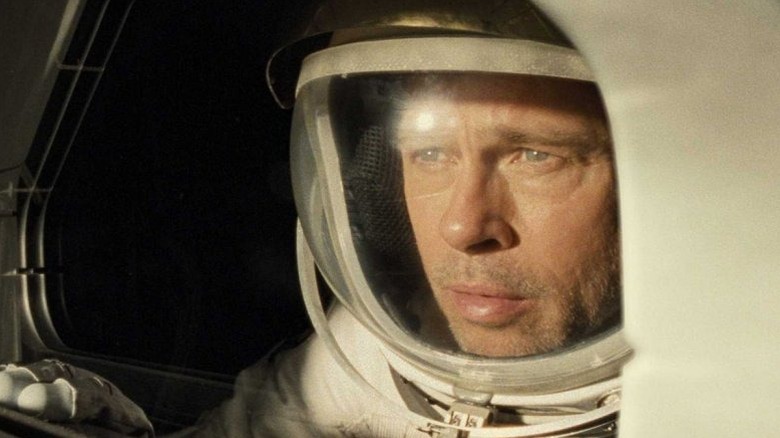
Ad Astra takes a much quieter and more reflective approach to space adventure than its premise might suggest. In James Gray’s 2019 film, Pitt plays an astronaut tasked with protecting the universe, yet the movie’s introspective tone created a sharp divide between critics and audiences. It earned an impressive 83% Tomatometer score on Rotten Tomatoes, compared with a considerably lower 40% Popcornmeter rating.
Viewers expecting alien battles and futuristic shootouts may be surprised by Ad Astra. Pitt portrays Roy McBride, who travels to Neptune to investigate an antimatter crisis threatening the solar system. The source of the problem is a station led by Roy’s father, the celebrated Clifford McBride, played by Tommy Lee Jones. If Roy cannot restore contact with the mission, he may be forced to destroy the entire facility.
The setup sounds straightforward, but the film becomes considerably more philosophical than its $80 million space-movie premise implies. Ad Astra is visually striking and anchored by strong performances, yet its real subject is not the fate of the universe. Beneath the cosmic stakes, it is a story about family, isolation and the search for belonging. Its deliberate pace may not suit every viewer, but the film leaves a lasting impression.
1. 12 Monkeys
Universal Pictures
Where Ad Astra split audiences, Terry Gilliam’s 1995 sci-fi thriller 12 Monkeys found broad approval from both critics and viewers. Widely regarded as one of Gilliam’s finest films, it holds an 88% Tomatometer score on Rotten Tomatoes, matched by an identical 88% Popcornmeter rating. Brad Pitt is a major reason the movie remains so memorable.
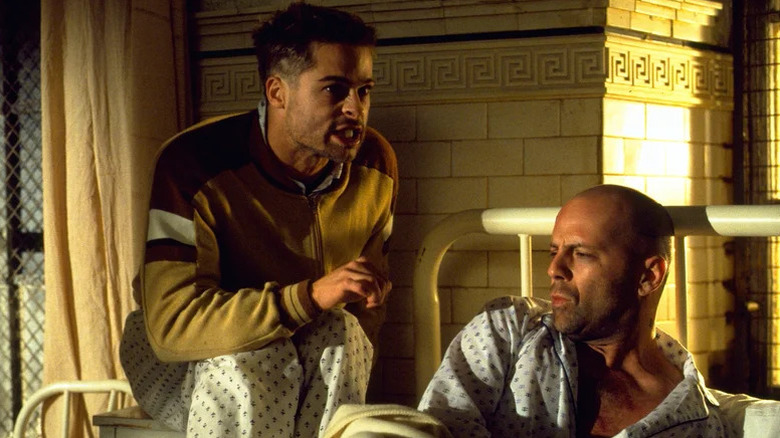
Like World War Z, 12 Monkeys centers on a last-ditch effort to stop a virus capable of wiping out humanity—but it adds time travel to the equation. Bruce Willis plays James Cole, a prisoner from 2035 sent back to 1996 to trace the origins of a plague that has killed most of the population in his era. Instead, he arrives in 1990, where his erratic behavior leads to confinement in a psychiatric hospital. There, he encounters Dr. Kathryn Railly, played by Madeleine Stowe, and Jeffrey Goines, Pitt’s anti-consumerist inmate and the eccentric leader of the Army of the Twelve Monkeys, a group suspected of causing the outbreak.
Every element of 12 Monkeys works with unusual precision, but Pitt’s manic, unpredictable performance makes Jeffrey one of his most memorable early roles. Though he is not the film’s central character, Pitt dominates every moment he receives. The movie’s $168 million worldwide box office return from a $29 million budget also helped strengthen the actor’s standing in Hollywood.