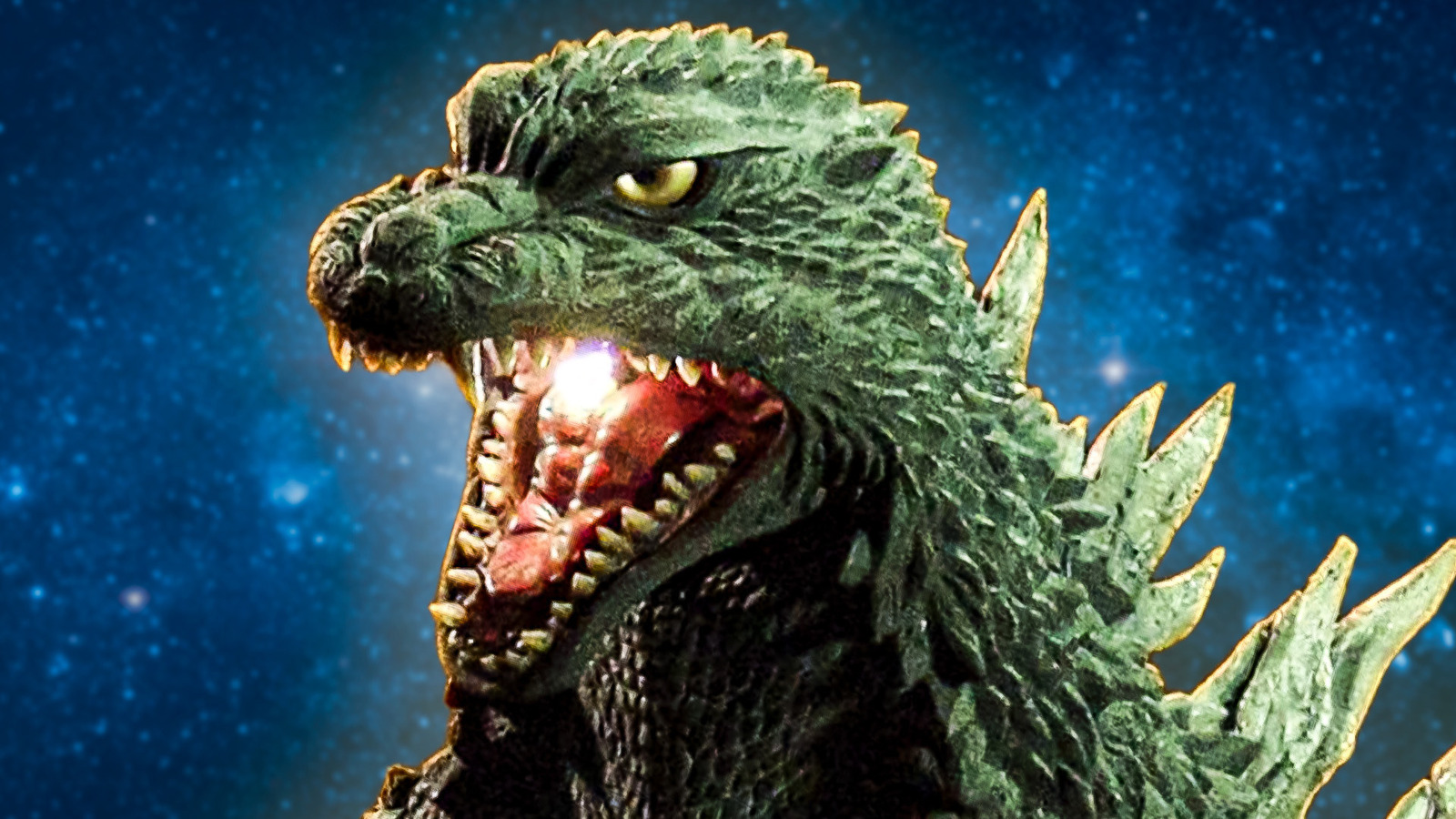

Anyone who has attempted to watch every Godzilla film knows the franchise can take some truly strange turns. The Big G has been portrayed both as a terrifying symbol of the atomic age and as a superhero for children, so unusual ideas are practically built into the series. Even so, the movies that reached theaters represent only a small portion of the bizarre concepts that never made it into production.
WikiZilla contains 81 pages devoted to unmade or canceled projects tied to Toho’s kaiju universe. Some were early versions of films that eventually arrived in another form, such as “The Return of King Ghidorah!” evolving into “Godzilla vs. Gigan” and “Resurrection of Godzilla” becoming “The Return of Godzilla.” Others were considerably more unconventional.
We reviewed those abandoned screenplays and proposals to identify five projects that could have produced the strangest Godzilla movies of all. The entries are presented chronologically, beginning with a 1950s sequel that might have blown up Godzilla and ending with a 21st-century IMAX concept that helped pave the way for Legendary’s MonsterVerse.
Bride of Godzilla?
The first entry dates to 1955, shortly after the release of the second Godzilla movie, “Godzilla Raids Again.” Actor Hideo Unagami sent producer Tomoyuki Tanaka an unsolicited screenplay titled “Bride of Godzilla?” Producers generally were not expected to read scripts submitted this way, but Tanaka was intrigued enough to request additional drafts. The project eventually collapsed, apparently because its production would have been prohibitively expensive at the time. The idea resurfaced in 1978, when Hideichi Nagahara prepared further rewrites, but it still never reached the screen.
Several ideas from “Bride of Godzilla?” later echoed through the franchise. Its supporting monsters — a giant flea and an Archaeopteryx — can be viewed as early versions of Meganulon and Rodan, respectively. Rodan appeared in 1956’s “Rodan,” a film in which Unagami had a small role. The script’s hollow Earth, populated by monsters, also anticipates the setting eventually developed for Legendary’s MonsterVerse, although that version has yet to feature mermaids. Its title character, meanwhile, is a giant robot built to battle Godzilla, an idea that predates Mechagodzilla, one of his most formidable enemies.
The concept is strange not merely because it was ambitious, but because the robot is designed as a giant naked woman modeled after its creator’s foster daughter. Godzilla falls in love with the mechanical bride, follows her into the hollow Earth and is ultimately destroyed by a hydrogen bomb. The King of the Monsters’ romantic entanglements will appear more than once on this list.
Batman Meets Godzilla
In 1966, the “Batman” television series and movie starring Adam West became unexpectedly popular in Japan, while Godzilla’s films continued building an audience in the United States. The timing seemed perfect for an outrageous international crossover. Shinichi Sekizawa, who wrote “Mothra vs. Godzilla,” and an unidentified American writer each developed treatments for “Batman Meets Godzilla.” The project stalled after West’s “Batman” saw its ratings fall rapidly. Batman and Godzilla finally crossed paths in the 2023 comic series “Justice League vs. Godzilla vs. Kong,” written by Brian Buccellato and illustrated by Christian Duce and Luis Guerrero.
The American treatment was later discovered in the archives of producer William Dozier, and its plot is every bit as campy as the premise suggests. The villain, Klaus Finster, possesses weather-control technology — an idea that would also appear in 1967’s “Son of Godzilla” — and uses it to summon the monster. Batman concludes that Godzilla is seeking a mate, so he creates a device capable of imitating a female Godzilla’s mating call. A crossed-out line reveals that the original plan involved constructing a female Godzilla robot. In an especially odd twist, the kaiju develops feelings for Batgirl, a development more reminiscent of King Kong than Godzilla. Quite how that romance would have worked remains unclear.
A Space Godzilla
After the success of the wonderfully campy 1977 horror film “House,” director Nobuhiko Obayashi and actor Mitsutoshi Ishigami proposed what may be the most unconventional Godzilla concept of all: “A Space Godzilla.” Toho rejected the pitch, but the story was later adapted into a two-part short work published in Starlog magazine in 1979. Sakio Hirata, another “House” actor, wrote it, with illustrations by Nobuyuki Shirayama and Katsuhiro Otomo, who would later create “Akira.”
The story begins with Godzilla dying from diabetes. After scientists harvest his organs, they discover a way to communicate psychically with his brain. Their findings reveal that Godzilla is actually a pregnant female alien named Rozan, who must return her unborn child, Lilin, to the Godzilla Planet. Rozan’s body is converted into a rocket so Lilin can be sent home. The Godzillas are then revealed to be a peaceful species, with humanity blamed for Rozan’s violent behavior. Their population has been nearly destroyed by the Sunerians, a half-goat, half-human species described in unusually sexualized terms. Rozan’s former mate, Kuunin, battles the Sunerian General Gamoni to save his offspring, who is also psychically linked to a human girl named Momo on Earth.
Had it reached theaters, “A Space Godzilla” would have been an astonishingly strange cinematic experience. It would also have radically rewritten the franchise’s mythology, which may explain why the idea remained an intriguing “What if?” rather than becoming an actual Godzilla movie.
God’s Godzilla
Also in 1979, surrealist science-fiction writer Yoshio Aramaki proposed “God’s Godzilla,” a story in which the monster encounters Jesus. The idea may have been encouraged by the way “Gojira” was rendered in English as “GODzilla.” It was not the only late-1970s concept to connect Godzilla with Christianity: several magazines mentioned a possible “Godzilla vs. The Devil.” A battle between Godzilla and Satan is easier to imagine reaching theaters without controversy, however, than this science-fiction reworking of the story of Jesus.
Aramaki’s proposal imagines gods as extraterrestrials composed of mental energy. They resurrect Godzilla during World War III, which the story predicts will begin in the Middle East during the 1980s. Godzilla’s return triggers the apocalypse described in the Book of Revelation, prompting the gods to send Jesus as an emissary. His mission is to manipulate Godzilla while guiding humanity’s suffering survivors toward Heaven. “The humanoid (Jesus) is the Superego, and Godzilla is the Unconscious,” the proposal declares — perhaps the most grandiose analysis ever applied to a lizard portrayed by a performer in a rubber suit.
Godzilla 3-D
With its psychedelic visuals, child-friendly superheroics and grim environmental-horror story, 1971’s “Godzilla vs. Hedorah” — also known as “Godzilla vs. The Smog Monster” — may be the strangest Godzilla film that was actually produced. Producer Tomoyuki Tanaka, who was ill for much of the shoot, disliked the movie and barred director Yoshimitsu Banno from making sequels. After Tanaka died in 1997, Banno spent years trying to revive the franchise. Between 2003 and 2009, he developed an IMAX project titled “Godzilla 3-D,” also known as “Godzilla vs. Deathla to the MAX” and “Godzilla 3-D to the MAX.”
“Godzilla 3-D” would have revisited ideas from “Godzilla vs. Hedorah.” Hedorah would be reimagined as Deathla, a rainforest-destroying creature capable of taking locust, mushroom and skeletal humanoid forms, while Godzilla would once again be able to fly. The story was set in the United States. The first two script drafts had Godzilla defending New York City’s 9/11 memorial, but later versions moved the climactic battle to Las Vegas. The project also gave Godzilla another new ability: when his tail crashed through waterfalls, it created rainbows.
In the end, Legendary Pictures’ feature-length “Godzilla,” directed by Gareth Edwards and released in 2014, moved ahead of the proposed IMAX short. Banno nevertheless received an executive producer credit on the finished film.


