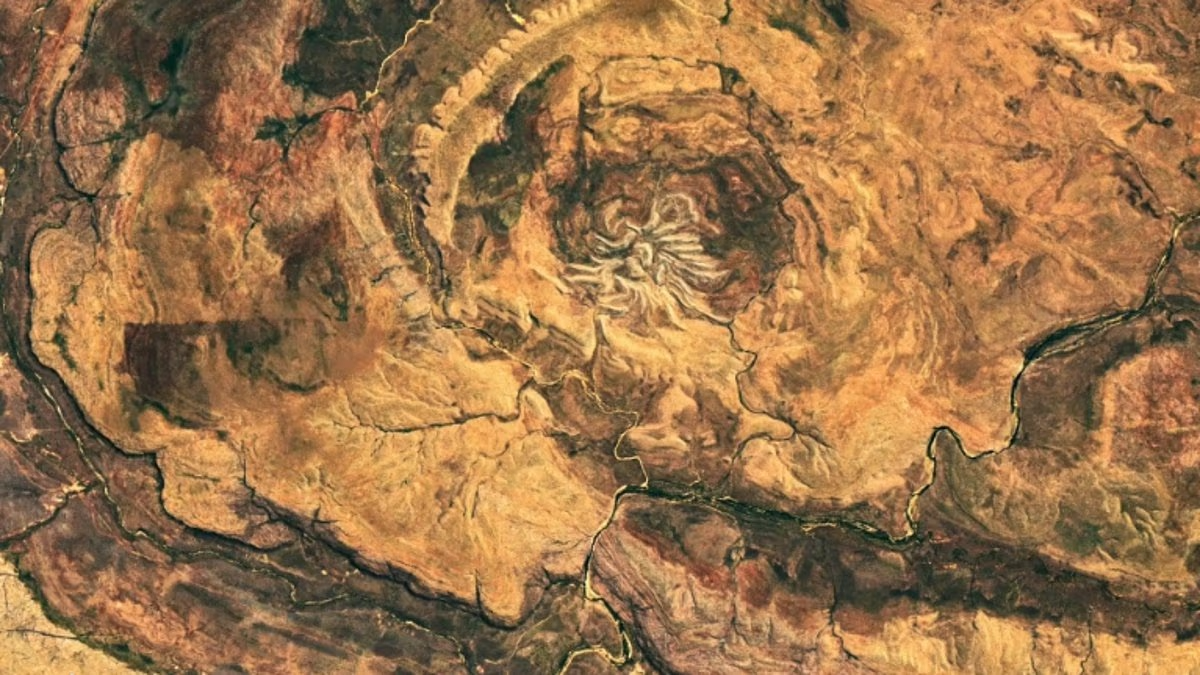

NASA has released a striking satellite image of a mysterious formation concealed in the Australian desert.
Landsat 9 captured the image while passing over Western Australia’s Kimberley region, revealing what the agency described as “an impact structure with legs.”
Its otherworldly appearance comes from Spider Crater, a meteorite impact site shaped by hundreds of millions of years of erosion.
From above, scattered patches of green vegetation stand out against the region’s red rocks.
The vegetation becomes denser along the banks of a narrow stream that winds diagonally through the crater.
Spider Crater’s unusual form perplexed geologists for decades, until evidence uncovered in the 1970s began to reveal its true origin.
Researchers discovered grooved, cone-shaped fractures in the surrounding rock—distinctive markers of a meteorite or asteroid strike.
Heavily distorted layers of sedimentary rock added to the evidence, showing the enormous forces released when an object from space collided with Earth.

Landsat 9 captured Spider Crater in Western Australia’s Kimberley region, which NASA described as “an impact structure with legs.”
The oval formation stretches roughly eight miles by seven miles, while its spiderlike central section is about 2.5 miles wide.
Although scientists now understand what created Spider Crater, its precise age remains uncertain.
Current estimates suggest the impact occurred between 600 million and 900 million years ago.
After the crater was identified in the 1950s, scientists spent years trying to explain how its distinctive shape had developed.
Its remote setting and rugged landscape make the site difficult to visit, while its unusual pattern is most clearly visible from the air or in satellite imagery.
Some experts initially proposed that the formation was volcanic. Closer examination, however, pointed to a much more violent event.
MORE ON THIS: 4-Year-Old Girl Executed After Private Equity Lawyer Dad Won Custody
Geologists identified shatter cones—fractures formed when powerful shock waves rip through rock—across Spider Crater’s central dome. Their presence provided compelling evidence of an impact.
Laboratory studies of shocked quartz and zircon crystals embedded in the sandstone have offered additional clues, including information that may help researchers determine the meteorite’s angle of impact.

Scientists revealed in July that North Pole Dome in Western Australia’s Pilbara region, pictured, is the oldest asteroid impact crater on Earth.
Australia is also home to the oldest known impact crater on Earth.
For years, scientists suspected that North Pole Dome in Western Australia’s Pilbara region marked the site of an ancient cosmic catastrophe.
In July, researchers uncovered the first rock–solid evidence that provides an exact date for the impact.
Using advanced mineral dating techniques, they show that the crater was formed when a space rock smashed into Earth 3.02 billion years ago.
While billions of years of erosion have wiped away much of the evidence, this impact was substantial enough to leave a lasting legacy on Earth.
Lead author Professor Chris Kirkland told Our News Outlet that this meteor could have been a ‘kilometre–scale’ object, although its precise size is impossible to determine.
He said: ‘At North Pole Dome, the impact appears to have generated a long–lived fractured system that was later reused by fluids.
‘On the early Earth, that kind of process could have influenced chemical exchange between rocks and an early ocean, causing mineral alteration and potentially modifying the environments available for microbial life.’
The key piece of evidence was zircon, an extraordinarily resilient mineral that can hold its shape for billions of years.
When the researchers took samples from the rocks around North Pole Dome, they found that some zircon crystals had strange branching or ‘skeletal’ shapes.
Professor Kirkland believes that these are ‘impact–modified crystals’ formed when old zircon in the rocks was disrupted and partially recrystallised by the intense heat of an impact.
Critically, they were also able to date the formation of these crystals to an event around three billion years ago.


