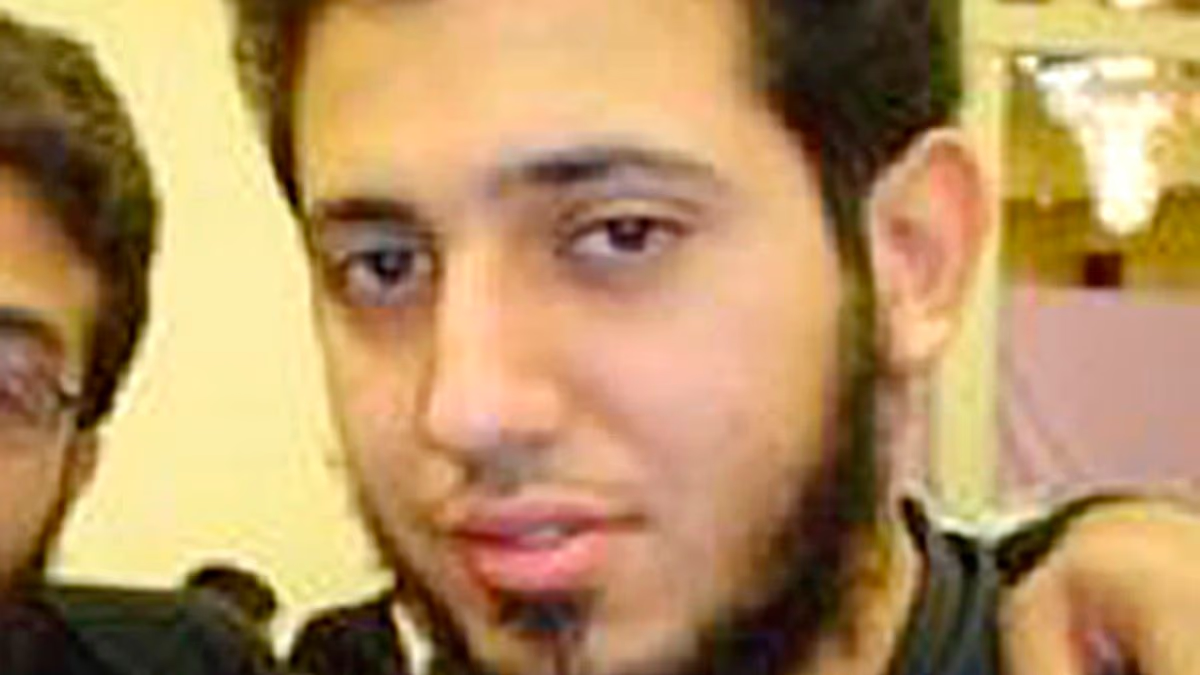

Zakaria Amara, described as the “mastermind and chief organizer” of a plot to bomb three Toronto government facilities, has been granted full parole and is now living in the community after officials cited his “respectful, polite and quiet” conduct.
Amara, 41, pleaded guilty in Ontario’s Superior Court of Justice in 2009, three years after helping devise the extremist attack. The planned operation was stopped following an extensive police investigation.
He received a nine-year sentence for organizing a terrorist training camp, along with life imprisonment and no possibility of parole for 10 years for conspiring to build a bomb. Amara was arrested as bomb-making materials were delivered to a warehouse.
A 2010 appeal of his sentence was rejected. The Parole Board of Canada later approved day parole in 2022, allowing him to live in a supervised residential facility under strict conditions.
On Friday, the Parole Board of Canada’s Ontario division approved Amara for full parole. In a written decision obtained by the Canadian Press, the board said he no longer displayed “any signs of holding onto extremist beliefs or radical ideologies.”
Officials credited Amara with making a successful transition during his period of day parole, citing rehabilitation and a “positive change, both in attitude and in behavior.”
The decision noted that Amara continued to hold extremist views during his imprisonment. However, authorities recorded a change in his ideology in 2014, after which he was moved to a minimum-security institution.
“During the latter part of your federal custody and for the past four years in the community, you have undertaken a process to distance yourself from extremist ideologies and others who share the same views,” the board wrote.

Zakaria Amara, 41, has received full parole more than two decades after helping plan a major terrorist attack in Canada

Amara spent time in a maximum-security prison for the plot before being released on day parole four years ago. He is pictured in Facebook images uncovered in 2018

Amara was arrested in 2006 during a major police operation targeting the terrorist network. His former home is pictured above
As a condition of his release, Amara is prohibited from contacting anyone involved in criminal activity, including members of the Toronto 18 group, as well as people who promote extremist beliefs.
He will reside at his own home, attend a mosque, maintain contact with family, take part in “appropriate leisure activities” and hold a full-time job, according to the review.
He must also continue counseling and financial monitoring, while complying with limits on his telephone and internet use.
In 2018, Global News reported that a Facebook account bearing Amara’s name had circulated images apparently showing him behind bars. The account was later removed, Global News reported.
FIND OUT MORE: Millions Back LA Repair Shop After Influencer Publicly Shames It
The Toronto 18 investigation stunned Canadians and became widely regarded as the country’s first major homegrown terrorist conspiracy.
The scale of the operation emerged after a sweeping police raid in the summer of 2006, when roughly 400 officers searched homes across Toronto and Mississauga. Among those arrested were teenagers aged 15 and 17.
An informant who infiltrated the group for the Canadian Security Intelligence Service, or CSIS, testified that the plan to attack the Toronto Stock Exchange Tower, CSIS headquarters and a military base was far advanced.
The informant said Amara had sought help obtaining ammonium nitrate, the fertilizer used in the 1995 Oklahoma City bombing that killed 168 people. Amara also intended to pack the explosives with metal fragments to increase the number of casualties.
The conspirators planned to detonate the devices during rush hour. The sentencing judge warned that a successful attack would have produced “catastrophic” consequences and caused numerous deaths. Prosecutors likened the proposed assault to a “Canadian 9/11.”

Amara pleaded guilty to the attacks in 2009. His sister (right) is pictured above holding his daughter outside Brampton Court

A written review from the parole board said he has worked to rehabilitate and no longer harbors extremist views. He is pictured above in an undated social media photo

Amara was described by the review board as ‘respectful, polite and quiet’
‘Driven by his violent Jihadist convictions, the appellant plotted and schemed for months, schooled himself in the science of bomb-making, recruited underlings to assist him, used tactics designed to reduce the chances of detection, and played a central role in every important decision that was made to further the conspiracy,’ judges wrote in an appeal denial in 2010.
During his sentencing, Amara read aloud a two-page letter to the judge, expressing remorse and accepting his fate.
‘Even though my terrorist plans were divinely aborted I still feel that I have killed since actions are intertwined with intentions. Therefore, until I save the same number of souls that I almost took away, I will remain indebted with a heavy burden that I would hate to meet God with,’ he said.
Amara recalled that during his incarceration, he met an inmate whose brothers worked in the Exchange Towers.
‘Although it could be said that everyone was a potential victim, this title fit him right on. I was shook by the irony of the meeting. I felt pathetic, I felt foolish, I felt sorry,’ he said.
In a letter to his fellow Canadians, Amara said he regretted his actions and vowed to be a better man so that one day his peers ‘will perhaps contemplate accepting me once more into the fold.’
Our News Outlet has reached out to the Parole Board of Canada for comment and the written review.


