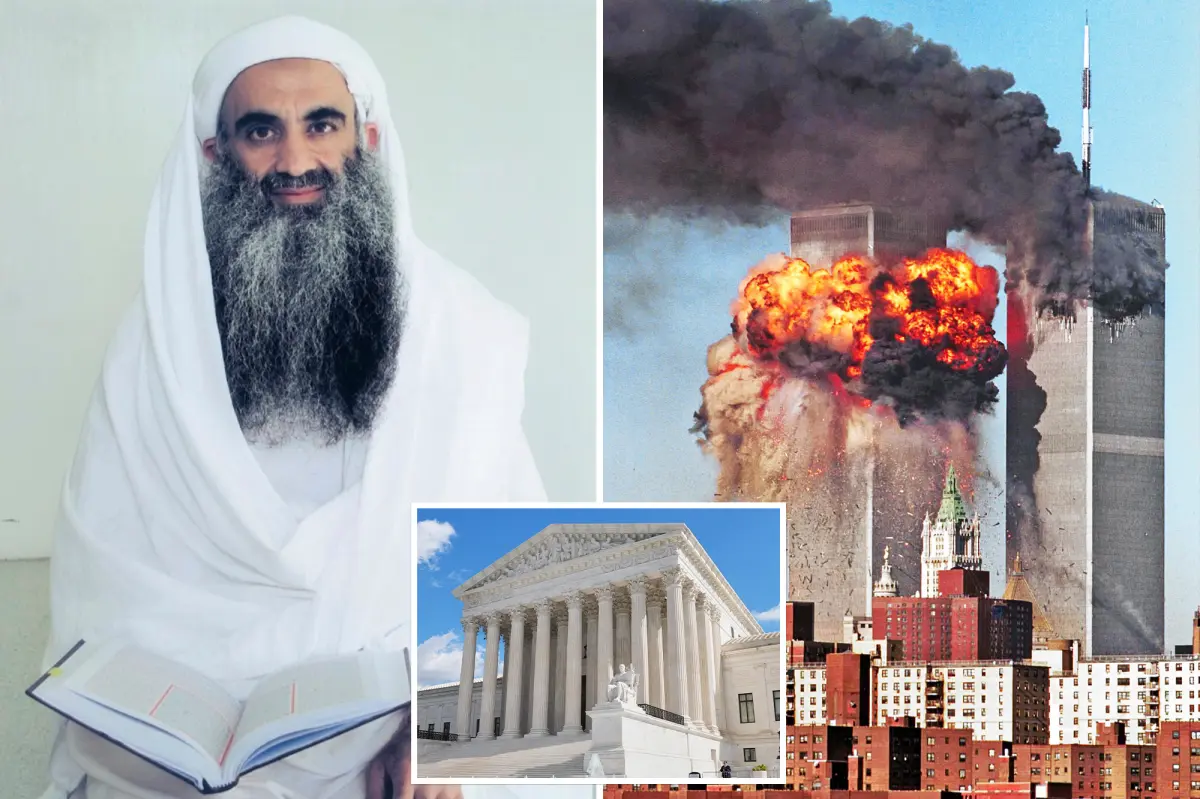

WASHINGTON — The Supreme Court on Monday rejected Khalid Sheikh Mohammed’s bid to revive a controversial 2024 plea agreement that would have removed the possibility of a death sentence for his role in masterminding the Sept. 11, 2001, terrorist attacks.
Mohammed, widely known as “KSM,” is scheduled to stand trial before a military commission beginning June 5, 2028. He has been held for more than two decades at the U.S. naval base in Guantanamo Bay, Cuba.
The Supreme Court’s order contained no noted dissents. Justice Brett Kavanaugh recused himself because he worked in the George W. Bush White House counsel’s office when Mohammed was captured in 2003.
On July 31, 2024, Mohammed and two co-defendants — Walid bin Attash and Mustafa al-Hawsawi — reached an agreement with the Office of Military Commissions to plead guilty in exchange for life sentences without the possibility of parole. The charges stem from the attacks that killed 2,977 people at the World Trade Center, the Pentagon and in Shanksville, Pa.
The agreement triggered a national backlash. Two days later, then-Defense Secretary Lloyd Austin withdrew it, arguing that only the Pentagon chief had the authority to approve such a deal.
MORE ON THIS: Hungary and Poland Defend Tough Migration Policies Amid France Unrest
A divided panel of the U.S. Court of Appeals for the District of Columbia Circuit upheld Austin’s decision last year, making the Supreme Court Mohammed’s final avenue for challenging the cancellation.
Mohammed’s trial has been postponed for nearly 25 years amid continuing disputes over whether prosecutors can use evidence obtained from all three defendants during CIA “enhanced interrogation” sessions.
Those legal battles resulted in Mohammed and four other defendants being charged in 2008 and then charged again four years later.
As recently as August, a military judge excluded statements Mohammed gave to the FBI in 2007, four years after his capture. The judge ruled that the statements were not made voluntarily.
A bipartisan commission report issued in 2004 described Mohammed as the “principal architect of the 9/11 attacks.” He faces 2,977 counts of murder, terrorism and violations of the law of war, among other charges.
At a U.S. military hearing in 2007, Mohammed was quoted as saying, “I was responsible for the 9/11 operation, from A to Z.” He also said he was “very sorry” that children were killed and insisted, “I don’t like to kill people.”