
Washington — The Trump administration asked the Supreme Court on Wednesday to temporarily clear the way for construction of a border wall and related infrastructure across a remote section of West Texas that includes Big Bend National Park.
In an emergency filing, the Justice Department urged the justices to dissolve a lower-court injunction blocking the Department of Homeland Security from constructing barriers and other infrastructure in the Big Bend Sector. The region encompasses more than 500 miles of the U.S.-Mexico border and 77 Texas counties.
“The district court’s injunction significantly frustrates the government’s ability to stop the flow of illegal aliens and drugs across the southern border,” Solicitor General D. John Sauer wrote. He said the Homeland Security secretary selected the project sites because of elevated rates of illegal crossings and drug smuggling in the area over the past several years.
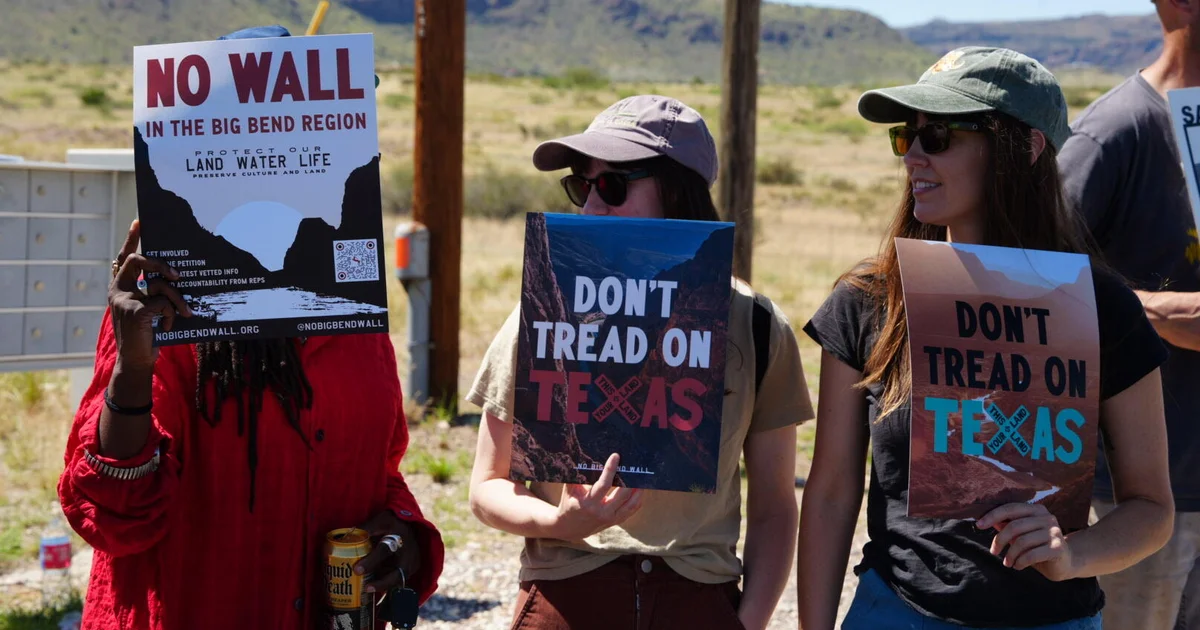
President Trump’s pledge to build a wall along the southern border has remained a central part of his immigration platform for nearly a decade. This year, however, the plan drew opposition from Democrats and Republicans, Texas ranchers and local law enforcement after photos and videos appeared online showing bulldozers moving into Big Bend National Park.
Amid the backlash, Customs and Border Protection Commissioner Rodney Scott halted construction inside the park through the end of September. CBP has maintained that the proposed wall itself will not cross Big Bend National Park, though other planned features—including patrol roads, surveillance technology and about 17 miles of vehicle barriers—would enter the area.
CBP said construction on a 47-mile section of wall in the Big Bend region began last month. The Justice Department said the government has awarded contracts for five border-barrier projects along that portion of the U.S.-Mexico border.
The administration announced in February that DHS would build barriers and roads throughout the Big Bend Sector. The plans call for 30-foot bollard walls extending from Fort Quitman, Texas, to Closed Canyon in Big Bend Ranch State Park. According to the government, the planned walls and roads would cover more than 300 miles.
Ordinarily, a project with potential effects on cultural sites, recreation, wildlife and the environment would have to undergo reviews under federal environmental and historic-preservation laws before construction could begin.
But when then-Homeland Security Secretary Kristi Noem unveiled the project earlier this year, she relied on a 1996 immigration law allowing the secretary to waive legal requirements considered necessary to speed construction of barriers and roads near the southern border. The law applies to areas with high levels of illegal entry. Markwayne Mullin, who replaced Noem after her firing, later issued two additional waivers authorizing CBP to build barrier systems.
An environmental nonprofit, a professional river guide and a religious organization working to preserve the Sacred Heart of the Church of Jesus along the Rio Grande responded by filing a lawsuit in April. The plaintiffs asked the court to block the administration from moving ahead with the project.
The administration has described the disputed area as one of “high illegal entry,” citing illegal crossings and drug smuggling. Government filings say more than 89,000 people were apprehended while attempting to enter the United States illegally in the Big Bend Sector from 2021 through 2025.
The plaintiffs countered that Big Bend has the fewest apprehensions of the seven sectors along the southern border. Although the sector covers more than one-quarter of the U.S.-Mexico border, annual apprehensions there accounted for between 0.3% and 2.2% of all border-wide apprehensions, according to court records.
Earlier this month, U.S. District Judge Kathleen Cardone granted the challengers a preliminary injunction. Her order barred DHS from building border barriers or related infrastructure and from conducting “any construction or ground disturbing activities” in the Big Bend Sector.
Cardone concluded that Noem and Mullin had exceeded their legal authority by issuing waivers between February and July that enabled construction to move forward.
Shortly before the Justice Department asked the Supreme Court to intervene, Cardone denied the administration’s request to put her injunction on hold.