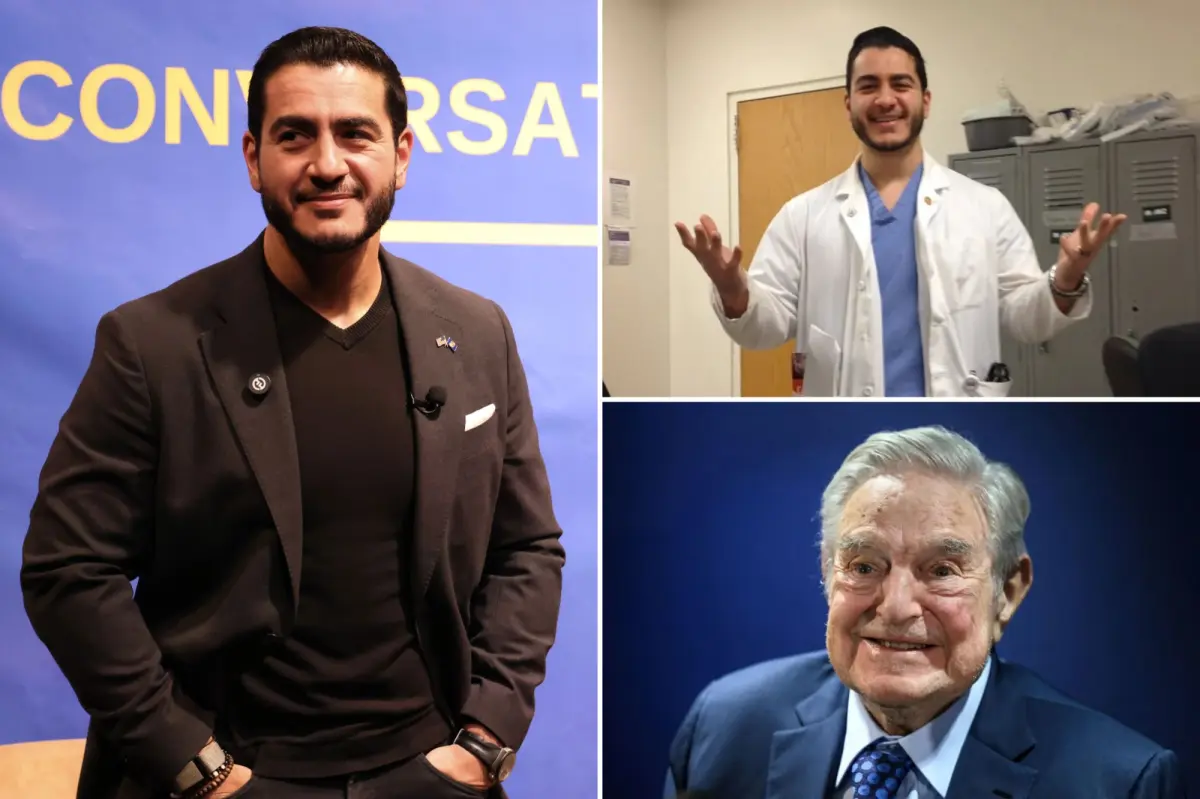

Michigan Democratic Senate candidate Abdul El-Sayed’s academic work has become a focus of political criticism, with opponents arguing that his research on race, ethnicity and religion helped elevate his profile and open doors to influential funding, according to a review of his publications and comments from critics.
Between 2007 and 2014, while affiliated with Columbia Medical School, El-Sayed authored more than 50 papers. More than a dozen examined topics involving race, religion or the experiences of specific ethnic communities.
One 2011 paper explored why suicide rates among Arab Americans were lower than those recorded among white Americans, pointing to religious prohibitions against suicide as one possible factor.
Titled “Suicide among Arab Americans,” the study examined suicide deaths in Michigan from 1990 through 2007 and received partial support from grants awarded by the National Institutes of Health.
Published in the Public Library of Science journal, the research reported that Arab men had approximately half the suicide rate of white men. Among Arab women, the rate was 24% lower than among white women.
In the paper’s conclusion, El-Sayed wrote that traditional interpretations of Islamic Sharia law classify suicide as haram, or forbidden, and that relatives of suicide victims may face social isolation within some Muslim communities.
His other publications examined subjects including birth outcomes among Arab Americans before and after the September 11, 2001, terrorist attacks, as well as mortality differences affecting Arab Americans.
Additional studies addressed racial and insurance-related differences in treatment for carotid artery disease and disparities in the amount of medical school debt students expected to carry based on race.
More recently, critics have focused on a 2011 paper in which El-Sayed and his co-authors examined whether marriages between Arab and non-Arab partners were associated with differences in birth outcomes.
“Our findings suggest that interethnic mating may be associated with increased risk for adverse birth
outcomes among Arab ethnicity mothers,” he wrote, using the name Abdulrahman M. El-Sayed at the time.
Opponents have condemned the study, characterizing its conclusions as scientifically flawed and racially charged.
“This is ‘science’ with ‘a pre-ordained racist & eugenics outcome,’” Sen. Ted Cruz, Republican of Texas, wrote on X. “Scary stuff.”
DISCOVER MORE: French Shop Owner Assaulted While Defending His Store from Rioters – VIDEO
El-Sayed’s academic record also drew the attention of members of the Soros family, whose support helped finance the next stage of his career, according to accounts of his fellowship and political fundraising.
In 2012, he received a $90,000 Paul and Daisy Soros Fellowship for New Americans to pursue a doctorate in epidemiology at Columbia University.
After completing the degree in 2014, El-Sayed was appointed executive director of the Detroit Health Department the following year.
Jeffrey Soros, a Hollywood producer and nephew of billionaire Democratic donor George Soros, recently discussed his connection to El-Sayed while hosting a celebrity-studded fundraiser in Los Angeles in September.
“I just wanted to welcome you here and express my appreciation for coming. And it’s been a privilege,” Jeff Soros said beside El-Sayed, according to video of the event obtained by Fox News Digital.
“Speaking of privilege, I’ve had the pleasure of knowing Abdul since 2012. I got to interview him as a finalist for my parents’ fellowship, the Paul and Daisy Soros Fellowship for New Americans,” he added.
El-Sayed, 41, is also facing scrutiny over alleged connections between members of his family and the Muslim Brotherhood, an Islamist political movement designated as a terrorist organization by some governments and associated with efforts to establish Sharia-based governance in Muslim-majority nations. After months of controversy, El-Sayed has said he rejects those ties.
“We already knew he was a bigot, but this is over the top,” said Julian Epstein, a former chief counsel for the Democratic House Judiciary Committee. Epstein accused El-Sayed of using what he described as antisemitic rhetoric and questionable research to appeal to more radical supporters and promote racial separation.
He added: “How much more evidence do moderate Democrats need in order to switch.”
Kyle Shideler, director of Homeland Security and Counterterrorism at the Center for Security Policy, previously told The Post the brotherhood’s goal is to “prevent Muslim Americans from assimilating into American culture” — a recurring theme that emerges throughout El Sayed’s research.
“The brotherhood wants to use political power in the United States to support activities abroad,” said Shideler. “At the end of the day, its big picture goal is to impose Islamic law on all nations everywhere and establish a caliphate.”
El Sayed’s campaign did not return The Post’s request for comment.