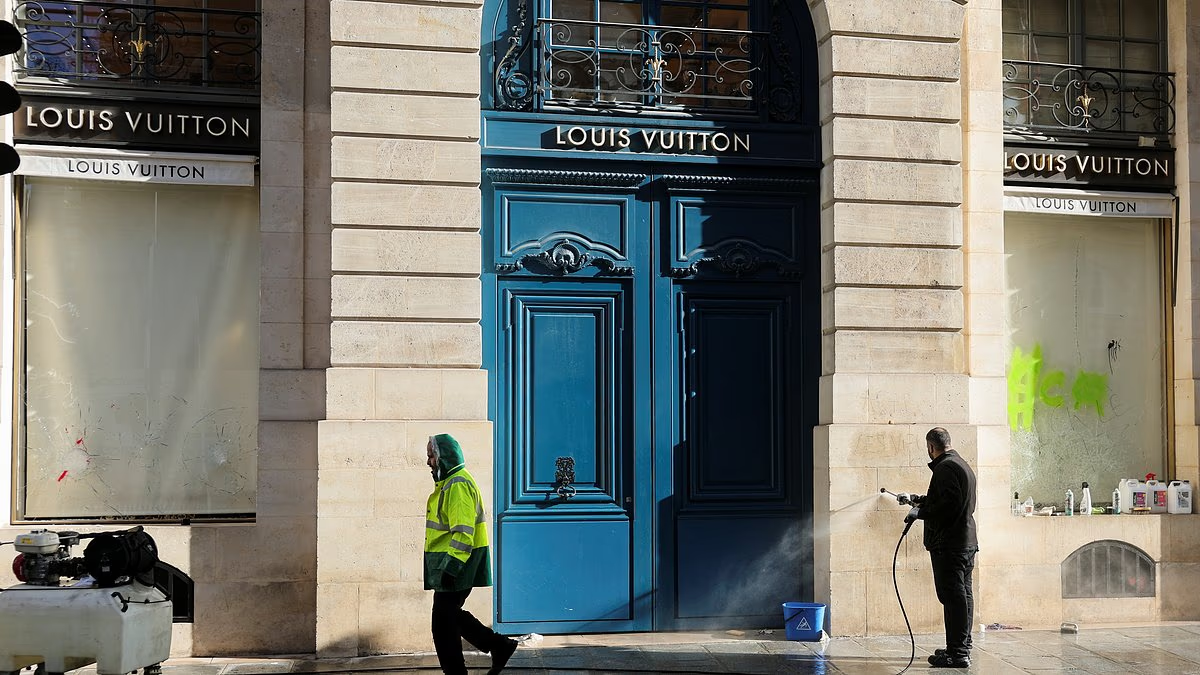

Images of luxury boutiques in Paris being looted and set ablaze this week have created an uncomfortable dilemma for investors in high-end goods companies.
The question is whether the destruction will delay a recovery in the $350billion luxury market even further, putting additional pressure on the shares of Hermes, Kering, LVMH, Richemont and other listed groups behind the world’s leading handbag and jewellery brands.
Kering, which owns Gucci, saw its shares plunge 17 per cent yesterday. Weak sales at the fashion house were compounded by concerns that further unrest could damage the group’s prospects.
Hermes and other luxury brands are increasing security at their stores, but concerns remain that scenes of civil disorder could discourage Chinese shoppers from returning to France and other European destinations.
Chinese consumers represented one-third of global luxury spending at the height of the post-pandemic boom.
That share has now fallen to 22 per cent, according to consultancy Bain, amid China’s property crisis and rising youth unemployment.

Images of looted and burned luxury boutiques in Paris this week have left investors weighing the risks facing the sector
Hermes this week became the latest luxury name to point to China’s economic difficulties as a factor behind weaker third-quarter sales.
Can LVMH and its rivals rebuild their fortunes, supported by America’s growing appetite for handbags and jewellery — a change that artificial intelligence may also help accelerate?
James Harries, co-manager of the STS Global Income & Growth trust, believes investors should look beyond the sector’s immediate problems to its enduring appeal: what he calls ‘the deeply ingrained desire for people to show off their wealth and impress others’.
For investors who believe in buying shares rather than bags when others are fearful, the luxury sector offers a number of names to consider.
LVMH – the unhappy giant
In Paris, mobs ransacked LVMH-owned Sephora beauty stores as well as a Celine boutique.
The unrest also hit the Galeries Lafayette department store in the capital, along with shops in other cities.
LVMH shares had already been under heavy pressure before the attacks. They have fallen 41 per cent since January to €383, close to their level during the 2020 pandemic. The decline has largely followed a 5pc sales drop in the three months to September, made worse by the downturn in China.
The owner of Dior, Louis Vuitton and Tiffany is also viewed as struggling to meet the needs of twentysomething shoppers looking for a handbag priced at £1,000 rather than £10,000.
As Luca Solca of broker Bernstein and other analysts have stressed, winning over these aspirational customers will be crucial to any recovery in luxury spending.
The pressures have also reshaped the fortunes of Bernard Arnault, LVMH’s 77-year-old chief executive. He is now the world’s 16th-richest person, having topped the billionaires’ rankings in spring 2024, when the shares stood at €844.
Even so, 14 of the 27 analysts covering LVMH rate the shares as a ‘buy’, suggesting they continue to place faith in Arnault’s widely recognised business judgment.
Yet the obstacles confronting LVMH are substantial, meaning that investors relying on Arnault’s renowned determination will need considerable patience.
Bling brought low
For the wider luxury sector, much may depend on creating handbags that feel convincingly exclusive — and jewellery with the distinctive appeal capable of winning customers over.
At present, although demand may dip around next month’s US mid-term elections, Americans appear willing to splash out on bling. Some perceive a bracelet to be a better store of value than a bag in a challenging era.
Analysts’ enthusiasm for shares in the Swiss group Richemont is based on the allure of the glittering wares made by its Cartier and Van Cleef & Arpels jewellery houses – whose stores were not spared in the Paris riots.
Indeed, Richemont seems so sure of long-term demand for precious stones that it may join a consortium to acquire the diamond miner De Beers.
Richemont stands at 161 Swiss Franc (SFr). The average analysts’ target price is 226 SFr, suggesting it may be a share to put on your list. Note that Arnault – who covets Cartier (modelled by actress Lily Collins, pictured) – likes the company enough to have taken a personal stake.
Since the start of the year, there has been a 42 per cent stock decline in the shares of Hermes to €1,238. This is the worst performance since it made its stock market debut in 1993.
This month analysts at UBS even declared Hermes shares to be a ‘sell’ on the basis that the increased supply of ‘pre-loved’ Birkin bags could undermine the exclusivity on which this €130billion company is built.
Other analysts are more sanguine. But a bet on revival could take a long time to pay off, and a bid is most unlikely. The Paris mob also descended on the store of Gucci – the largest house in the Kering empire.
Following this week’s dispiriting results, analysts suggest holding the shares, which, at €178, are 72 per cent lower than five years ago.
There may be even more pressure than before on boss Luca de Meo, who was drafted into Kering to restore its former glory, but this is another shopping list pick only for patient investors.

Even before the attacks in Paris, shares in LVMH were tumbling
Cool Britannia
Paris may be the traditional home of luxury, but London also boasts illustrious players – so perhaps some UK companies should be on your list.
This week the British handbag maker Mulberry reported a 28 per cent bounce in US sales thanks to its Back To The Mulberry Spirit campaign. Under this strategy, 60 per cent of items are priced below £1,000 to appeal to the younger, aspirational clientele.
Mulberry shares have jumped by 116 per cent this year to 227p. Good news for Mike Ashley, the acquisitive founder of Frasers Group and luxury fan – he has a 37 per cent stake in Mulberry.
Another British beneficiary of Americans’ readiness to spoil themselves is Watches Of Switzerland whose shares have soared 57 per cent this year to 745p.
The price was 654p when this column last month highlighted the company’s success in selling timepieces such as the Rolex Submariner to America’s wealthy.
It is interesting to note that US bank Goldman Sachs this week raised its target price for Watches of Switzerland shares to 920p.
Burberry shares are down by 18 per cent this year to 1,040p, highlighting continuing concern over China. But Britishness is resonating in America, where Burberry bags like the Cotswolds, priced from £1,595, have gained a new clientele.
Goldman Sachs also believes in Burberry, setting a target price of 1,250p for the shares, which I bought after following my own advice at 724p in the company’s hapless summer of 2024.
Mike Ashley is an investor, too, although he seems this month to have slimmed down his stake to 6 per cent… but who knows what he could be plotting?
DIY INVESTING PLATFORMS
AJ Bell
AJ Bell
Easy investing and ready-made portfolios

Hargreaves Lansdown
Hargreaves Lansdown
Free fund dealing and investment ideas

interactive investor
interactive investor
Flat-fee investing from £4.99 per month

Freetrade
Freetrade
Investing Isa now free on basic plan

Trading 212
Trading 212
Free share dealing and no account fee
Affiliate links: If you take out a product This is Money may earn a commission. These deals are chosen by our editorial team, as we think they are worth highlighting. This does not affect our editorial independence.
Compare the best investing account for you


