
Political polling has endured a bruising decade, with several major election cycles producing results that missed the mark by substantial margins.
Just before the 2024 presidential election, the respected Des Moines Register poll placed Vice President Kamala Harris ahead of Donald Trump in Iowa, 47 percent to 44 percent. Trump ultimately carried the state by more than 13 percentage points.
More recently, polling in Democratic primary contests in Michigan and Wisconsin also proved dramatically inaccurate, with some surveys missing the final result by double digits.
In Wisconsin’s Democratic gubernatorial primary, far-left State Representative Francesca Hong was projected to win by roughly 20 points. Instead, she was defeated.
In Michigan’s Democratic Senate primary, Abdul El-Sayed was shown with a double-digit advantage. Although he went on to defeat Representative Haley Stevens, his final margin was just one percentage point.
Initially, many assumed the polling failures were made in good faith. The industry has struggled to assemble representative samples as fewer Americans rely on traditional landline telephones.
But recent events suggest the problem may be more troubling than ordinary polling error.
Earlier this week, FiftyPlusOne, a website that analyzes election data, released a detailed investigation into Wedgewood, a relatively new polling company. The report alleged that the firm had fabricated its survey findings.

Far-left State Representative Francesca Hong was projected to win Wisconsin’s Democratic gubernatorial primary by roughly 20 points, but lost. She is pictured with Representative Ilhan Omar and streamer Hasan Piker

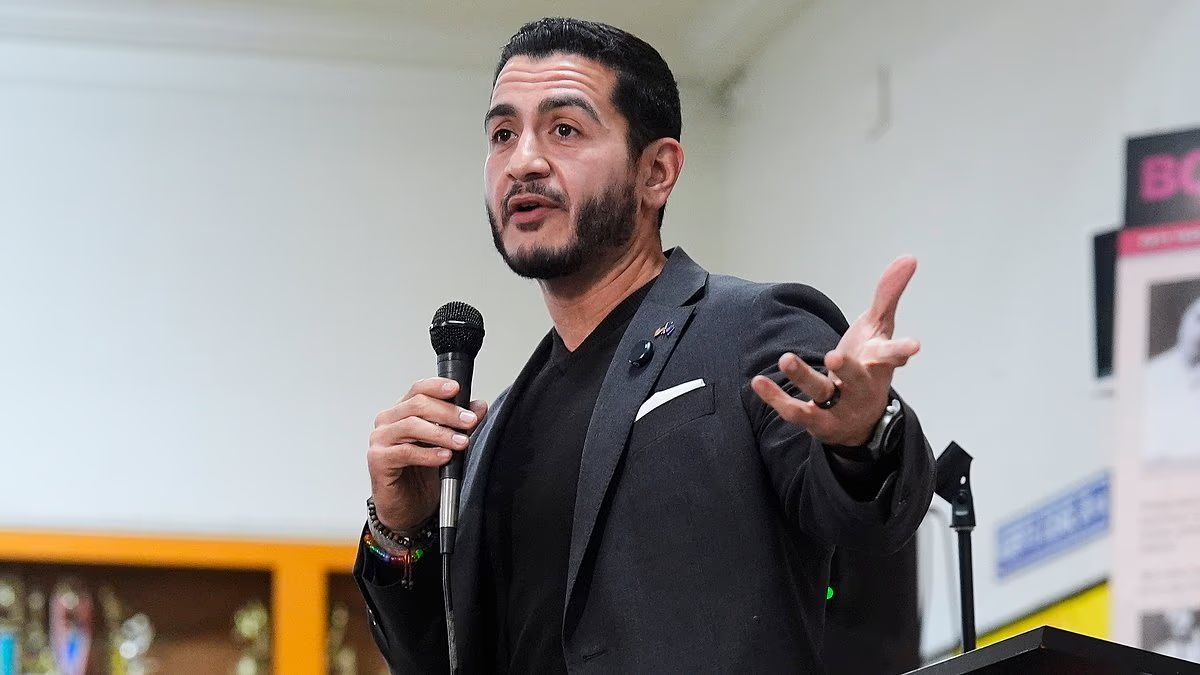
Democratic Senate candidate Abdul El-Sayed was shown leading by double digits before ultimately defeating Representative Haley Stevens, above, by just one percentage point
Wedgewood initially responded with an expletive-laden direct message to FiftyPlusOne co-founder. The firm then issued a statement acknowledging that it had falsified data, arguing that the work was part of “an experimental project” intended to expose weaknesses, limited oversight and the low barrier to entry in today’s polling industry.
That justification was met with widespread skepticism.
If the stated purpose was truly to improve polling standards, critics argued, Wedgewood could have conducted a small number of surveys, revealed the experiment itself and then proposed safeguards against fraudulent polling. There is no indication, however, that the firm intended to disclose its actions voluntarily.
Wedgewood released more than a dozen surveys covering important races. Its numbers were also incorporated into several polling aggregators, including those operated by The New York Times and Nate Silver. These models combine multiple surveys to reduce the effect of individual outliers and produce more dependable estimates.
Both The New York Times and Nate Silver have since removed Wedgewood’s figures from their models. Before that happened, however, the firm’s inclusion gave its polling an appearance of legitimacy.
In June, during a pivotal phase of Michigan’s Democratic Senate primary, Wedgewood published a survey portraying El-Sayed as significantly more competitive against Republican Mike Rogers than Democratic rivals Haley Stevens and Mallory McMorrow. The poll also placed El-Sayed ahead in the primary and gave McMorrow just nine percent support.
For me, that particular survey felt especially personal.
I remember being stunned when I saw the results. I supported McMorrow, and several friends who shared that view began arguing that Democrats should consolidate around Stevens, whom many regarded as their second-choice candidate.
On Tuesday, McMorrow issued a lengthy statement arguing that the Wedgewood poll contributed to a drop in donations and triggered a wave of media inquiries asking whether she should abandon the race.
EXPLORE MORE: California Flood Alert Issued as Monster King Tides Sweep In
McMorrow called the episode “a one-two punch” that “killed us.” Her strategist, Lis Smith, wrote that Wedgewood was among the pollsters Abdul El-Sayed cited when responding to criticism that he would be less electable in a general election.
Wedgewood’s true motivations are still unclear, but it should be noted that when their results diverged from the mainstream view, they tended to do so in ways that tilted in a particular ideological direction. Nate Silver also noticed that ‘the most conspicuously out-of-consensus ‘polls’ that Wedgewood did involve strong numbers for progressive candidates.’
These included polls showing far-left Wisconsin gubernatorial candidate Francesca Hong leading Republican Tom Tiffany, and another showing Democrat Troy Jackson leading Susan Collins during a critical stretch when Maine Democrats had to decide who would replace Graham Platner on the ballot.

McMorrow released a lengthy statement on Tuesday detailing how, she believes, the Wedgewood poll caused donations to her campaign to dry up

In June, Wedgewood published a poll showing El-Sayed as far more competitive against Republican Mike Rogers than either of his two Democratic opponents

Ravi Gupta is a former Obama Administration official and host of the Majority 54 and Lost Debate podcasts
The firm also recently released a poll showing the Democratic Senate nominee in Mississippi as surprisingly competitive. That was followed by a $1.2 million television buy from the Democrats’ Senate Majority PAC.
That pattern demands an investigation into whether Wedgewood’s allegedly fake polling was actually intended to influence the political process.
The firm was founded by a Republican named Jack Sims and a Democrat named Andrew Prater. Sims apparently had credible polling experience, which helped the firm slip past the limited quality-control measures used by aggregation sites.
Could the firm have been ideologically inclined to help far-left progressives? Or was the goal to help Republicans by boosting the least moderate Democrats in their primaries? Were its founders manipulating prediction markets for profit, as some have alleged? Or were they merely mercenaries paid by some outside organization to sway these elections?
These are all questions that I don’t claim to have answers to. But the Federal Election Commission and other relevant regulators should investigate the firm and its founders to determine their true motives.
Former Kamala Harris adviser Mike Nellis called the founders ‘absolute scumbags’ who ‘should be prosecuted to the full extent of the law.’
In the meantime, an electorate already skeptical of the polling industry has been given yet another reason to tune out the surveys. And whether or not these firms were trying to manipulate elections, there’s now a new playbook to use fake polls to try and shape outcomes.
Partisan operatives, foreign adversaries, and prediction market manipulators could follow their example and shape donor, media and voter expectations.
What should we do? The boring technocratic solution is to create better screens for polling aggregators – only accepting surveys from reputable news organizations, higher education institutions and established independent pollsters who disclose their methodologies and verify their sample collection. But as we learned with the 2024 Des Moines Register poll, even veteran pollsters can be wildly off when fraud isn’t involved.
Republican Speaker Mike Johnson has seized on the moment to urge voters to ignore surveys and go vote. It’s in his interest to discount the polls, given how bleak the data has been for the GOP. But I can’t blame anyone for losing trust in an industry that has misled us time and time again.
We used to worry that bad polls could mislead us about who would win. Now we must contend with fake ones that could decide elections.
Ravi Gupta is a former Obama Administration official and host of the Majority 54 and Lost Debate podcasts


