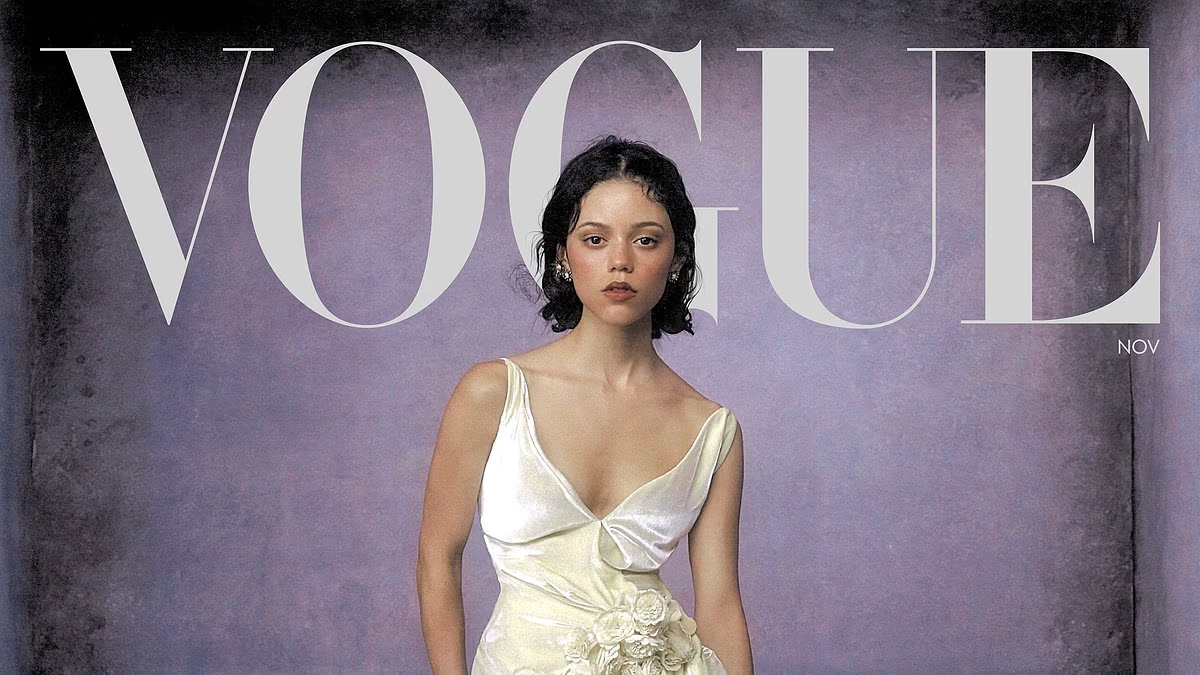

A magazine cover controversy may be taking shape after three major titles unveiled strikingly similar images featuring the same photographer within a matter of days.
Vogue, Elle and WSJ. Magazine each commissioned Szilveszter Makó to photograph their November 2026 covers. The images shared a remarkably similar visual concept, prompting plenty of discussion online.
Vogue unveiled its November 2026 cover featuring Jenna Ortega on Thursday. The Wednesday star was pictured sitting on a stool and gazing seductively toward the camera against a minimalist, box-shaped backdrop.
Ortega wore a silky white high-low dress decorated with roses, leaving one of her long legs fully exposed.
Her brown hair fell in loose, tousled curls, while dark, striking makeup intensified the look.
Only three days earlier, Elle had revealed its own November 2026 cover, starring Hunter Schafer.
Like Vogue’s image, the cover showed the transgender actress seated on a stool and looking directly into the camera against a plain backdrop.
Schafer wore a black-and-white patterned gown and posed with two stuffed rodent toys resting on her lap.


Both Vogue (left) and Elle (right) commissioned photographer Szilveszter Makó for their November 2026 issues, and the resulting covers were strikingly alike, sparking conversation online. Each featured its cover star seated on a stool and facing the camera against a minimalist backdrop

Earlier this month, WSJ. Magazine also unveiled a Makó-shot cover featuring Gigi Hadid. The model stood against a white, box-shaped background that was notably reminiscent of Vogue’s image, while a stool again featured prominently in the composition
Hadid’s hair and makeup were also strikingly similar to Ortega’s styling on the Vogue cover.
Days before that, WSJ. Magazine had revealed its cover featuring Gigi Hadid.
The model posed in front of a white, boxy backdrop reminiscent of Ortega’s cover, facing the camera with one knee resting on a stool.
She wore a dramatic strapless blue bodysuit covered in feathers and finished with a large black tail.
White tights, blue heels and a tightly pulled-back bun completed the ensemble.
YOU MIGHT ALSO LIKE: Natalie Portman ‘Full of Wonder’ After Welcoming Second Child
Makó has also photographed similarly styled covers for Vogue Italia, Vogue Arabia, British Vogue and Interview Magazine in recent months.
Our News Outlet has contacted Makó for comment.
The resemblance between the covers was also noted by social media users on X.

Makó also photographed a similar Vogue Italia cover featuring Alicia Keys seated on a stool against a plain backdrop. He has previously spoken openly about reusing the same concepts, saying: ‘I don’t think photographing the same objects or concepts over and over again makes the work any less effective’

During her interview with Elle, Schafer, 27, who transitioned to female as a teenager, revealed that she had undergone gender-affirming bottom surgery. She is seen earlier this month
‘Vogue, Elle and WSJ. Magazine covers [being published] in the same period with overlapping designs is intriguing,’ Japanese reporter Toshio Shimizu wrote on X of the similar covers.
‘[Was it a] coincidence using the same freelance photographer’s composition idea – placing the model in a chair or box-shaped space?’
Makó previously spoke about his style to Aperture, explaining: ‘I often think in opposites. I enjoy holding tension between severity and play.’
He also did not shy away from the fact that he likes to use the same concept over and over again.
‘I’m not interested in producing something new for the sake of it, and I don’t think photographing the same objects or concepts over and over again makes the work any less effective,’ he said.
During her interview with Elle, Schafer, 27, who transitioned to female as a teenager, revealed she had undergone gender-affirming bottom surgery.
‘I just had bottom surgery in December, which was amazing, and I love it so much,’ she said.
‘”Bottom surgery,” also known as genitourinary reconstruction surgery, describes a wide range of gender-affirming procedures performed on the genitals. Bottom surgeries can be feminizing or masculinizing,’ according to UChicago Medicine.
Schafer decided to move forward with the procedure when the idealized, LGBTQ+ vision she strove to live in failed to come to fruition, she said, as well as the manner in which she wanted to present herself in it.
‘Like I said, for a long time I’ve embraced the gender-expansive part of myself, and I really wanted to try to make that previous body work, because I thought there was something really cool and badass about it,’ she said.


