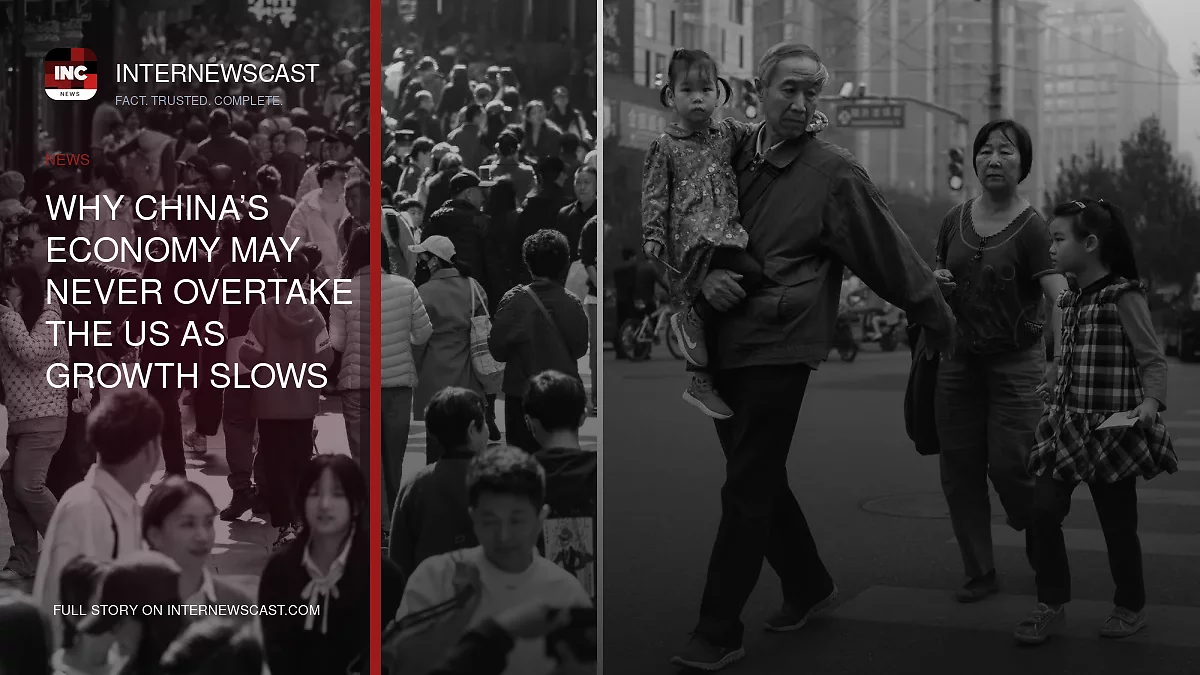

China’s one-child generation may have dealt a lasting blow to the country’s ambition of surpassing the US.
Once viewed as an unstoppable economic powerhouse that could overtake the American economy within years, China is now not expected to pull ahead until sometime in the 2040s — and some analysts question whether that milestone will be reached at all.
Yi Fuxian, a Chinese demographer at the University of Wisconsin-Madison, attributes much of the slowdown to the one-child policy introduced in 1979, arguing that its demographic consequences are now weighing heavily on economic growth.
China’s sharply declining birthrate, combined with mounting economic challenges, has brought an end to the annual growth of more than 6% that the country reported before the COVID-19 pandemic.
Fuxian said economists in China and abroad were misled by official figures released by the Chinese Communist Party, which he believes overstated both the nation’s population and its spending power.
The warning comes after a Goldman Sachs analysis concluded that China’s population began contracting in 2022, only 13 years after Japan’s. China’s decline is expected to be considerably faster, creating serious risks for its long-term economic outlook, according to the Financial Times.
China’s economy is valued at about $21.6 trillion, equivalent to roughly two-thirds of the US economy.
In an interview with The Post, Yi claimed that Chinese authorities have overstated birthrates and overall population totals in official data for decades.
Although government statistics put China’s population above 1.4 billion, Yi estimates that the actual figure in 2020 was “under 1.28 billion” — at least 130 million fewer people than reported.
Yi also contends that India became the world’s most populous country earlier than official estimates indicated. His views draw on his 2007 book, “Big Country with an Empty Nest,” which challenged China’s one-child policies.
The US remains the world’s third-most populous nation, with approximately 342 million residents — around one-quarter of China’s reported population.
According to Yi, China’s population began declining as early as 2018, four years before Goldman Sachs’ estimate and more than a decade ahead of the government’s projection, which placed the start of the decline between 2031 and 2034.
The demographic crisis is closely linked to China’s controversial one-child policy, which sought to restrict most families to a single child amid fears that rapid population growth would fuel poverty and resource shortages.
Beijing later loosened the rules, allowing couples to have two children in 2016 and three in 2021. Even so, China’s fertility rate remains among the lowest anywhere in the world.
China has made extraordinary progress in reducing poverty: Officially, the share of people living in extreme poverty has fallen to zero, compared with 88% four decades ago.
The country has not, however, reached high-income status. China’s annual GDP per person is about $13,800, or roughly 15% of the US figure.
On a per-capita basis, Turkey, Russia and Kazakhstan all rank ahead of China.
China’s total fertility rate dropped below the replacement benchmark of 2.1 children per woman in 1991 and has continued to fall. Yi estimates it now stands at approximately 0.8 births per woman.
China recorded just 8 million live births last year, the lowest figure on record. By comparison, the far smaller US recorded 3.6 million births.
Yi also pointed to economic reforms introduced by former Chinese Premier Zhu Rongji during the 1990s, saying they created “many problems” that ultimately slowed the country’s growth and weakened its campaign to catch up with the US.
Decades of strict birth restrictions and fiscal centralization severely curtailed household disposable income in China, to roughly 42-44% of GDP.
In contrast, in the US, that figure is over 70% of GDP.
While this may have helped China’s economy in the short term, allowing it to flood the US with cheap imported goods, in the long run, it may have signed the CCP’s suicide note, according to Yi.
Children function as “super-consumers,” driving much of household spending, he explained.
With China missing several full generations worth of children, this severely crippled Chinese domestic consumption, he argued.
To offset weak domestic consumption, China became heavily dependent on manufacturing exports, an unsustainable real estate bubble, and state-subsidized industrial overcapacity, he explained.
Those policies, “killed China’s economy, the population and the economy — and also killed America’s manufacturing,” Yi said.
China is now one of the oldest countries in the world, with a rapidly shrinking labor pool and aging population. The median age is expected to reach 59 by 2050, compared to 44 in the US.
This means Beijing may never catch up with the US economically — and worse, could face a long-term economic deceleration, Yi argued.
Yi puts the over-optimistic predictions about China’s economic growth down to mainstream economists and Chinese government-aligned institutions relying on fabricated data — assuming China’s population would soon grow five times larger than the US.
This played into the popular narrative that “the East is rising while the West is declining,” he said, while the truth is very different.
“By 2029 to 2035, China will lag behind the US across all major demographic and growth metrics,” Yi said.
However, for pro-democracy activists who might hope that this demographic time bomb could topple the CCP, Yi has a warning.
Contrary to Western expectations that economic development would foster a pro-democracy middle class, China’s rapid aging has depleted it of the young population required to drive political activism.
Just 16% of China is aged 15 to 29, down from 31% at the time of China’s last mass-democracy movement in 1989, which culminated in the communists’ brutal crackdown in Tiananmen Square.
An aging, risk-averse China is far more likely to support a centralized strongman who will safeguard pensions and social stability, Yi explained.


