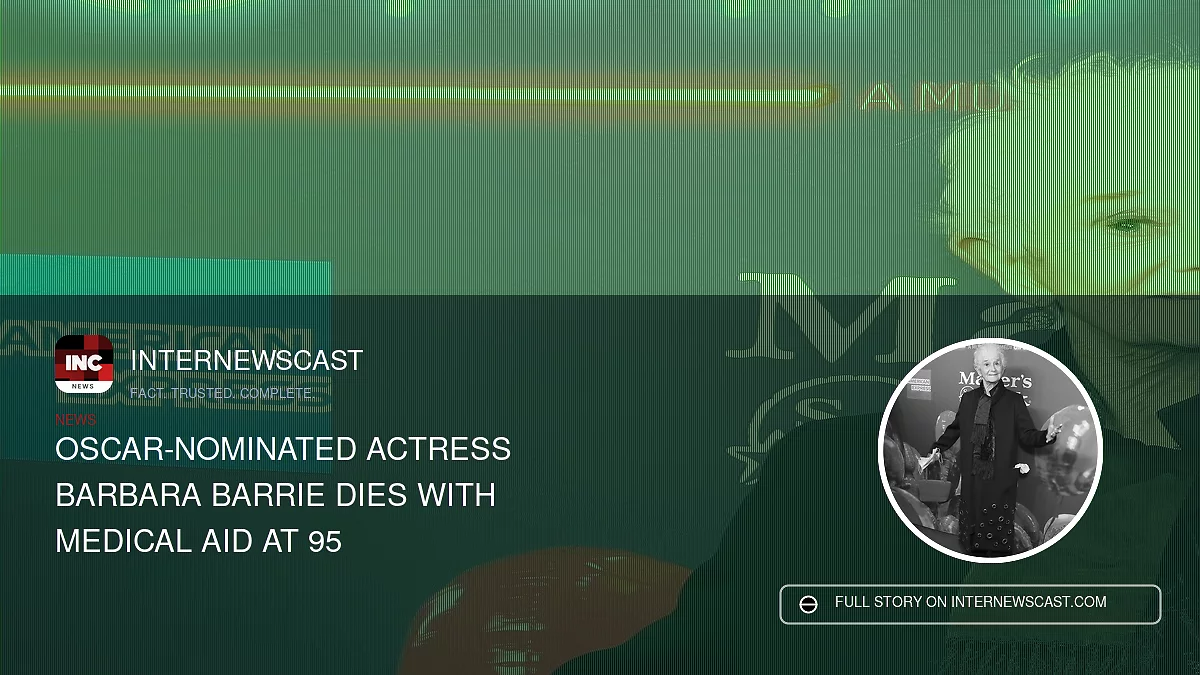

Barbara Barrie, the acclaimed character actress whose career spanned Broadway, film and television, died at her home in New York City on Wednesday. She was 95.
The Oscar-, Tony- and Emmy-nominated performer died with medical assistance after being diagnosed with terminal cancer.
Her daughter, actress and writer Jane Harnick, confirmed Barrie’s medically assisted death in a statement to the New York Times.
Barrie received an Academy Award nomination for Best Supporting Actress in 1979 for her memorable performance as a warm, supportive mother in the acclaimed film Breaking Away.
She ultimately lost the Oscar to Meryl Streep, who won her first Academy Award that year for Kramer vs. Kramer.
Barrie later earned an Emmy nomination after reprising her role in the short-lived 1981 television series adapted from Breaking Away.

Barbara Barrie, the acclaimed star of stage, film and television, died at her New York City home on Wednesday with medical assistance at age 95; pictured in 2021

Her daughter, actress and writer Jane Harnick, confirmed her medically assisted death after a terminal cancer diagnosis to the New York Times; pictured on Suddenly Susan with (clockwise from left) Kathy Griffin, David Strickland, Brooke Shields, Nestor Carbonell and Judd Nelson
Born Barbara Ann Berman on May 23, 1931, in Chicago, Barrie moved with her family to Texas at age nine. She graduated from Corpus Christi Senior High School in 1948 and later earned a degree from the University of Texas at Austin in 1952.
Her seven-decade career in show business began on Broadway in 1955 with The Wooden Dish, a production that closed after just 12 performances.
Barrie went on to establish herself on the New York stage, appearing in two of Neil Simon’s celebrated 1970s comedies, The Prisoner of Second Avenue and California Suite. In 1983, she also played Harvey Fierstein’s nagging mother in the groundbreaking production of Torch Song Trilogy.
Her Tony nomination came for originating the role of Sarah, a devotee of fad diets, opposite Elaine Stritch in Stephen Sondheim’s landmark 1970 musical Company.
“It changed my life, being in ‘Company,’” Barrie wrote. “I didn’t think I was going to be an actress.”
Her final Broadway appearances included the attention-grabbing role of Yente in the 2004 revival of Fiddler on the Roof. She made her last stage appearance in Joshua Harmon’s 2017 play Significant Other.
Television audiences may have known Barrie best as the wife of police officer Barney Miller, played by Hal Linden, on ABC’s Barney Miller from 1975 to 1982. She later played Brooke Shields’s eccentric grandmother on NBC’s Suddenly Susan, part of the network’s “must-see TV” lineup from 1996 to 2000.
Her film credits also included an uncredited appearance in the 1956 James Dean and Elizabeth Taylor drama Giant. In 1980, she played the weary mother of Goldie Hawn’s spoiled socialite character in the box-office hit Private Benjamin.

Barrie’s defining film role as the nurturing mother in Breaking Away earned her a 1979 Academy Award nomination for Best Supporting Actress. She later received an Emmy nomination after reprising the role in the short-lived 1981 television series; pictured with Shaun Cassidy (left) and Vincent Gardenia (right) in 1980

Barrie appeared with Dean Jones in the original New York production of Stephen Sondheim’s Company; pictured in the Broadway show around 1970 with lead actor Dean Jones (right)
Barrie received additional Emmy nominations for her television work on Law & Order in 1992 and Law & Order: Special Victims Unit in 2003. Her other guest appearances ranged from The Twilight Zone to The Mary Tyler Moore Show.
Barrie was also the author of four books published during the 1990s, including Second Act and Don’t Die of Embarrassment. The nonfiction books chronicled her life after colon and rectal cancer and challenged the stigma surrounding colostomies.
“I think if I can get the word out on this thing, that will be my legacy,” Barrie told the South Florida Sun Sentinel in 1997.
In 2014, Barrie announced that she had been diagnosed with idiopathic pulmonary fibrosis, a degenerative disease, according to Variety.
Her first major critical breakthrough, however, came with the 1964 independent film One Potato, Two Potato. Directed by Larry Peerce, the film earned Barrie the Best Actress prize at the Cannes Film Festival for her portrayal of a white woman with a young daughter who, after her husband, played by Richard Mulligan, leaves her, falls in love with and marries an African-American man, played by Bernie Hamilton.
The Times praised Barrie’s performance, writing that she “justifies the [Cannes] prize with a portrayal that is perceptively naturalistic. She is timid, worried and, finally, feminine in the extreme as a woman fighting against impossible odds in defense of her love and family.”
Barrie told the outlet in 1964 that she had fallen in love with filmmaking while working on the controversial film.
“I thought — boy, this is exciting! This is what I want,” she said at the time. “It is, too. That — and to live a healthy life and be a good woman, and wife.”

Max Gail, Barbara Barrie, Gregory Sierra, Jack Soo, Hal Linden, Ron Glass and Abe Vigoda appear in a cast photo from Barney Miller, which aired on ABC from 1975 to 1982
Decades later, during her final Broadway appearance in 2017, Barrie reminded The Times that “your life is more important than your work.”
Barrie’s husband, Jay Harnick, died in 2007. He was the founder and artistic director of TheaterWorksUSA.
She is survived by her daughter, Jane; her son, Aaron Harnick; and three granddaughters.