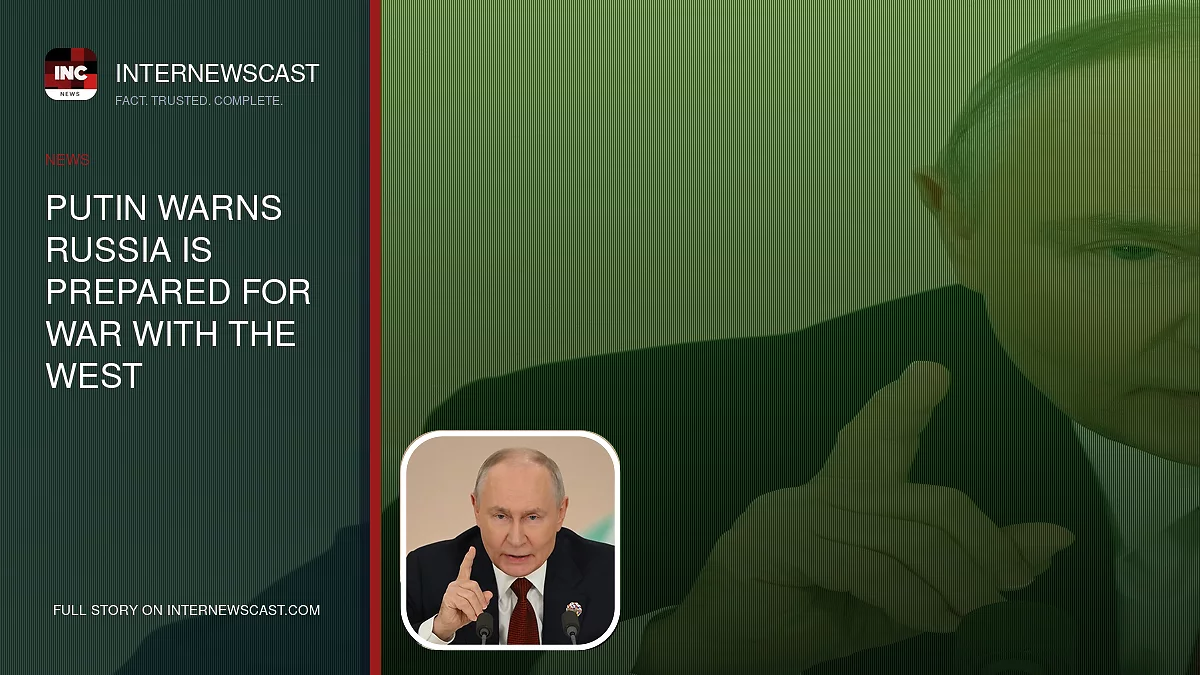

Vladimir Putin has said Russia is prepared for the possibility of a major conflict with Europe, while warning that a war with Nato would leave no side victorious.
The Russian president claimed he did not want a confrontation with European countries, but insisted Moscow would be ready to respond if tensions continued to rise.
“Many people are talking about preparing for war by 2030. Is that right or wrong?” Putin said at a press conference in Moscow on Thursday, following the Russia-Africa summit.
“First of all, we are ready, but we do not want any war with Europe. If anyone wants it, let them prepare.
“They have not achieved their aim of inflicting a strategic defeat on Russia, and it is unlikely they will be able to do so by 2030.
“If matters go too far, there will be no winners at all. No one should forget that.”
The warning comes as European governments grow increasingly concerned that Moscow is testing Nato through drone activity, cyberattacks and sabotage targeting critical infrastructure.

Vladimir Putin said Russia is prepared for a conflict with Europe
European defence officials believe Russia has intensified its so-called “hybrid attacks” across the bloc, using them to probe Nato’s response while applying pressure to nations backing Ukraine.
Western intelligence officials have separately warned that Putin appears willing to expand Russia’s sabotage campaign in Europe, raising fears that such operations could contribute to a wider conflict by 2030.
Earlier this month, Germany’s military said the country faced a “significant” threat from Russian sabotage after raising its assessment to the second-highest level for the first time.
In Britain, Russia is suspected of being behind the firebombing of two properties and a vehicle linked to former Prime Minister Sir Keir Starmer.
Moscow has also been accused of carrying out a series of drone incursions near British military facilities during 2024. Intelligence analysts have claimed the aircraft were launched from sanctioned Russian oil tankers to monitor nuclear weapons sites and US airbases.
Russian drones have also entered the airspace of other European nations. Italian fighter jets were scrambled last month in an attempt to intercept one of the Kremlin’s aircraft over Lithuania.
Western intelligence agencies have played down suggestions that Russia is preparing to use nuclear weapons against Europe, despite repeated nuclear threats from figures close to the Kremlin.
IN CASE YOU MISSED IT: Student Sparks Outrage With Rant Celebrating Charlie Kirk Assassination
However, officials have warned that Putin’s campaign of sabotage could create the risk of a “miscalculation” and accidentally provoke a direct clash with Nato.
“Russia’s appetite for conducting sub-threshold or hybrid operations against Nato countries, whether through sabotage or cyberattacks, is very clear. President Putin clearly wants to avoid a direct confrontation with Nato. However, there is a risk of miscalculation in all of this,” one official said.
During Thursday’s remarks, Putin said he supported efforts to rebuild relations between Moscow and European capitals.
He also said Russia did not want the Baltic Sea to experience a situation resembling the one in the Strait of Hormuz, which has been held to ransom by Iran following joint US-Israeli strikes.
Putin spoke days after the leaders of Norway and Finland held what they described as a “frank and substantive” telephone discussion with him on Tuesday, prompting criticism from other Nordic governments.
The 90-minute conversation was the first call in more than a year between pro-Ukraine European leaders and the Russian president.
Danish Prime Minister Mette Frederiksen criticised the discussion, saying it “was not coordinated with the rest of us”.
She called for European unity and warned that leaders should be cautious about giving Putin “an opportunity that he did not have until a few hours ago”.
Swedish Prime Minister Ulf Kristersson, speaking at an event in Helsinki, said he had not been informed about the call in advance and did not expect it to produce significant results.
He reiterated Sweden’s position that any peace agreement must be reached on Ukraine’s terms.
Finland’s President Alexander Stubb and Norwegian Prime Minister Jonas Gahr Store defended the contact with the Kremlin, saying in a joint statement that “ending the war requires direct discussions”.
“We stressed the importance of de-escalation,” Store said. “There are major differences in our positions,” he told Norwegian media in Helsinki, where he was attending a Nordic leaders’ meeting.
Ukrainian President Volodymyr Zelensky, who spoke with the two Nordic leaders after their conversation with Putin, said on social media that they had made clear to the Russian president that “real de-escalatory steps are needed” concerning Ukraine’s energy and infrastructure.
This is a breaking news story. More to follow.


