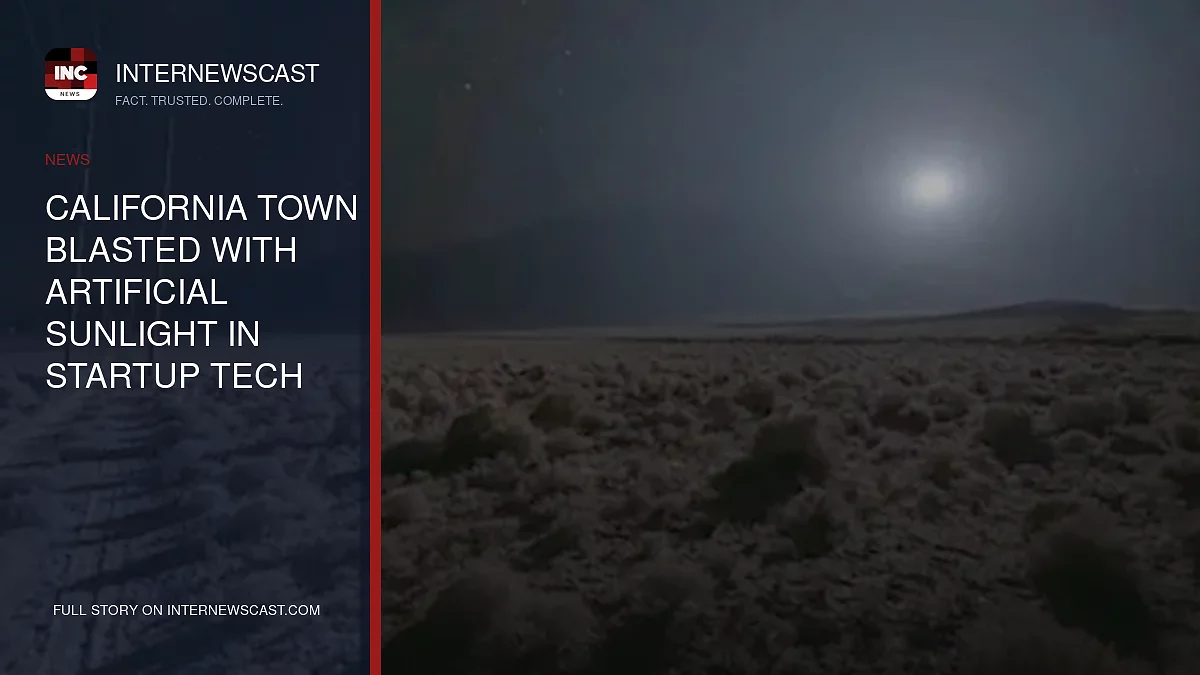

A small California town was bathed in an eerie nighttime glow on Oct. 10, when a tech startup tested its futuristic proposal to bring sunlight to Earth after dark — using powerful mountain-mounted spotlights rather than mirrors in orbit.
The demonstration near Lone Pine illuminated roughly three miles of desert, offering residents a preview of Reflect Orbital’s plan to launch 50,000 satellites over the next decade and direct reflected sunlight onto specific locations at night.
Reflect Orbital transported high-powered generators and spotlights up Horseshoe Meadows Road near Mount Whitney, sending intense beams down onto the desert floor.
The company worked with volunteers from the China Lake Mountain Rescue Group, who used the artificial light to conduct nighttime search-and-rescue exercises, including stretcher carries under conditions comparable to full-moon brightness.
But the concept has drawn sharp criticism and raised scientific concerns. Researchers caution that light scattered through the atmosphere could produce widespread “sky glow,” illuminating areas miles beyond the intended target to levels brighter than a full moon and potentially disturbing nocturnal wildlife.
“This is not a ‘concern’ — this is like a bullet in your head,” Princeton astrophysicist Gaspar Bakos told Sky and Telescope. “It’s the end of ground-based astronomy.”
MORE ON THIS: California Ballot Measures: Prediction Markets Reveal the Latest Odds
Critics also warn that the satellites could be used for mass surveillance, attract military customers and intensify debates over who has the authority to control the night sky.
Climate scientists have condemned the proposal as well.
“This is an idiotic project,” Earthjustice attorney Jan Hasselman told The Guardian, citing “a huge number of unresolved questions and significant potential impacts.”
Reflect Orbital has purchased two dedicated launches from India’s Skyroot Aerospace to send its first experimental mirror satellites into orbit. The company’s initial “Earendil” mission is scheduled for the second quarter of 2027.
Regulatory hurdles remain unresolved.
The Federal Communications Commission granted Reflect Orbital an initial U.S. demonstration license, but specified that light pollution and environmental effects fall outside its jurisdiction. That leaves a legal gray area as oversight questions increasingly shift toward Indian space regulators.


