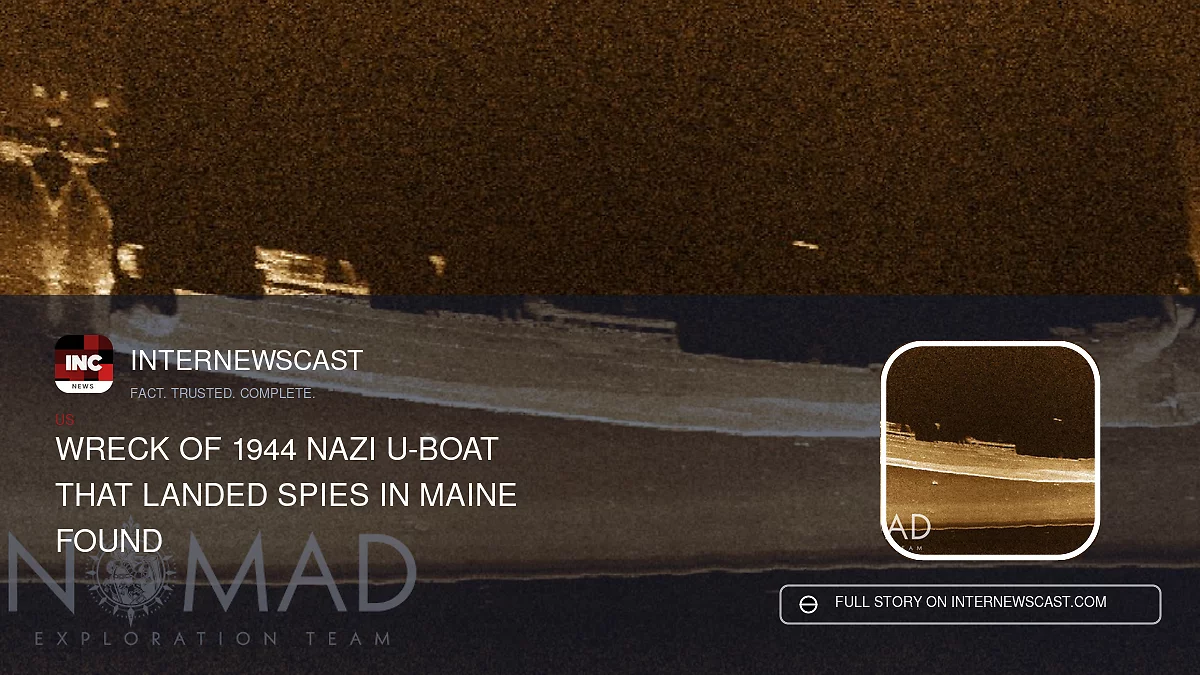

On Nov. 29, 1944, a German U-boat navigated the icy waters off New England and secretly landed two Nazi agents near Maine. Their mission was to collect intelligence inside the United States during the final years of World War II.
Four days later, the submarine encountered a merchant vessel nearby and launched a torpedo into its cargo hold. The 400-foot Canadian steamship SS Cornwallis sank in roughly 10 minutes. Of the 48 people aboard, only five survived.
More than eight decades later, the Cornwallis has finally been located. The wreck was discovered in July at a depth of nearly 400 feet, the Nomad Exploration Team announced this week.
Nomad Exploration Team 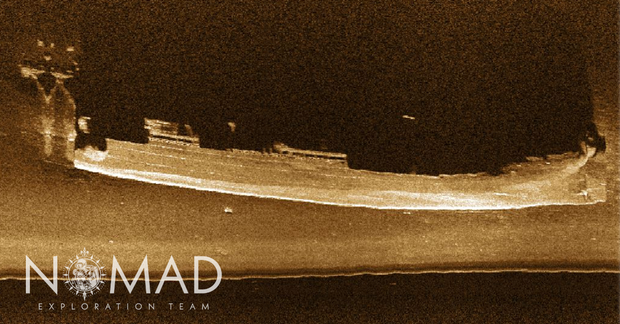
The New Hampshire-based expedition faced frigid water, powerful currents and challenging, isolated dive sites as it searched for the ship. Side-scan sonar eventually identified a large wreck, while subsequent dives confirmed that it was the long-lost Cornwallis, the team said.
“Finding the wreck was the result of years of determination,” dive team member Danny Allan said. “For the families and communities tied to the ship, the discovery shines new light on a tragedy that had largely faded from public memory.”
The Cornwallis’ final voyage
Built in Vancouver, British Columbia, and launched in 1921, the 5,458-ton steam merchant vessel originally carried the name Canadian Transporter. It was later renamed Cornwallis after becoming part of Canadian National Steamships.
Nomad Exploration Team 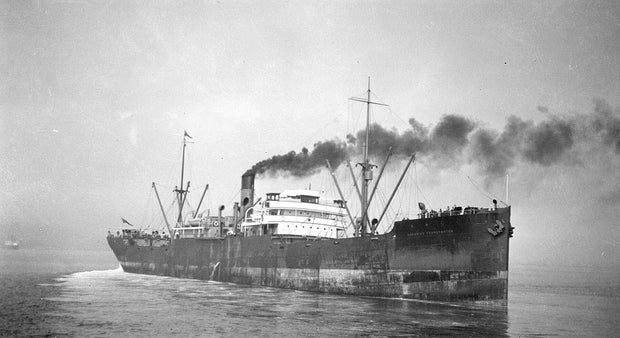
The ship had already survived one attack. On Sept. 11, 1942, while anchored off Barbados, it was torpedoed by a German submarine and badly damaged. Because it sank only partly in relatively shallow water, the vessel was eventually salvaged, repaired and returned to service.
In November 1944, the Cornwallis departed Barbados carrying sugar and molasses for St. John, New Brunswick. Nautical historian Eric Wiberg reported that the ship carried a 4-inch gun, a 12-pound gun and machine guns positioned on the bridge. None of the weapons were used.
On Dec. 3, while the ship was traveling along the Maine coast, U-1230 spotted it. The submarine, commanded by Hans Hilbig, fired a torpedo that struck near the Cornwallis’ bow, sending the ship beneath the waves in less than 10 minutes.
Six crew members managed to escape into life rafts, but one later died from hypothermia. Fishing boats rescued the remaining five before they were transferred to a U.S. Navy vessel and taken to Rockland, Maine.
“An underwater time capsule”
The sinking drew renewed attention because of the submarine’s actions only days earlier. On Nov. 29, 1944, U-1230 had put two German agents, Erich Gimpel and William Colepaugh, ashore near Hancock, Maine. Their goal was to spy on the United States. According to a 2018 Main Line Today article, Colepaugh was an American who traveled to Germany that year and received espionage training. After arriving in Maine, the pair made their way to New York City without immediately attracting attention.
Following the Cornwallis attack, U.S. officials investigated whether the submarine responsible had also delivered enemy agents onto American soil. The FBI later discovered that Hancock residents had reported seeing unfamiliar men in the area around the time the merchant ship was sunk.
The espionage operation eventually unraveled in New York City. Colepaugh admitted his role to a friend, who notified the FBI, and Gimpel was arrested several days later. A military court sentenced both men to death, but those punishments were eventually reduced to life in prison.
AP Photo 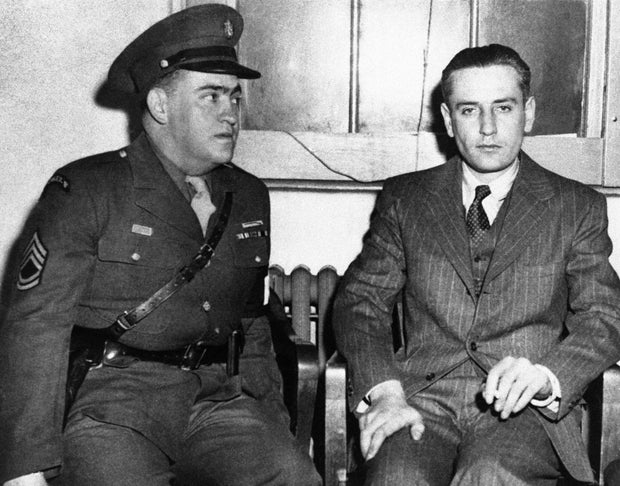
U-1230 remained in service until the end of the war and was scuttled in 1945. The whereabouts of the Cornwallis, however, remained unknown for generations—until the recent discovery.
“At nearly 400 feet below the surface, the Cornwallis is no longer the vessel that carried sugar and molasses north,” the Nomad Exploration Team said. “It is an underwater time capsule preserving one of the most extraordinary wartime episodes along the Maine coast.”