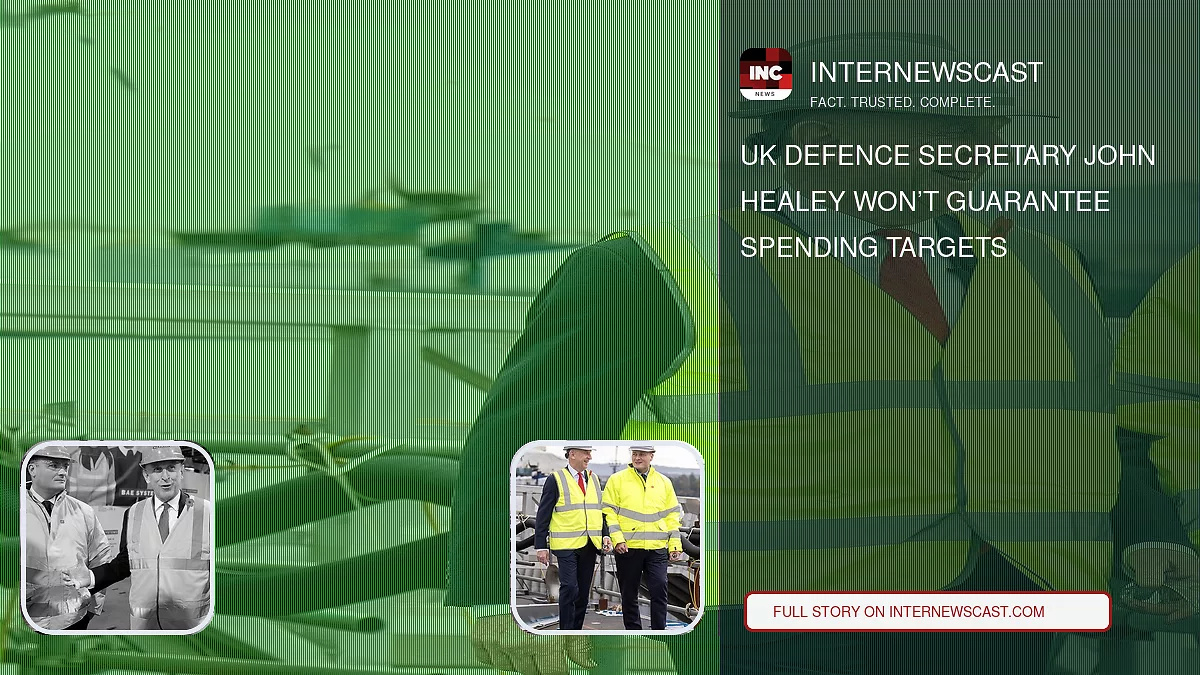

John Healey’s defence spending pledges came under renewed scrutiny tonight after he declined to guarantee that the Government would deliver them.
The Chancellor appeared to avoid questions about how he plans to finance his Budget commitments, which are expected to require £11billion a year.
Mr Healey has so far refused to explain where the money will come from to increase defence spending to three per cent of gross domestic product (GDP) by 2030. Instead, he has deferred the decision until next year’s spending review.
In his first Budget on Wednesday, he described 2030 as a “target”, prompting accusations that he was buying time without a firm plan. When challenged on Friday, the Chancellor again declined to guarantee that the ambition would be met.
Speaking to Our News Outlet during a visit to the BAE Govan shipyard in Glasgow, Mr Healey said: “I said we needed a target date of 3 per cent in 2030 on the way to that.
“I’ve confirmed that in the Budget this week, and I’ll set out the detail of that quite rightly when we set our multi-year spending plans next year as a government.”
During his Budget speech, Mr Healey stressed that he remained committed to the wider Nato pledge to spend 3.5 per cent of GDP on the military by 2035. He said the route to achieving that goal would be outlined next year.
The delay prompted fierce criticism, with Admiral Lord West accusing the Chancellor of “betraying” the Armed Forces by putting off decisions on defence funding.
Tensions escalated on Friday when three former military chiefs—Gen Sir Peter Wall, Field Marshal Lord Richards and Gen Lord Dannatt—warned that the Government’s approach could embolden Russia.

Chancellor John Healey (left) with Defence Secretary Wes Streeting (right) in Glasgow
“The lack of strategic urgency is shocking and will only embolden our opponents,” Gen Sir Peter, who served as chief of the general staff from 2010 to 2014, told The Telegraph.
Gen Lord Dannatt, the former head of the Army, accused Labour of relying on “creative accounting instead of finding real money”.
“Russia is serious, we are not. Deterring aggression by being prepared for war is the best way to keep this country safe. Find the money now, don’t kick the can down the track for another year,” he added.
As criticism mounted, Defence Secretary Wes Streeting came to the Chancellor’s defence on Friday, saying he trusted Mr Healey to deliver the spending plan.
“I understand why people are more cynical now about politicians and political promises. But what I would say about this Chancellor in particular is [to] judge him by actions and not just words,” he told BBC Radio 4.
“As Defence Secretary, he was investing heavily in our capability. As defence secretary he was willing to resign as a point of principle on that very issue. So, when John Healey says he will fund 3 per cent by 2030, I think we can believe him… we can trust him.”
IN CASE YOU MISSED IT: Aspiring NYPD Officer, Hockey Captain Killed in Crash With Twice-Deported Mexican National
Although he offered no further details about the Chancellor’s plans, Mr Streeting defended the decision to delay explaining how Labour would meet its defence targets.
“Of course that’s right because of the scale of the investment that’s needed. It’s right to do that at the spending review,” he added.
The Defence Secretary also appeared to dismiss criticism from figures including General Lord Dannatt, the former Army chief, who accused Labour of “fiddling while Rome burns” over the delay to the spending plans.
“I would agree with that criticism if we weren’t investing right now, if we hadn’t been investing already. I think that’s where we’re speaking at cross purposes here with some of the critics,” Mr Streeting said.

His remarks came amid renewed concern over Vladimir Putin, who warned on Thursday that he was “ready” to go to war with Europe, a conflict he said would have “no winners”.
The delay also fuelled fears that Britain’s standing within Nato was being damaged, with claims that allies were becoming increasingly uneasy.
“Nato is actively calling out Britain for failing to deliver,” said Stuart Anderson, the Conservatives’ “war readiness” minister. “We are significantly dropping in everybody’s estimation when it comes to our Nato commitments.”
Mr Anderson, a member of the Nato Parliamentary Assembly who regularly meets politicians from across the alliance, criticised the Chancellor’s military spending strategy.
“Every decision that has been made this week takes us further away from being ready for war,” the MP for South Shropshire told Our News Outlet.
“We are making in-year cuts that are removing our operation capability and will have a long-term knock-on impact on our Armed Forces.
“We should have been in the position of committing to three per cent now, but Labour hasn’t done it. We are going to suffer because of this.”
Mr Streeting insisted that Labour was doing more for defence than previous Conservative governments, which he accused of having “hollowed” out the Armed Forces to their smallest size in living memory.
He also highlighted supportive comments from Nato Secretary General Mark Rutte and other senior military figures, who welcomed the Budget’s defence commitments.
“I think we are doing as much as we can, as fast as we can. The biggest sustained increase in defence spending since the end of the Cold War,” he said on BBC Breakfast.
The Chancellor is understood to be considering “off the books” ways to increase defence spending without raising taxes or adding to borrowing.
Among the proposals are plans for an international defence bank with allies and allowing private companies to provide upfront funding for new military equipment.