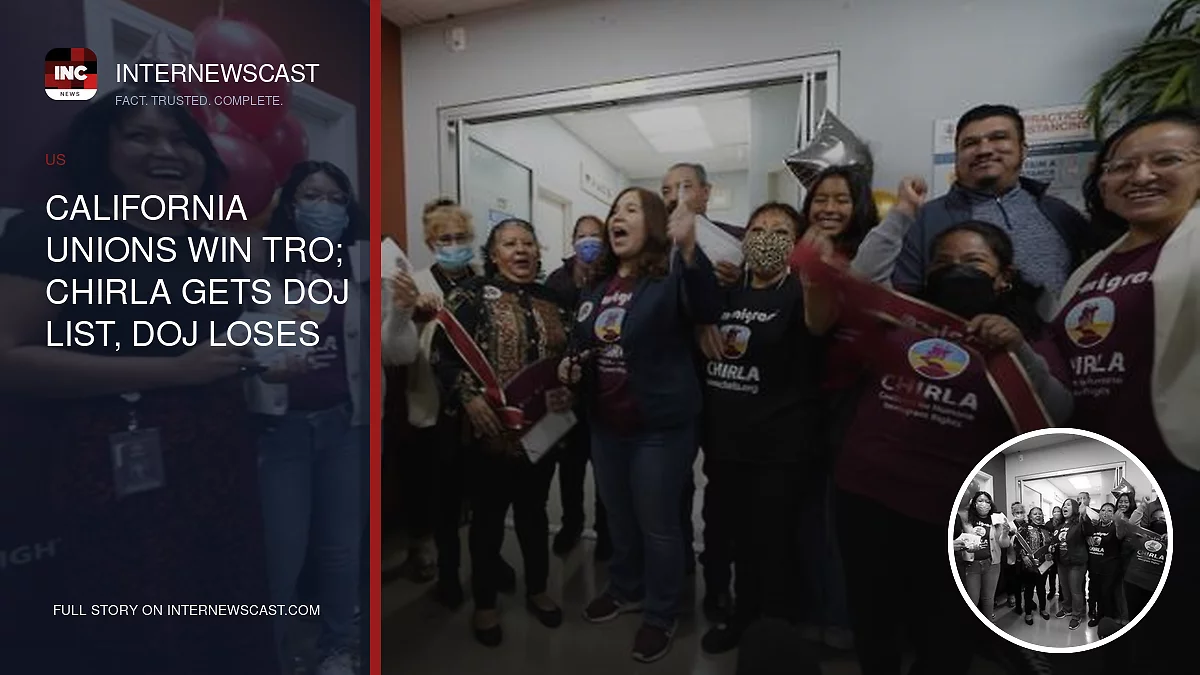


On Thursday, the SEIU and AFL-CIO, which represent election workers across California, sued the Department of Justice in the Northern District of California. The unions accuse the DOJ of pursuing “a series of efforts to actually or attempting to intimidate, threaten, or coerce election workers who aid others in exercising their right to vote.” They also asked the court to issue a temporary restraining order (TRO) barring the department from pressuring election officials to segregate ballots cast by people it considers likely to be noncitizens, as well as from threatening prosecution over routine election duties. Norm Eisen’s organization is representing the plaintiffs, which also include the NAACP and LULAC. Both groups recently sought permission to intervene in the separate Central District lawsuit covered here throughout the week.
Without holding a hearing or receiving a response from the DOJ, District Judge Trina Thompson, a Biden appointee, granted the requested TRO on Friday evening. The order states that the defendants are “temporarily enjoined and stayed, including under 5 U.S.C. §705, from the following”:
- Defendants shall not threaten, intimidate or coerce state or local elections officials or workers to demand that they halt processing the ballots of any registered voter solely on the basis that the ballot belongs to an individual alleged by Defendants to be ineligible to vote;
- Defendants shall not demand that any state or local election official
- (i) remove specific registered voters from their statewide voter registration lists;
- refuse to issue ballots to specific registered voters; or
- (iii) segregate or otherwise not count any ballots cast by specific registered voters for the November 3, 2026 General Election, solely on the basis that the ballot belongs to an individual alleged by Defendants to be ineligible to vote;
- Defendants shall not threaten state or local election officials and workers with criminal prosecution for failure to comply with such demands;
- Defendants shall not threaten state or local election officials and workers with criminal prosecution for processing or counting ballots in the 2026 election in compliance with state and federal laws that govern election administration on the basis that a ballot belongs to an individual alleged by Defendants to be ineligible to vote.
- The Court further ORDERS Defendants to inform any State, county, or any other local government to which any Defendant sent a letter regarding the processing and counting of ballots in the 2026 election and any list of individuals alleged by Defendants to be ineligible to vote that the demands and threats of prosecution to election officials and workers reflected in that letter have been enjoined.
- The Court further ORDERS Defendant U.S. Department of Justice to inform the Court of any pending search warrant applications, grand jury subpoenas, or other demands to access election materials or ballots pertaining to any list of individuals alleged by Defendants to be ineligible to vote, or compel testimony related thereto.
I am not an attorney, but I question whether the judge had authority to impose several of these restrictions. Regarding the fourth provision, Bill Shipley argued that federal law-enforcement officials may advise people about the law and the potential consequences of violating it. “There is black letter authority that a federal law enforcement officer can ADVISE anyone of the law and the possible consequences of violating the law. This judge is an idiot,” he wrote.
There is black letter authority that a federal law enforcement officer can ADVISE anyone of the law and the possible consequences of violating the law. This judge is an idiot.
— Shipwreckedcrew (@shipwreckedcrew) October 31, 2026
The order also requires the DOJ to disclose certain law-enforcement activity to the court, a provision that raises additional questions about the scope of the judge’s authority.
MORE ON THIS: Steve Hilton Could Bring Flavored Nicotine Pouches Back to California
Also on Friday, Judge Boasberg issued an order in a separate case requiring the DOJ to provide CHIRLA—the California organization that RedState has accused of coordinating much of the organization and funding behind the 2025 anti-ICE riots—with a list of 20,000 people identified as “likely noncitizens” on California voter rolls. The order would allow CHIRLA to determine whether any of its members appear on that list.
Meanwhile, CHIRLA operated as a Los Angeles County Flex Vote Center on Friday. Critics allege that activity violated laws governing conduct near polling locations.
Prohibited conduct “within the immediate vicinity of a person in line to cast their ballot or within 100 ft of the entrance of a polling place, drop box”: “DO NOT engage in electioneering; photograph or record a voter entering or exiting a polling place CHIRLA today – a LA County Flex Vote Center
— Jennifer Van Laar (@jenvanlaar) October 31, 2026
Between these two rulings and the developments in the Central District case this week, the disputes appear increasingly likely to reach the Supreme Court—and potentially soon.
MUST READ: Former AFL Footballer Assaulted Partner After Grand Final Upset, Court Hears