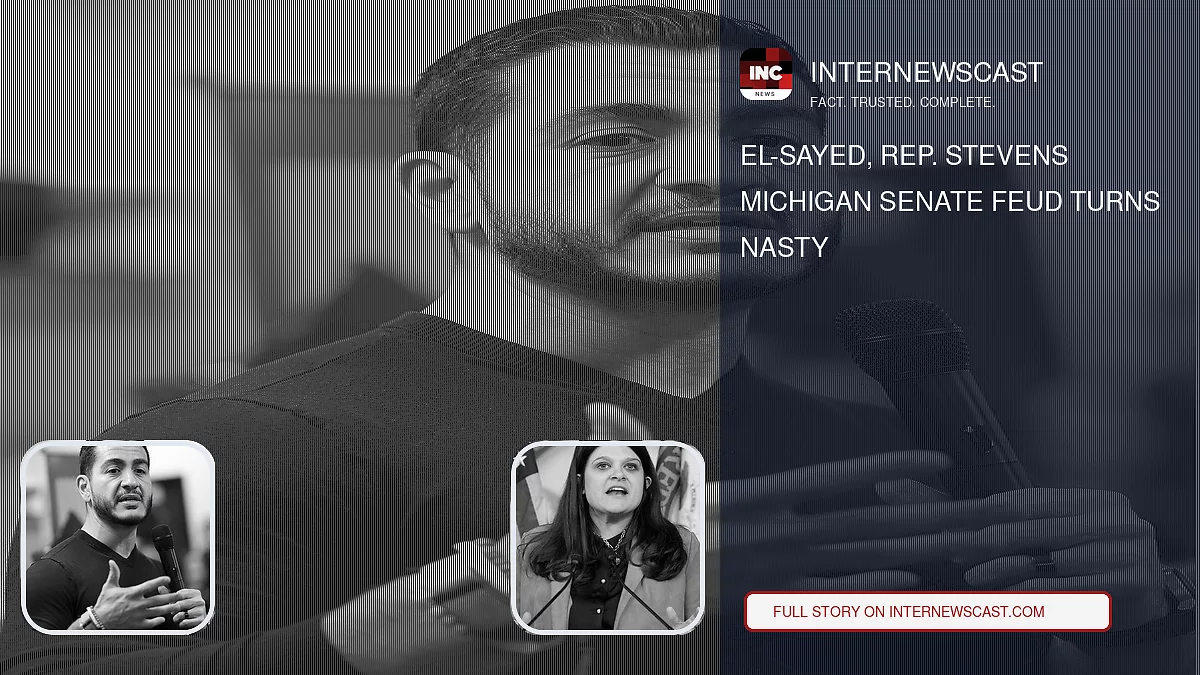

With just three days remaining before the 2026 midterm elections, a bitter Democratic dispute has erupted in Michigan between progressive Senate nominee Abdul El-Sayed and former primary rival Rep. Haley Stevens.
The rift began Wednesday after Stevens’ fiancé, Jason Turkish, said he planned to vote for Republican Senate candidate Mike Rogers instead of El-Sayed.
Hours later, Stevens appeared on CNN and confirmed that she would vote for El-Sayed, while also calling on his campaign to “shut out the hate and call it out.”
The two Democrats appeared to patch things up Thursday, when they scheduled a Sunday campaign appearance at a Detroit church with South Carolina Rep. Jim Clyburn. The veteran Democrat is widely regarded as a key figure in Joe Biden’s 2020 primary victory.
But Stevens reignited the dispute Friday with a social media statement criticizing El-Sayed and demanding that he denounce an advertisement tying U.S. support for Israel to soaring grocery prices.
El-Sayed’s campaign has since asked Stevens not to attend the event, MS NOW reported Saturday.
Asked by reporters whether he wanted Stevens beside him at the appearance, El-Sayed avoided a direct answer, saying she “wants to talk about other things.”
When a reporter asked whether Stevens was “trying to rat f***” his campaign, El-Sayed laughed and replied: “That is not a question for me.”

Abdul El–Sayed’s campaign has asked former Democratic primary opponent Rep. Haley Stevens to stay away from a church event on Sunday and future events

Stevens’ fiancé, Jason Turkish, said Wednesday that he would be casting a vote for Republican candidate Mike Rogers

The invitation for Stevens to attend church ‘still stands,’ according to Clyburn adviser Antjuan Seawright
Rogers said he would welcome Stevens “to join us at an event or any of our campaign events,” according to MS NOW.
Clyburn adviser Antjuan Seawright said Stevens’ invitation to attend the church service “still stands,” the outlet reported.
El-Sayed’s decision to distance himself from Stevens may extend beyond Sunday’s church appearance.
His campaign has asked Stevens to avoid all future campaign events in the final days before next week’s election, Politico reported.
A source told the outlet that Stevens should stay away so she does not “distract from the central issues of the campaign.”
Asked Thursday about the planned church appearance, El-Sayed said, “we’re always trying to unify the party.”
He attributed the delay in holding a joint event to the candidates’ crowded schedules.
The progressive nominee also said voters were less interested in internal party tensions than in the rising cost of living, adding that “nobody cares” about the party’s dynamics.

El–Sayed said that Stevens ‘wants to talk about other things’ when asked on Saturday if he wanted her to appear with him at the church
The one-minute advertisement at the heart of the dispute was produced by the left-wing commentator Cenk Uygur’s Rebellion PAC. Uygur is the uncle of controversial streamer Hasan Piker.
El-Sayed, an outspoken critic of Israel, has previously campaigned with Piker, prompting concern among some members of Michigan’s Jewish community.
EXPLORE MORE: Heartbreaking Final Tribute for 24-Year-Old Killed by Father
The ad depicts several conversations inside a grocery store, including a woman telling a man she cannot afford eggs because her money had to be spent “killing Palestinians.”
El-Sayed’s campaign has emphasized that it did not produce or approve the advertisement, saying it “has always been focused on addressing the most critical challenges Michiganders are facing.”
El-Sayed told reporters Saturday that he did “not agree with the contents of that ad.”
Stevens said she was pleased to hear El-Sayed reject “the content of the vile… ad which claimed Israel and Jews were to blame for the high costs of groceries.”
According to a statement reported by Semafor’s Nicholas Wu, Stevens did not name El-Sayed and referred to him only as “our senate nominee.”
“Whenever anyone tries to set us against each other, we have an obligation to stand up and fight back,” Stevens wrote. “This is what our constituents deserve from those of us in elected leadership.”
Stevens had sharply condemned the advertisement Friday and indicated that El-Sayed should take stronger action to distance himself from it.
She is a staunch supporter of Israel and represents a suburban Detroit district with a sizable Jewish population.
“Abdul promises to get money out of politics,” Stevens wrote Friday on X. “He can begin by getting Israel out of his explanation for everything Michigan cannot afford.”
El-Sayed and Stevens were last seen campaigning together on August 6, two days after the Democratic primary.
Stevens, who lost the primary by just under one percentage point, pledged to support El-Sayed and said she would do “whatever he wants me to do” on the campaign trail.
Michigan has not elected a Democrat to the Senate since 1994. Donald Trump carried the state in both 2016 and 2024.
Republicans are confronting their own political headwinds, including voter dissatisfaction with President Trump, the Iran war and persistent economic pressures.
Rogers has remained closely aligned with Trump on most major issues. At a Michigan rally last Sunday, he credited the president with helping bring manufacturing jobs back to the state.
Trump has repeatedly attacked El-Sayed’s Muslim faith, labeling him a “jihadist” and claiming he was “on the side of terrorists.”
Trump previously said: “If you’re black, or if you’re Jewish, and you vote for Abdul, you’re not smart.”
Both candidates are competing for Black voters, particularly in Detroit’s Wayne County, where Stevens defeated El-Sayed in the Democratic primary.
El-Sayed’s church appearance with Clyburn is part of that broader effort to reach those voters.
Rogers, meanwhile, has visited a reading-remediation program at a Detroit high school and spoken with residents in Pontiac, north of the city, about housing costs.
Michigan’s early-voting period began October 24.
Our News Outlet has contacted El-Sayed and Stevens for comment.


