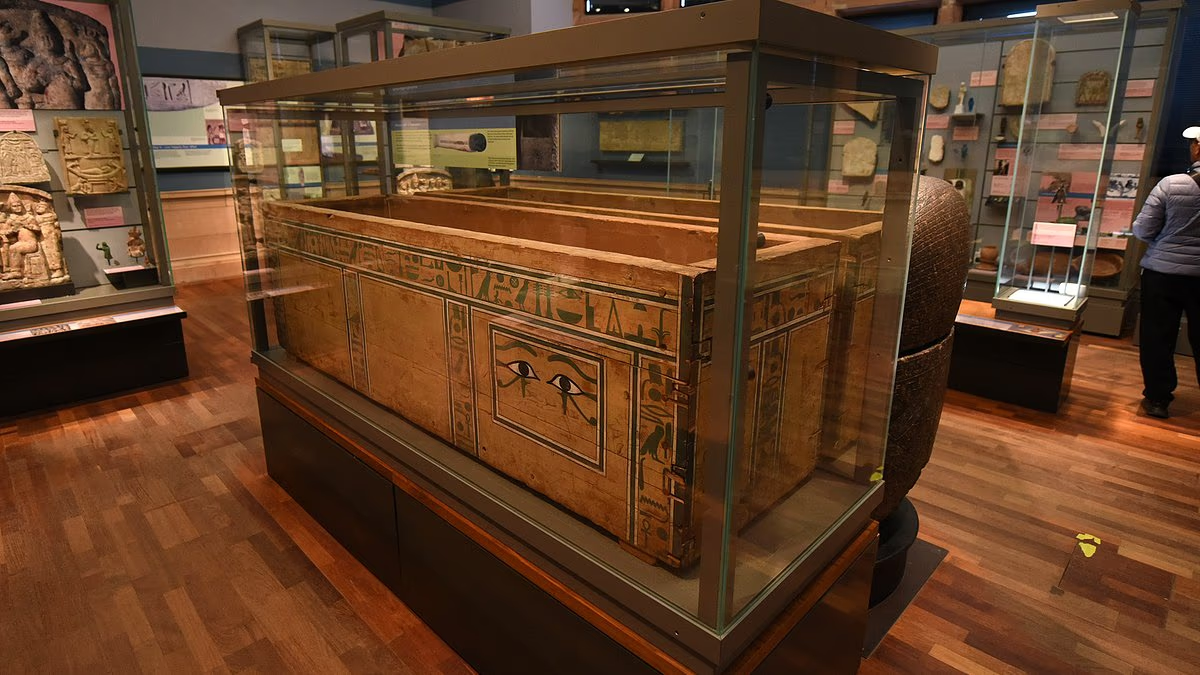

The story attracted international attention and prompted widespread ridicule of museum officials in Scotland.
Now, an ancient mummy taken off public display could potentially be returned to Egypt.
Egyptian authorities have requested the repatriation of the mummified remains of Nekht, a priest whose body was recently removed from Kelvingrove Art Gallery and Museum in Glasgow over concerns about a lack of “informed consent from the deceased individual”.
However, Chris McGovern, chairman of the Campaign for Real Education, warned that returning the remains could create a “dangerous precedent”.
The development came as museum officials confirmed that the bones of a Scottish child and an adult dating from the Bronze Age are also due to be removed from display at Kelvingrove.
Kelvingrove is operated by Glasgow Life, the charitable organisation responsible for managing Glasgow City Council’s cultural and sporting assets.

Egyptian authorities have requested the return of the mummified remains of the priest Nekht

The remains were recently taken off display at Kelvingrove Art Gallery and Museum in Glasgow
The decision to remove Nekht’s 4,000-year-old mummified remains from public view has prompted Egyptian officials to seek their repatriation.
Calls to return Egyptian artefacts have intensified since the opening of the £910million Grand Egyptian Museum near Cairo last year.
The museum houses more than 100,000 objects, including artefacts from the tomb of Tutankhamun, the boy king whose collection includes his famous golden mask.
Glasgow Life confirmed: “We have received a request in the last few days to repatriate the remains to Egypt.
“Glasgow has a well-established process for repatriation requests. We will follow this process to guide our next steps.”
The prospect of returning the mummy, which had been exhibited at Kelvingrove for decades, was criticised by Mr McGovern, a former adviser to the Policy Unit at 10 Downing Street.
He said: “The repatriation of Nekht’s remains to Egypt will impoverish Scottish education and set a dangerous precedent.
“Will the next step be to repatriate to Israel those bones of Saint Andrew held at St Mary’s Cathedral in Edinburgh?
DISCOVER MORE: Liverpool vs Arsenal LIVE: Premier League Team News and Updates
“Should the bones of Saint Valentine kept in a Glasgow church now be returned to Italy?”
The Hunterian Museum at the University of Glasgow has also removed from display the mummified remains of Lady Shep-en-hor, an Egyptian woman whose coffin was discovered in Thebes.
Her remains had been exhibited for more than 200 years.
Museum officials have also addressed the future of the bones of a child and an adult discovered in a Bronze Age grave at Bonhill, Dunbartonshire, which are currently displayed at Kelvingrove.
Glasgow Life said: “It is our intention to remove these remains from display at a future date. A specific storage area with restricted access was built to house human remains and other sensitive objects during the second phase of the Glasgow Museums Resource Centre, and that is where these remains will be kept.”
Mr McGovern responded: “The purpose of museums is to educate, not to promote woke ideology.
“Removing Bronze Age skeletal remains is an anti-educational decision that conceals an important part of Scottish national identity.”

Museum officials said the bones of a Scottish child and adult from the Bronze Age are also due to be removed from display
Scottish Conservative culture spokesman Murdo Fraser said: “SNP-run Glasgow Life has completely lost the plot if it believes that hiding history is the answer to modern sensitivities.
“What comes next? Will museums be expected to remove anything that someone, somewhere might find offensive?
“These remains have survived for thousands of years and form an important part of our shared history.
“Museums should educate the public rather than give in to increasingly ridiculous demands for censorship.”
Nekht is believed to have lived between 1985 and 1797BC. His remains were excavated at Beni Hasan in Middle Egypt during archaeological digs in the early 20th century and donated to the city of Glasgow in 1923.
Lady Shep-en-hor’s ornate sarcophagus has been described as a “fine work of late period ancient Egyptian funerary art”. She has never been removed from the coffin, although the remains have been examined using X-rays and CT scans during the past 50 years.
The controversy followed the International Council of Museums’ (Icom) revision of its ethical code in June. The updated guidance recommends that museums “uphold the inherent dignity of human remains and promote respect for their significance”.
It also states: “Decisions about these items and collections should be made in collaboration with descendants or communities from which they originate, if known.”


