
When I was a Conservative MP and our parliamentary committee visited Beijing in 2018, we received two remarkable warnings.
The first was that every room in the British embassy was bugged. The second was that a central element of our diplomacy involved ‘reassuring’ China that Britain did not pose a threat.
I could scarcely believe what I was hearing.
Here was a Communist superpower building a formidable military machine, conducting blatant espionage on British soil and seeking control of the industries on which Western economies rely.
At the same time, Britain was reducing the size of the Royal Navy while our diplomats appeared to be carrying out Operation Kowtow. Successive governments have continued along this damaging course.
This week, Parliament’s Business, Innovation, Science and Trade Committee delivered a devastating assessment of Britain’s relationship with Beijing.

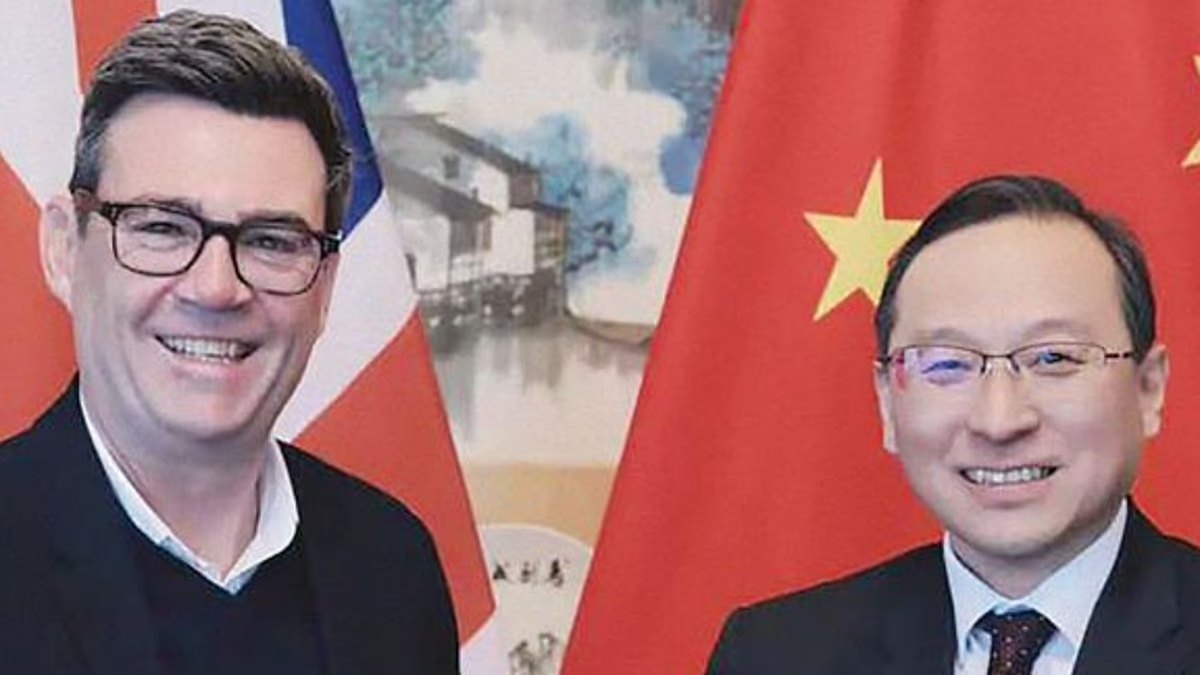
Andy Burnham met China’s Consul General Tang Rui at the Consulate General in April to discuss expanding practical cooperation between China and Manchester
Despite its cumbersome name, the committee produced an unusually forceful report by parliamentary standards. It confirms what many of us have argued for years: Britain lacks a coherent China strategy, acts inconsistently and has no clear sense of where the limits should lie.
Labour was ‘making up its China policy as it goes along’, according to chairman Liam Byrne, who is a cut above most profoundly uninspiring Labour MPs. Decisions on China – the greatest strategic threat facing our country – were characterised by ‘reactivity, inconsistency, and opacity’.
Coming from a Labour-led committee, that is a serious condemnation.
When it comes to China, Britain’s political class appears stuck in an endless Groundhog Day. First come warnings about the threat, followed by promises of a coherent response – and then no meaningful action. Another scandal, espionage revelation or economic and political humiliation follows, and the cycle begins again.
Almost every expert body now recognises Britain’s economic dependence on China as a serious national risk. They warn that weakness, timidity and inadequate planning could allow Beijing to dominate our supply chains and accumulate such influence here that British leaders would eventually have little choice but to accept its demands. We could become a satrap of a Communist superpower.
It does not have to happen. Yet the grim irony is that Labour’s own economic policies are making Britain ever more exposed to precisely this dependency.

A statement in this week’s parliamentary report reads: ‘Low-cost, increasingly high-quality Chinese imports are a boon to UK consumers at a time when household incomes are squeezed’ (Pictured: Chinese-owned MG cars line up at Bristol Port)
The causes of our stagnation are plain to see: the highest peacetime tax burden in our history, punishing energy costs and a socialist Government that views employers less as sources of prosperity than as convenient targets for ministers seeking to placate the trade unions.
Unsustainable levels of low-skilled immigration, together with hundreds of thousands of undocumented migrants, are placing an additional strain on the country.
Labour politicians would rather not discuss these issues. Instead, they approach China with an outstretched hand, hoping Beijing will somehow rescue Britain from the economic consequences of policies that are undermining the country. This is merely a distraction.
In fact, I would argue that this week’s parliamentary report does not go nearly far enough. Its conclusions contain a troubling degree of naivety.
Consider this sentence: ‘Low-cost, increasingly high-quality Chinese imports are a boon to UK consumers at a time when household incomes are squeezed.’ Put more plainly, China has exploited the global trading system to undercut our industries, drive British companies out of business and saturate our markets with low-priced goods.
The committee recommends negotiating improved market access and pursuing fair trade. Good luck. China is not seeking free trade with Britain; it wants trading dominance over us.

Protesters voiced their opposition to plans for a new Chinese mega-embassy outside the Royal Mint Court in January
NEXT UP: Former West Point Cadet Sued for Allegedly Drugging Pregnant Girlfriend
Beijing’s economic model is designed to strengthen Chinese industry, reduce its dependence on foreign suppliers and extend its influence overseas. There is no economic El Dorado waiting for Britain – no pot of gold at the end of a Beijing rainbow.
The respected Inter-Parliamentary Alliance on China, or IPAC, a global coalition of more than 320 parliamentarians, recently published a study that is more candid than the trade committee’s report.
Under the Communist Party, China is and will remain an economic and political threat to Britain, it concluded. The country offers limited trading opportunities while exposing us to enormous strategic dangers. Led by former Tory leader Iain Duncan-Smith MP, IPAC is right.
China is not pursuing mutual prosperity. It is using economic power as a weapon – weakening the West while concentrating influence in Beijing.
China has built its wealth through the theft of intellectual property and the aggressive use of international trading rules to undercut Western businesses. It does not operate by the same standards, nor does it intend to start doing so.
Yet Britain continues to neglect even the most basic measures needed to protect itself.
Consider Net Zero. In our determination to decarbonise, we have become increasingly dependent on Chinese solar technology, despite serious evidence uncovered by researchers of forced labour involving Uyghurs in parts of the industry’s supply chains.
The arrangement is absurd. Our pursuit of decarbonisation raises energy costs, damaging businesses or driving them overseas. China, meanwhile, benefits from abundant cheap energy, much of it generated by burning coal – the world’s dirtiest major pollutant – and sells us the solar panels required by our Net Zero agenda.
If China’s President Xi Jinping were directly controlling British politicians, it would be difficult to devise a more effective policy for harming this country.
The contradictions do not stop there. Britain has the National Security and Investment Act, intended to shield sensitive assets from hostile foreign acquisitions. Yet the legislation was deliberately weakened to avoid damaging Chinese investment in Britain. What, then, is its purpose?
We also have the Foreign Interference Reporting System, designed to make foreign influence-peddling more difficult. But China has not been placed in the upper tier, undermining the system’s central purpose.
For years, we have debated a proposed agreement to transfer sovereignty over the Chagos Islands to Mauritius, an ally of China. That deal has stalled, but the broader issue remains: why does Britain so often seem willing to consider strategic concessions before developing a coherent national-security policy to protect us from Beijing?
There must be a better approach. Britain needs an honest assessment of its China policy – one that acknowledges Beijing as a threat and addresses the economic, political, defence and technological dimensions of that challenge.
We should also confront the cynical position on slavery adopted by China’s Communist rulers.
Last week, the Prime Minister said he was open to a formal apology for Britain’s role in the slave trade. I wonder whether Andy Burnham understands that China – which now wields enormous influence in the Caribbean after investing heavily in the region’s critical infrastructure – has quietly encouraged the reparations movement as a means of undermining the West.
This is despite China being accused of practices tantamount to modern-day slavery. Britain’s response should be to ban all goods made in China using forced or slave labour.
That should not even be controversial. It ought to be a basic element of the ethical global free trade Britain claims to champion.
We should hold China to account and remind its leaders that Britain was the nation that abolished slavery.
Sadly, Andy Burnham’s Government appears more concerned with bus fares than with Beijing.
Dr Robert Seely MBE is a military expert, former MP and author of the book The New Total War, out in paperback on November 10.


