
Images of King Charles and Queen Camilla greeting diplomatic figures have flooded the internet during their nine-day Caribbean tour.
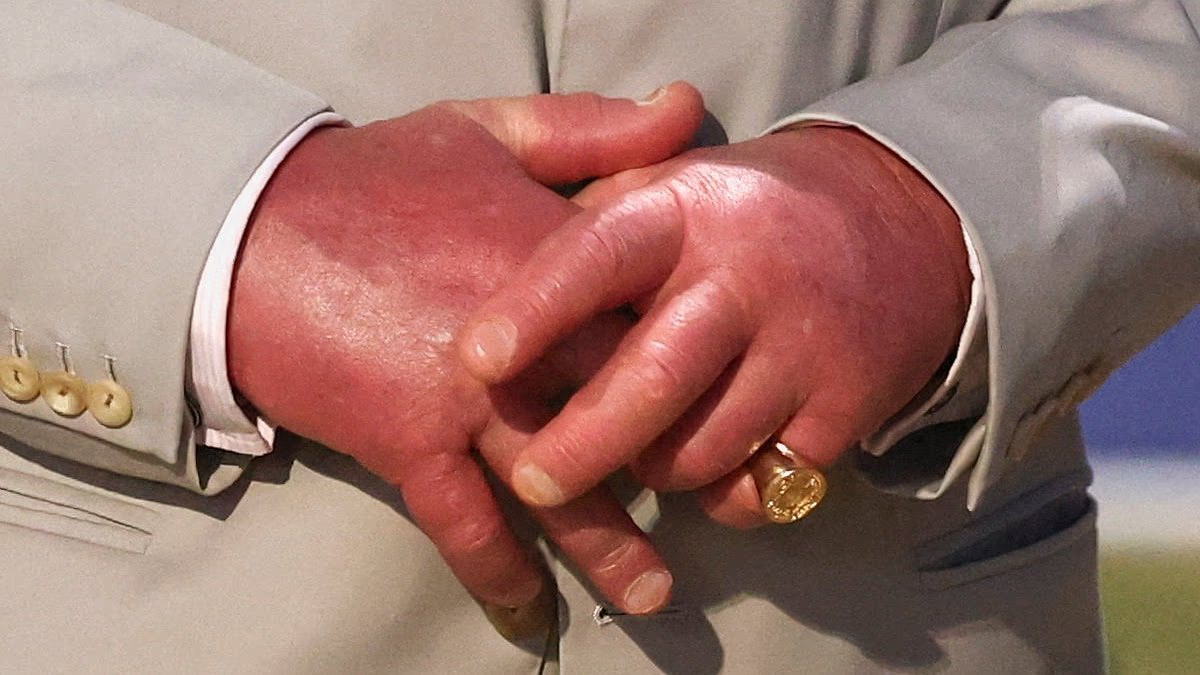
Yet one detail has attracted particular attention: the monarch’s seemingly swollen fingers.
The King’s so-called “sausage fingers” have been widely discussed online since his accession in 2022, when viral photographs appeared to show unusually puffy digits.
In a documentary aired in December 2023, Charles even described his own hands as sausage-like.
Concern over what the appearance of his hands might indicate about his health has now resurfaced, after social media users scrutinised photographs taken during the past week.
Dr Stephanie de Giorgio, a GP in Kent, says concerns about swollen hands and feet are common. She frequently sees patients with these symptoms, particularly during periods of very hot or cold weather.
‘Patients often arrive confused and slightly alarmed, describing puffy ankles, rings that will not come off their fingers or feet that seem larger by the end of the day,’ she says. ‘They are often convinced that something serious is wrong. Thankfully, most of the time it is not.
‘However, recognising the difference — and knowing when to seek medical advice — is important.’

Concern over what swollen fingers might mean for Charles’s health has resurfaced, with social media users focusing on photographs taken during the past week, including this image from a celebration marking the 45th anniversary of Antigua and Barbuda’s independence

A close-up of the King’s hands during his Caribbean tour. In a documentary broadcast in December 2023, Charles described his hands as sausage-like
When temperatures fall, the body works to protect its vital organs by keeping them warm. Blood vessels in the fingers, toes, hands and feet narrow, helping to reduce heat loss.
Once a person moves indoors and begins to warm up, those vessels quickly widen again. The resulting surge of blood flow to the extremities can make the hands and feet look swollen.
The effect can be more pronounced in people with Raynaud’s phenomenon, whose blood vessels narrow excessively in response to the cold. When circulation returns, this may lead to marked swelling.
Cold weather can also affect the movement of fluid between the bloodstream and surrounding tissues, particularly in older adults. This can cause fluid to collect in the fingers and toes.
Another possible cause is chilblains, which affect around one in 10 Britons during the colder months.
The tips of the fingers and toes may become swollen and painful, turn red or purple, and develop a burning sensation. These symptoms can last for days or even weeks after exposure to cold.
Chilblains occur when blood vessels respond abnormally to cold conditions and become overly restricted.
Dr de Giorgio also notes that women are generally more susceptible to fluid retention than men.
‘The hormone progesterone encourages the body to retain water, which is why many women experience swollen ankles during the two weeks before their period. Menopausal women may also be more vulnerable because declining oestrogen levels can interfere with the body’s control of fluid.’
Limited movement can also increase the risk of swelling. Physical activity helps pump blood back from the lower limbs, so remaining seated for long periods — whether on a plane, at a desk or in a wheelchair — can make swelling more likely.
Being overweight is another risk factor. Additional tissue can place greater pressure on blood vessels, forcing the veins in the legs to work harder to return blood to the heart.
The reassuring point is that, for most people, swelling linked to cold temperatures is harmless.
‘If the swelling subsides overnight or improves when you lie flat, that is reassuring,’ says Dr de Giorgio.
‘Even so, swelling in the legs and feet can sometimes signal an underlying health problem. Heart failure is one condition I would want to exclude because, when the heart is not pumping effectively, fluid can back up and accumulate in the hands and legs.

The King’s fingers have been widely discussed online since his accession in 2022, with viral photographs appearing to show particularly swollen digits
‘Kidney problems can also cause the body to retain excess fluid. If the kidneys cannot efficiently remove additional sodium and water from the blood, fluid may build up and leak into surrounding tissues.’
She explains that kidney-related swelling commonly affects the legs, ankles and feet because of gravity, as well as the area around the eyes. Unlike some temperature-related swelling, it generally persists rather than disappearing overnight.
‘Seek medical advice if the swelling does not improve or continues to get worse,’ Dr de Giorgio warns.
‘You should also seek help if you become short of breath, especially during exertion or when lying flat; if you are passing considerably less urine than usual; or if swelling affects only one leg rather than both.
‘Swelling in one leg — particularly when accompanied by redness, warmth or pain — could be a sign of deep vein thrombosis, or a blood clot, and requires urgent assessment.’
If temperature-related swelling affects the legs, elevating the feet can provide effective immediate relief, she says.
‘Lie down and raise your legs above the level of your heart, allowing gravity to help move the fluid back.’
‘It is also important to stay hydrated. This may seem counterintuitive when you already feel swollen, but dehydration can prompt the body to retain more fluid as a protective measure. It triggers the release of vasopressin, also known as antidiuretic hormone, which tells the kidneys to reduce water excretion and reabsorb more of it. In effect, the body enters survival mode and conserves the fluid available to it.’


