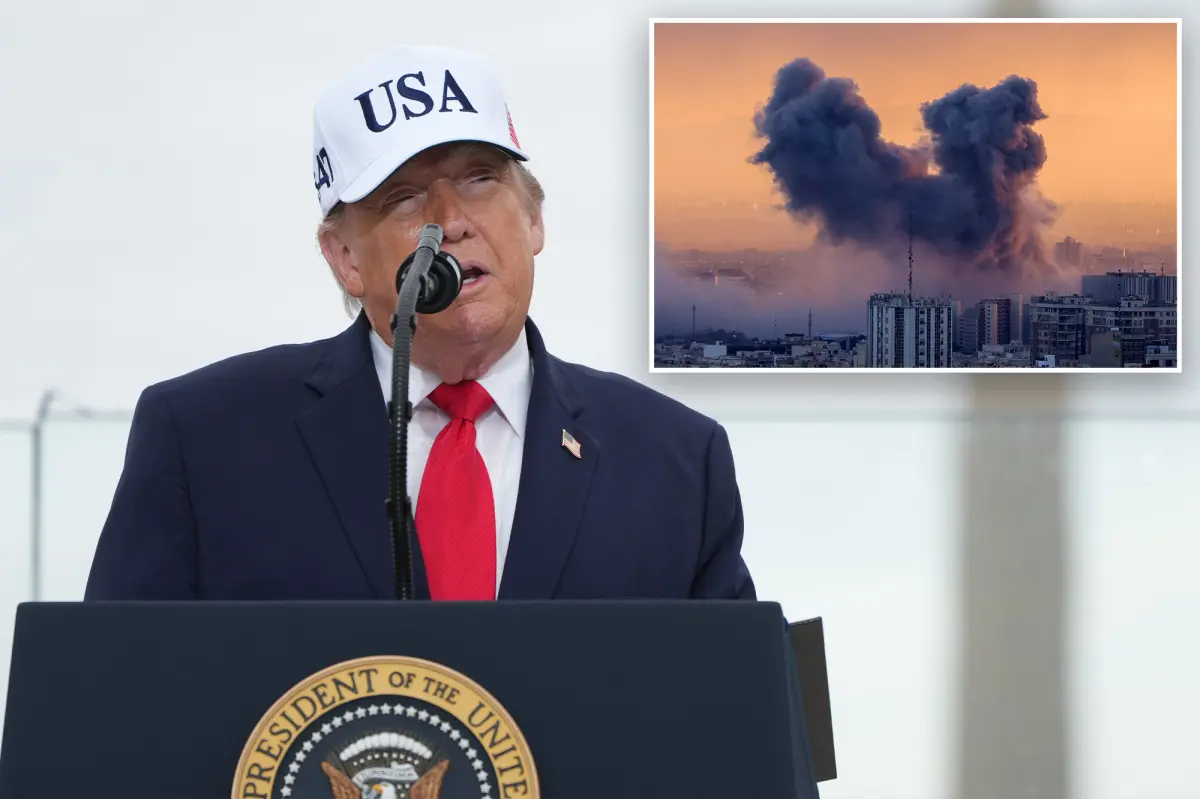

President Trump could have only a few weeks after the midterm elections to reopen a military campaign against Iran before a new Congress moves to restrict his authority to wage war, experts told The Post.
Trump has been advocating renewed talks with Tehran, but he has also warned that he would “finish the job” in Iran if the Islamic Republic refuses to meet his demands.
With Democrats projected to take control of the House on election night, Trump would likely have until January to act before facing significant congressional opposition.
“The outcome of the US elections could make pursuing the war difficult come January, but not impossible,” said Jonathan Schanzer, executive director of the Foundation for Defense of Democracies think tank.
“There is a 6-8 week window for freedom of action to continue the war in Iran,” he added.
Iran appears to understand the political timetable. The regime has continued pressing for diplomacy while intensifying threats throughout the region, potentially seeking to delay any US military action.
How could the US attack Iran?
If hostilities resume, Trump’s most likely option would be a brief but intense bombing campaign aimed at forcing Tehran to return to negotiations with greater urgency, said Mark Cancian, a senior adviser at the Center for Strategic and International Studies.
“There are a few possibilities, the most likely of which is a two-week, intense bombardment campaign,” Cancian said.
“It’s a low risk to the US, but it’s also unlikely to be effective,” he added.
“Iran withstood five weeks of intense bombings before, so two weeks won’t make much of a difference.”
Military targets would probably include the types of facilities struck earlier in the conflict, as well as coastal installations seen as threats to shipping through the Strait of Hormuz, the experts said.
Trump could also broaden the campaign by attacking Iran’s oil infrastructure and power grid — targets he repeatedly threatened in the past.
Another major escalation could involve the use of massive bunker-buster bombs against Iran’s Pickaxe Mountain site, which is believed to house a nuclear facility deep below the surface.
Cancian said the penetrator weapons might not reach a facility buried beneath the granite mountain.
Even so, an attack would signal that Washington was prepared to target every part of Iran’s nuclear program during the conflict.
What weapons could the US use?
The US currently has two aircraft carriers in the Middle East, the USS George H.W. Bush and the USS George Washington. The USS Theodore Roosevelt Strike Group is also heading toward the region, adding to America’s available firepower.
Each carrier can launch roughly 44 strike aircraft, including F/A-18 Super Hornets and stealth F-35C Lightning II jets.
FIND OUT MORE: McDonald’s CEO Faces Warren, Democrats’ Questions on AI Pricing
According to the Institute for National Security Studies, 22 destroyers and other US warships are positioned around the Arabian Gulf, including 17 enforcing a naval blockade near the Strait of Hormuz.
Follow The Post’s coverage of the war in Iran:
Once the Roosevelt arrives, the US naval force in the region is expected to include more than 20,000 sailors and Marines.
Overall, the American military presence in the region is estimated at approximately 50,000 personnel.
Washington also has access to a broad range of aircraft deployed at regional air bases, including F-15E Strike Eagles used during the previous round of fighting.
US defenses have been reinforced as well, with Patriot and THAAD missile systems stationed across the region. A new battery has also been sent to Israel, Cancian said.
How might Iran respond?
Striking Iran’s energy infrastructure would mark a significant escalation and could prompt a forceful response from Tehran, warned Ria Reddy, the Middle East deputy at the Institute for the Study of War.
Iran has repeatedly warned that a renewed US offensive would trigger retaliation across the Middle East. The country’s still-missing Supreme Leader Mojtaba Khamenei said last week that any response would have “no geographical limitations.”
“US bases will of course be the prime targets,” Reddy said. “Iran wants to increase the cost of the war for the US.”
Iran’s missile and drone attacks could also be more dangerous after the regime gained time to improve those weapons systems, Reddy said, pointing to deadly strikes carried out in June and July.
Tehran is also expected to intensify attacks on commercial shipping in the Strait of Hormuz, putting at risk the flow of oil that had nearly returned to prewar levels last month.
Beyond missile and drone strikes across the region, Iran could activate allied militant groups in Gaza, Lebanon and Yemen, including Houthi rebels currently threatening shipping in the Red Sea.
The conflict could also spread through cyberattacks and terrorist plots, including an operation recently thwarted at the RAF Fairford military base in the United Kingdom.
What role could Israel play?
Israel participated in the opening US strikes during February and March, but its role in any renewed fighting remains uncertain as the country contends with an inconclusive election result.
Neither Prime Minister Benjamin Netanyahu, who has repeatedly advocated restarting the war to bring down Iran’s regime, nor the opposition secured a majority in last week’s election. Netanyahu therefore remains in office for now.
“Netanyahu wants to deliver a knockout blow to the regime, but Trump is favoring diplomacy and letting the pressure campaign push Iran to make a deal,” Schanzer said.
Schanzer said a diplomatic resolution could end Netanyahu’s political career. It also remains unclear whether Israel’s opposition would exert the same influence over the Trump administration, which previously indicated that it entered the war at Israel’s urging.
Netanyahu’s critics have accused him of seeking to revive the conflict to interrupt Israel’s ongoing political process and extend his time in power.
DISCOVER MORE: 18-Year-Old Rapist Avoids Jail After Judge Cites Sexual Inexperience


