
America’s wealthiest billionaires and major corporations are pouring unprecedented sums into the 2026 midterm elections as President Donald Trump works to preserve the Republican majority in Congress and advance his sweeping deregulatory agenda.
Billions of dollars in corporate interests are at stake, particularly over whether lawmakers will preserve looser regulations and fewer restrictions that could make it easier for businesses to expand.
Rolling back federal regulations has become a defining feature of Trump’s second-term agenda. His administration has instructed agencies to eliminate existing rules, arguing that government red tape is holding American companies back.
The administration has also sought to reduce regulatory barriers for financial technology firms and speed the construction of infrastructure needed to support artificial intelligence.
Against that backdrop, a record $737 million in corporate contributions has flowed to political groups ahead of the midterms. Cryptocurrency companies, gambling operators and Silicon Valley technology firms account for much of the spending.
Combined, those three sectors have given $391 million — more than half of all corporate contributions reported to the Federal Election Commission.
The staggering total is already 60 percent above the $461 million corporations spent throughout the 2024 presidential election cycle, according to an analysis by consumer advocacy group Public Citizen.
It is also more than four times the $184 million corporations spent during the 2022 midterm elections.
Among the most prominent donors are venture capital billionaires Marc Andreessen and Ben Horowitz. Their firm, Andreessen Horowitz, has contributed more than $76 million to political groups during this election cycle, including $50 million to the AI-focused super PAC Leading the Future.

President Donald Trump is seeking to preserve the Republican majority while pursuing a broad deregulatory agenda

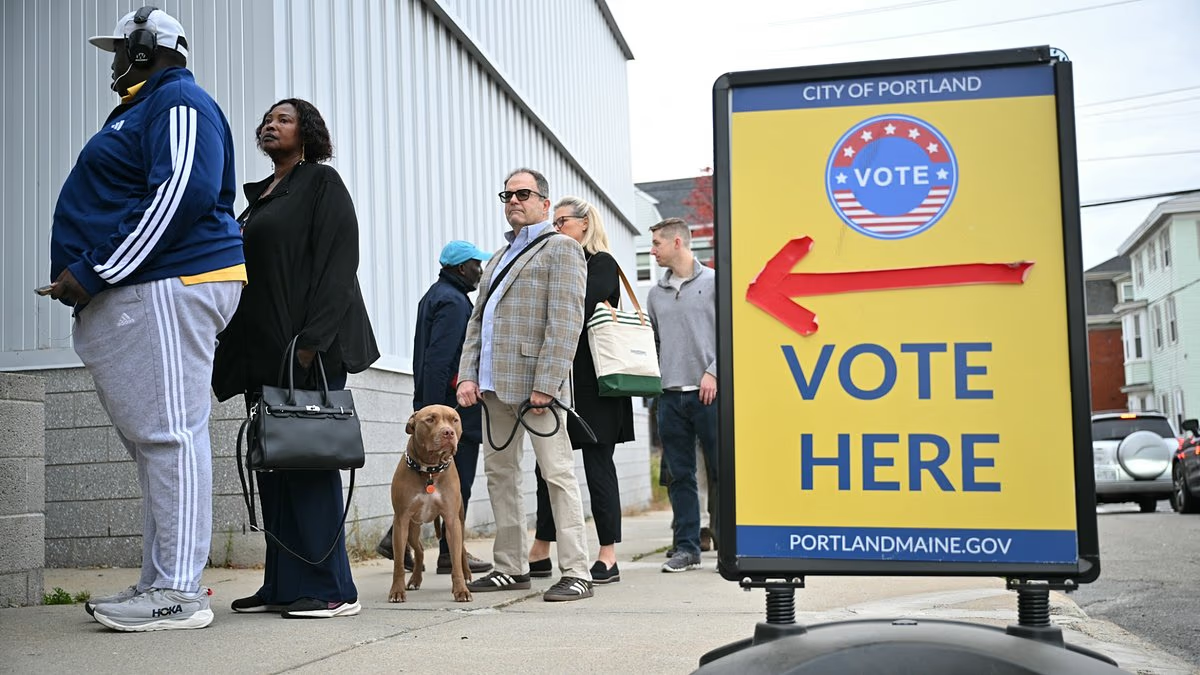
Voters line up outside a polling station on Election Day


Venture capital billionaires Marc Andreessen and Ben Horowitz, whose firm has contributed $76.2 million to political groups during this election cycle
Andreessen and Horowitz have established themselves as major supporters of artificial intelligence and cryptocurrency. Their political donations are intended to support candidates and organizations aligned with the priorities of both industries.
The stakes are especially significant for AI investors as lawmakers consider whether the fast-growing technology requires tougher oversight — and whether companies should navigate a patchwork of state laws or follow a single federal framework.
Elon Musk, the world’s richest man, is the largest individual political donor of the 2026 election cycle. He has directed more than $445 million to Republican-aligned political groups, according to OpenSecrets.
Much of Musk’s spending is aimed at helping Republicans retain control of Congress. That includes a $10 million contribution from his revocable trust to Lone Star Liberty PAC, which is supporting Republican Ken Paxton in his closely watched Texas Senate contest against Democrat James Talarico.
Musk’s total far exceeds the donations of other major political financiers, including casino billionaire Miriam Adelson. She has given about $67.6 million this cycle and has long used her fortune to back Republican candidates and pro-Israel political causes.
Cryptocurrency companies rank among the biggest corporate political spenders, contributing a remarkable $233 million during the 2026 election cycle.
A large share of that money has gone to Fairshake, a bipartisan super PAC supporting candidates who favor the cryptocurrency industry’s interests.
Its leading donors include Coinbase, which gave Fairshake $33 million, and Ripple Labs, which contributed another $48.5 million to the group and its affiliates.

Elon Musk is the biggest individual political donor of the 2026 election cycle, having directed more than $445 million to Republican-aligned groups


Musk gave $10 million to Lone Star Liberty PAC, which is backing Republican Ken Paxton in his closely watched Texas Senate race against Democrat James Talarico

Cryptocurrency companies, gambling operators and Silicon Valley technology firms have contributed a combined $391.3 million — more than half of all corporate donations disclosed to the Federal Election Commission
The crypto industry is seeking lawmakers who will promote clearer rules for digital assets and oppose regulations it believes could slow its expansion.
Not all cryptocurrency donations, however, have gone to bipartisan political organizations.
CHECK THIS OUT: Spencer Pratt Says Death Threats Forced $1,200-a-Night Hotel Stay
Crypto.com, through its Singapore-based parent company Foris Dax, gave $35 million to MAGA Inc., the super PAC supporting President Donald Trump, and a further $2.4 million to Keep America Great PAC.
Online betting companies have contributed a combined $85 million to political groups during the 2026 midterm cycle.
Sports betting giant DraftKings led the spending, giving $39 million to Win for America, a super PAC financed by major online sports betting and gaming companies.
Rival FanDuel has also contributed millions to the group, which is directing money to Republican- and Democrat-aligned committees involved in state-level elections.
The industry is spending heavily as it seeks to expand sports betting into additional states while fighting potential tax increases and tighter rules governing how Americans place wagers.
Because state lawmakers control much of the debate over whether online betting is legal and how operators are taxed, companies are increasingly targeting races that could shape the sector’s future.

DraftKings was the largest spender among sports betting companies, giving $39.2 million to the Win for America super PAC

Donald Trump appears at an event with his AI adviser David Sacks
The gambling sector is also facing growing competition from prediction-market platforms including Kalshi and Polymarket, intensifying the dispute over which companies can offer Americans election- and sports-related betting products.
Big Tech companies and firms involved in artificial intelligence and data center construction have contributed $73 million, with much of the spending focused on influencing regulation of the rapidly expanding industry.
For these businesses, the political outcome could affect everything from rules governing AI products to whether they can build the enormous data centers required to operate them.
Trump has become one of the industry’s most vocal supporters, repeatedly arguing that the United States must build more data centers to remain ahead of China in the global AI competition.
In August, he warned communities that opposed the facilities risked becoming “backwards and poor,” adding: “Let Data Reign.”
That stance has placed him at odds with some Republicans facing mounting pressure from residents concerned about the effect of data centers on household electricity bills and local resources.
In Texas, Trump criticized Governor Greg Abbott after Abbott paused new data center connections to the state’s power grid while officials assess pressure on electricity supplies. Republican Senate candidate Ken Paxton, meanwhile, has supported Abbott’s effort to address residents’ concerns.
The political consequences are especially important for AI companies such as Anthropic, which is testing the limits of its expansion plans as officials debate stricter oversight of the technology and the data centers needed to support it.

Trump met technology leaders outside the White House on September 29, including Anthropic co-founder Dario Amodei, whose company has reached major data center agreements in Texas and New York as officials consider tighter oversight

AI regulation is a central midterm battleground, with more than 41 local ballot measures on data center development going before voters today
The Los Angeles Times reported Tuesday that Anthropic has finalized major data center agreements in Texas and New York, leaving its expansion plans vulnerable to decisions by state officials.
Texas has ordered a pause on new data center connections to the grid while the state reviews their effect on electricity supplies. In New York, Governor Kathy Hochul has ordered a pause of up to one year for some large data center projects.
The conflict extends beyond state governments. At least 41 local ballot measures on data center development are going before voters today as communities across the country consider proposals that would restrict, block or enable new facilities.
Those votes could determine where AI companies are able to build and how quickly they can grow, making local opposition an increasingly important challenge for an industry that has spent heavily to gain political influence.
Public Citizen said its figures were drawn from federal campaign finance filings submitted through October 23. The analysis included contributions of at least $5,000 from for-profit corporations to super PACs and hybrid PACs.
The actual total may be higher, the group cautioned, because corporations can also route money through nonprofit organizations that are not required to identify their original donors.
The $737 million already accounts for more than 40 percent of the $1.8 billion corporations have spent on federal elections since the Supreme Court’s landmark 2010 Citizens United decision paved the way for unlimited independent corporate political spending.


