
Colin Farrell was once synonymous with wild nights, heavy partying and a battle with alcohol and drug addiction.
But the actor’s life took a decisive turn after his eldest son, James, now 23, was diagnosed with Angelman syndrome at the age of two.
Angelman syndrome is a rare genetic condition that primarily affects the nervous system and can lead to significant physical and intellectual disabilities.
Knowing James would probably need constant care and supervision throughout his life prompted Colin to confront his addiction and leave his former bad-boy reputation behind. He has credited his son with “saving his life” and described becoming a father as his greatest achievement.
“One of the things James taught me was to find within myself a desire to live, even if, at first, it was more about wanting to stay alive for him,” he said previously.
He continued: “You really do take nothing for granted. There’s a deep sense of fear — I’ve run through hospitals with James in my arms while he was having a seizure — but there’s also an even deeper sense of love and respect.”

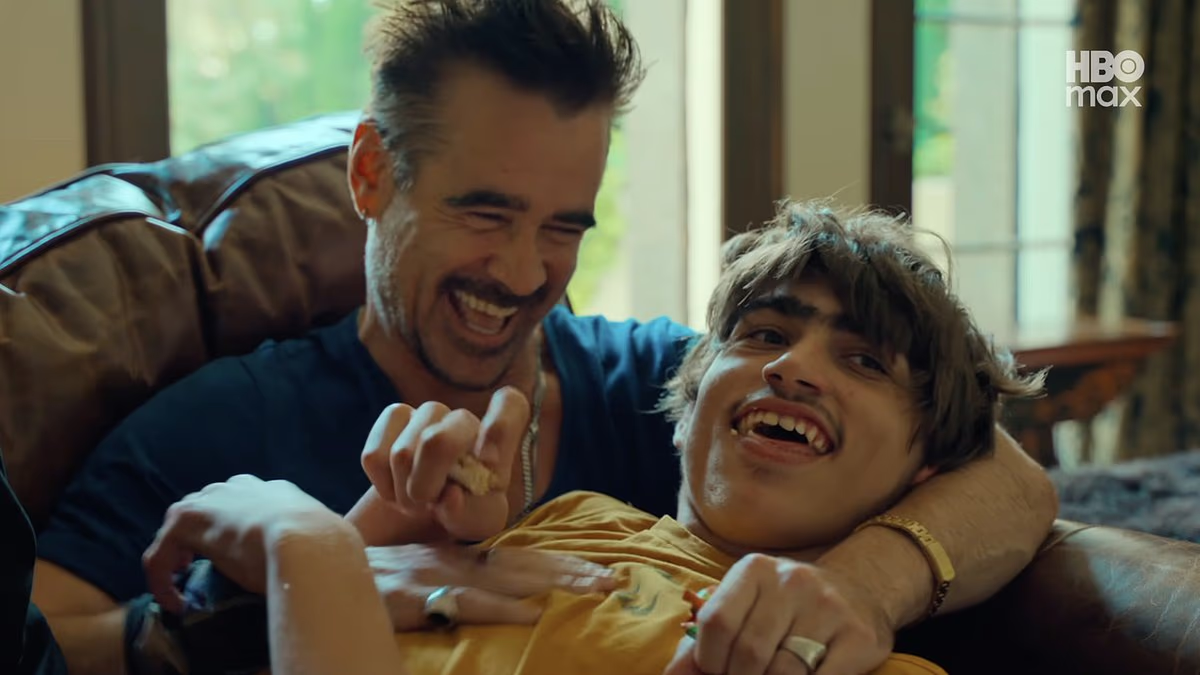
Behind Colin Farrell’s charming, happy-go-lucky Hollywood star persona is a homely family man who cares deeply for his disabled son James, 23, seen with Colin in the trailer for upcoming documentary The Slightest Touch

The actor turned his life around for the better when his eldest son James was diagnosed with a rare neurological disease called Angelman syndrome aged two
Colin, 50, is also father to 17-year-old Henry, whom he shares with his former partner Alicja Bachleda-Curús. James is his son with ex-girlfriend Kim Bordenave.
James was born in 2003, and in 2006, after completing work on Miami Vice, Colin entered rehab.
“James was a big, big part of me putting the bottle down,” he previously told People magazine.
“I was in no condition to be a friend, never mind the father of a child with such exacting needs. If it wasn’t for my sobriety, I wouldn’t be able to be there for James, enjoy the wonders of his life or support him in the way I feel I can.”
James recently appeared alongside his father in the trailer for the forthcoming documentary The Slightest Touch, a rare public appearance for the pair.
Colin has often spoken about how both James — who was initially diagnosed with cerebral palsy before doctors identified Angelman syndrome — and Henry have shaped the person he is today.
Speaking to Gabrielle Donnelly, he said: “Both my boys have taught me. I feel they’ve raised me more than I could ever raise them. That sounds twee, but it’s true.
“Whatever man I am today has a lot to do with my parents and my upbringing, sure, but it’s also very much connected to what my boys have asked of me.”
Describing James, who is non-verbal, Colin said: “James is incredibly strong, brave and determined.
“He works so hard to achieve physical abilities that most of us master by the time we are two or three. But he’s lovely. He’s funny as f***, cheeky as anything.
“He has a smile that would light up Manhattan. He has such a beautiful spirit and is so much fun to be around.”

After overcoming alcohol and drug problems and shedding his bad boy image, Colin calls fatherhood his greatest triumph, crediting his son for ‘saving his life’

Colin with his ex Kim Bordenave in February 2003. The pair dated from 2001 to 2003 and share James

When James turned 21, Colin and Kim agreed that it was time for him to live where he could be taken care of professionally
The actor first spoke publicly about James’s diagnosis at the 2007 Special Olympics in Shanghai, China.
“He has enriched my life,” Colin said. “But I don’t want to minimise the trials so many families face — the fear, uncertainty, frustration and pain.
“When you are raising a child with special needs, it is important to know that you are not alone.”
He also said he hoped the world would treat his son with kindness.
As James approached his 18th birthday, Colin and Kim applied for a conservatorship, explaining that he still needed assistance with everyday activities such as dressing and preparing meals.
Colin has since spoken about how he and James’s mother celebrate every achievement, no matter how long it takes to reach. Those milestones have included James saying his first words at six, learning to feed himself at 19 and gaining control over his seizures.
When James reached 21, Colin and Kim decided that he should move into a setting where professional carers could provide the support he needed.
Their distress over the shortage of suitable services helped inspire Colin to establish the Colin Farrell Foundation, which supports families affected by intellectual disabilities.
The actor launched the California-based foundation in 2024 in honour of his son. He hopes to expand its work throughout the United States and eventually into Ireland, his country of birth.
The organisation aims to assist adults with intellectual disabilities while supporting education, advocacy and resources for their families.
Colin leads the foundation with the support of CEO Paula Evans, who previously founded FAST — the Foundation for Angelman Syndrome Therapeutics.

Shortly before James turned 18, Colin and Kim filed to obtain a conservatorship of him, noting he still needed help with tasks like getting dressed and making meals (seen James and Kim)
Colin has explained that people with Angelman syndrome are sometimes misdiagnosed with cerebral palsy because the two conditions can present similar symptoms.
He told People: “[James] couldn’t sit up. He wasn’t crawling. I think he was about a year and a half when we took him for a thorough assessment, and he was diagnosed with cerebral palsy.”
Cerebral palsy refers to a group of conditions that affect movement and coordination because of damage to the developing brain before, during or shortly after birth.
The condition may also involve difficulties with speech, swallowing or vision, as well as learning disabilities.
“It was a common misdiagnosis because it shared many of the same characteristics,” Colin said. “And that was a downer for sure.”
The Oscar-nominated actor said a paediatric neurologist recommended testing for Angelman syndrome when James was around two and a half.
Remembering the diagnosis, Colin said: “I remember the first two questions I asked were, ‘What’s the life expectancy and how much pain is involved?’”
“And the doctor said, ‘Life expectancy, as far as we can tell, is the same for you and for me, and pain, no.’”
A doctor had become concerned after noticing a distinctive symptom associated with Angelman syndrome.
“One of the characteristics of Angelman syndrome is outbreaks of laughter. The doctor noticed that James was laughing a lot and making this movement,” Colin said, demonstrating the hand-waving gesture.
Seizures are another feature of Angelman syndrome, and Colin has described them as one of the greatest challenges faced by parents.
“Thankfully, James hasn’t had a breakthrough seizure in about 10 or 11 years, but I’ve been in the back of ambulances and in hospital with him,” he said.
“I’ve administered Diastat [a sedative] rectally to bring him out of a seizure that lasted longer than three minutes. Finding the right medication dosage without causing side effects is extremely difficult.”
James’s condition means he is non-verbal and needs a live-in caregiver to help him manage daily activities.
When James was four, Colin publicly discussed his Angelman syndrome diagnosis, praising his son for showing “amazing courage” while living with the condition.


