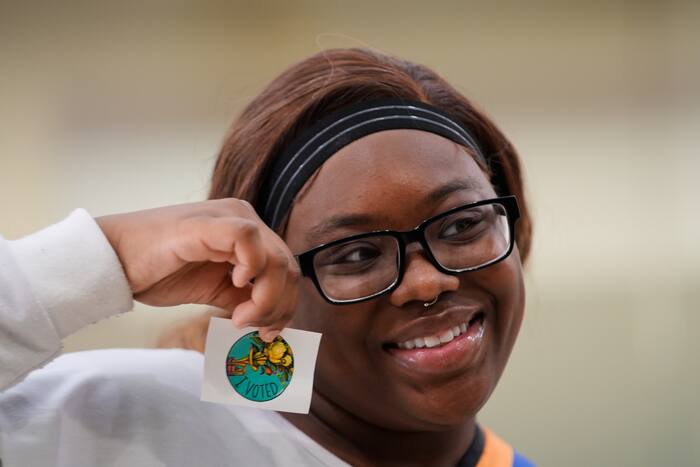


WASHINGTON – Democratic candidates regained substantial support among several important voting blocs in the 2026 midterm elections, according to The AP Voter Poll. The findings indicate that many of the gains President Donald Trump made with the traditional Democratic coalition in the 2024 presidential race had faded.
The wide-ranging survey of more than 100,000 voters across all 50 states found that younger Americans moved decisively back toward Democrats. Candidates from the party performed far better with voters under 30 than Vice President Kamala Harris did among the same group in the 2024 AP VoteCast survey.
Hispanic voters, who had shifted toward Trump in 2024, also moved in the Democratic direction this year. Black voters — especially Black men — followed a similar pattern. Moderates, many of whom said Congress was failing to provide sufficient checks on the presidency, supported Democrats nationally and helped fuel several key Senate victories.
Economic pressure was another factor. Most voters said inflation had caused at least a “moderate” hardship for themselves or their families during the past year. Among households earning less than $50,000 in 2025, voters shifted away from Republicans compared with 2024.
Here are five major demographic shifts identified by The AP Voter Poll in the 2026 election:
Young voters moved sharply toward Democrats
After giving Trump relatively strong support in 2024, voters under 30 swung back toward the Democratic Party in this year’s midterms.
About 7 in 10 voters under 30 nationwide said they supported the Democratic candidate in their local U.S. House contest, compared with roughly 3 in 10 who chose the Republican. That represented a major change from 2024, when the youngest voters were nearly evenly divided between Trump and Harris.
First-time midterm voters, who tend to be younger, also largely backed Democratic candidates.
Still, younger and first-time voters represented a relatively small portion of the electorate. Only about 1 in 10 voters nationwide was under 30, limiting the overall effect of the shift.
Their frustration with the nation’s direction and its leadership was unmistakable, however. About half of voters under 30 said they were “angry” about the state of the country, compared with roughly one-third of voters 65 and older. Around 6 in 10 young voters also said opposing Trump was one reason they voted in the House election. That compared with about half of voters ages 30 to 44 and roughly 4 in 10 voters 45 and older.
Young voters moved toward Democrats in every Senate race where the party gained a seat, including contests in Texas, Kansas, Iowa, Ohio and North Carolina.
Republicans gave back ground with Hispanic voters, especially in Texas
Republicans appeared to surrender most, if not all, of the support Trump gained among Hispanic voters in 2024.
About one-third of Hispanic voters said they backed the Republican candidate in their local House race, down from the roughly 4 in 10 who supported Trump two years earlier. Approximately 6 in 10 Hispanic voters nationwide chose the Democratic House candidate.
The change was especially apparent in Texas, where Democrat James Talarico defeated Republican Ken Paxton in the Senate race. The AP Voter Poll found that about 6 in 10 Hispanic voters supported Talarico, while roughly 3 in 10 backed Paxton. In 2024, Hispanic voters in the state had been much more evenly divided between Trump and Harris, according to AP VoteCast.
Florida showed a similar, though less dramatic, trend. Republican Sen. Ashley Moody narrowly won reelection, but fewer than half of Hispanic voters supported her, despite Trump winning the group decisively in 2024.
Trump’s Republican gains among Black voters appear to have faded
Black voters — and particularly Black men — were another group in which Trump’s 2024 gains failed to carry over into the midterms.
Nationally, only about 1 in 10 Black men supported the Republican candidate in their local House race, compared with roughly one-quarter who voted for Trump in the 2024 presidential election, according to AP VoteCast. About 9 in 10 Black voters backed the Democratic House candidate, up from approximately 8 in 10 who supported Harris.
The shift proved consequential in several major contests. In Georgia’s governor’s race, Keisha Lance Bottoms became the first Black woman elected governor, winning the support of about 9 in 10 Black men, according to The AP Voter Poll. Only about three-quarters of Black men had supported Harris in 2024.
Bottoms also received the backing of about 9 in 10 Black women, roughly matching Harris’ share from the previous presidential election.
Republican Byron Donalds, who became Florida’s first Black governor, performed less strongly among Black voters. About one-quarter of Black men in the state voted for Donalds over Democrat David Jolly, while only about 1 in 10 Black women supported him.
Democrats gained among moderate voters
Moderate voters also moved toward Democrats, a development that mattered in several Senate races where Democratic candidates captured Republican-held seats.
Roughly two-thirds of moderates supported the Democratic candidate in their local House race. That was higher than the approximately 6 in 10 moderate voters who backed Harris in 2024.
About 8 in 10 moderates said Congress was not doing enough to act as a check on the presidency. A similarly large share reported experiencing at least a “moderate” financial hardship because of inflation during the past year.
Moderate support was a notable feature of several Democratic Senate victories. In Kansas, Democrat Adam Hamilton won about 7 in 10 moderate voters, up substantially from the roughly half who supported Harris in 2024.
Iowa followed the same pattern: Democrat Josh Turek won about two-thirds of moderates, compared with approximately half for Harris the year before.
In North Carolina, Democrat Roy Cooper attracted about three-quarters of moderate voters, improving on the narrower majority that had supported Harris.
Voters with lower incomes turned toward Democrats as costs remained a concern
With economic concerns shaping many decisions at the polls, The AP Voter Poll found that lower-income voters also moved toward Democrats.
More than half of voters whose household income was below $50,000 in 2025 supported the Democratic candidate in their local House race. In 2024, this group was roughly divided between Trump and Harris. About 3 in 10 voters nationwide reported annual family incomes below $50,000.
The survey indicated that lower-income voters were more likely than higher-income voters to cite the price of groceries, gasoline and utilities as concerns. Roughly 6 in 10 voters earning under $50,000 said the cost of living was “crucial” to their decision, compared with about half of those earning $50,000 or more.
___
The AP Voter Poll surveyed more than 100,000 voters in a study conducted by SSRS for The Associated Press, ABC News, CBS News, CNN, FOX News Media, NBC News and Versant. The survey combined probability-based and nonprobability-based interviews with registered voters in all 50 states. Interviews took place from Oct. 19 through Nov. 3 in Alaska and from Oct. 22 through Nov. 3 in the other states. A detailed methodology statement is available here. The margin of sampling error for the full sample is plus or minus 0.6 percentage points.


