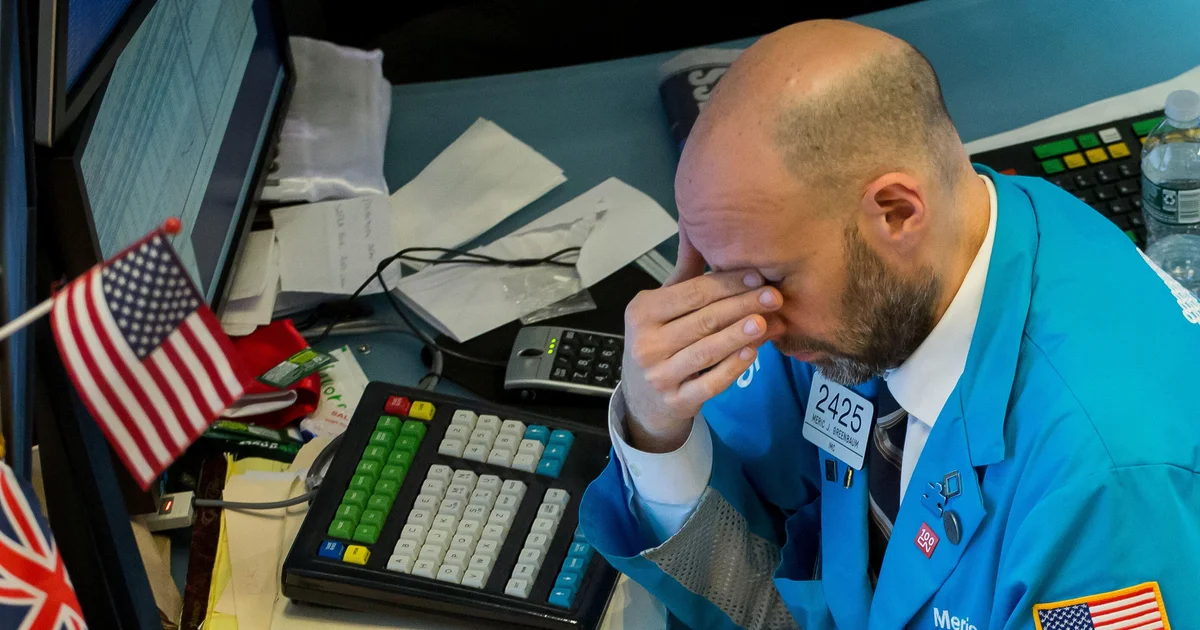

U.S. stocks plunged Thursday as investors weighed concerns that a shift in congressional control after the U.S. midterm elections could slow the data-center construction needed to support artificial intelligence services.
The sell-off spread across the market, with technology companies tied to the AI industry suffering some of the steepest losses. The tech-heavy Nasdaq Composite dropped 1,285 points, or 5%, in early-afternoon trading. The decline underscored what Wall Street analyst Adam Crisafulli of Vital Knowledge described as rising “headline” risks surrounding AI.
The broader S&P 500 fell 300 points, or 3.9%, while the blue-chip Dow Jones Industrial Average slid 1,586 points, nearly 3%. U.S. equities were on track for their worst session since the “Liberation Day” shock in April 2025, when President Trump announced tariffs on countries around the world, according to Joe Maher, a markets economist at investment research firm Capital Economics.
The dramatic reversal came one day after the Dow posted its biggest gain of the year. Other major indexes also rallied Wednesday as the election results temporarily reduced uncertainty over which party would control Washington.
“Although the market rallied Wednesday following the midterm elections, cracks were already visible in the AI ecosystem,” Chris Larkin, managing director of trading and investing for E*TRADE from Morgan Stanley, said in an email. “Those cracks widened Thursday as investors considered the possibility of a slower data-center buildout under Democratic control of Congress.”
Investors believe the Democrats’ sweeping victories this week could strengthen opposition to new data centers and slow the rollout of the facilities, which have faced growing resistance from communities nationwide.
A slowdown in data-center construction would pose a significant threat to AI companies. The industry is investing billions of dollars in new infrastructure while relying on broad adoption of the technology to justify those costs.
Pricking the bubble?
Investors are increasingly concerned that the massive spending spree tied to AI has inflated a stock market bubble, with soaring valuations becoming disconnected from companies’ underlying financial performance.
“Whether the midterm shock ultimately becomes the catalyst that derails the AI equity boom remains unclear, but it reinforces our view that the boom may be entering its final innings,” Maher said.
Semiconductor makers and other companies with significant AI exposure were among the hardest hit. Nvidia shares dropped 7.5%, making the company the largest drag on the S&P 500 after falling 3.2% a day earlier. Advanced Micro Devices plunged 14.6%, while CoreWeave, which provides customers with cloud-based access to AI chips, slid 12.1%.
Elsewhere in financial markets, the initial market reaction to the election results moderated. Brent crude rose 2.6% to $97.11 a barrel, recovering much of its nearly 9% decline the previous day. Uncertainty remains over the course of the war with Iran and when the global energy industry will be able to return to normal operations.