

MONTGOMERY, Ala. – Sheyann Webb-Christburg was 8 years old when she joined the civil rights marchers attacked on Bloody Sunday in Selma, Alabama, months before President Lyndon Johnson signed the Voting Rights Act.
On Tuesday night, she stood in Montgomery to celebrate a decisive political victory for Black voters and others who refused to accept the recent weakening of the landmark law by the U.S. Supreme Court and several Southern state legislatures.
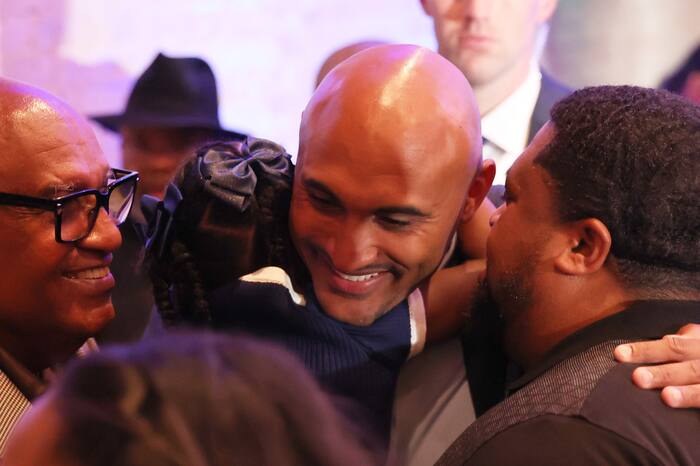
“I think a new movement has started,” she said after U.S. Rep. Shomari Figures won another term in Congress, overcoming Alabama Republican lawmakers’ efforts to redraw his district and make his reelection more difficult.
Strong Black voter turnout helped carry Figures, 41, past his Republican opponent in a newly drawn district that President Donald Trump won by double digits just two years earlier. His victory was one of several wins for Black Democrats across the South, including in Georgia’s governor’s race, while other candidates came close in states such as Florida, where Republicans have long dominated.
Party leaders and activists described the results as a rebuke of Trump and of the Supreme Court’s decision this year that weakened the Voting Rights Act and permitted Republican-led states to redraw congressional maps in ways that reduced Black representation.
LaTosha Brown, co-founder of Black Voters Matter, said Black voters were also motivated by the Republican president’s second-term campaign against diversity initiatives and his efforts to restrict how the federal government presents the nation’s history of race and civil rights.
“We can smell racism. We can see it … we can feel it, and we know how to respond to it,” Brown said. “Our survival has been based on our ability to resist it and respond and navigate around it.”
Black voter enthusiasm puts GOP-leaning states in play
That surge helped Georgia’s Keisha Lance Bottoms become the first Black woman elected governor in U.S. history. Black women also won statewide races for attorney general, secretary of state, agriculture commissioner, insurance commissioner, labor commissioner and school superintendent.
In North Carolina, U.S. Rep. Don Davis, a Black Democrat, secured reelection in a district Republicans had redrawn to favor their party.
In Mississippi, where Black voters account for a larger share of the population than in any other state, Scott Colom was locked in a razor-thin contest with Republican Sen. Cindy Hyde-Smith. The state has not sent a new Democratic senator to Washington since the era of Jim Crow segregation.
“Unlike all the people across the country that might be surprised, our campaign, our volunteers, the people of Mississippi are not surprised,” Colom said Wednesday.
Both polling and Election Day results pointed to increased Black turnout and stronger support compared with recent election cycles.
In Georgia, roughly nine in 10 Black men voted for Bottoms, according to The AP Voter Poll. That compares with about three-quarters who supported then-Vice President Kamala Harris in her 2024 presidential loss to Trump. In Clayton County, in metro Atlanta, where about two-thirds of residents are Black, Bottoms received nearly 86,000 votes — approximately 13,600 more than Democrat Stacey Abrams, who is also Black, won in her 2022 gubernatorial campaign.
The shift among Black men was large enough to lift Black voters’ overall support for Democrats. About nine in 10 Black voters backed the Democratic candidate in their local U.S. House race this year, compared with roughly eight in 10 who supported Harris in 2024.
Black women’s support was more consistent, in part because they were among the few groups that did not move significantly toward Trump in 2024.
Results should serve as a ‘wake-up call’ for Democratic leaders
After slavery ended, Black Americans won seats in Congress and other elected offices during Reconstruction. But disenfranchisement, violence and discriminatory laws sharply eroded that representation. Now, more than 160 years after Reconstruction and 61 years after the Voting Rights Act, Black Americans are holding more statewide offices in which they represent voters from diverse backgrounds.
The Supreme Court’s weakening of the Voting Rights Act this year prompted Congressional Black Caucus leaders to warn that they could lose as many as 19 seats, or about one-third of their roster. With ballots still being counted, however, the caucus’s potential nationwide losses appeared likely to fall well short of that estimate.
Harris, the first Black woman to hold nationwide office, said the results should deliver “a huge wake-up call” to the Democratic Party.
“I’ve long believed that we have failed to put the resources into Southern states” because of a “misdirected perception of who the people in those states are and what they want,” Harris told The Associated Press on Wednesday.
Abrams, who twice lost campaigns for Georgia governor, said the wins and losses reinforced her long-standing argument that Democrats need to invest in organizations across the South and Sun Belt.
“You weren’t talking about massive margins,” she said of Democratic losses in Louisiana, Florida and Tennessee. “When we underinvest, especially states with significant populations of color, we throttle our own ability to expand the map.”
Some Black candidates came close to upsets
The celebrations, however, did not reach every campaign.
Tennessee Republicans divided a congressional district centered on Memphis, a majority-Black city, into three districts. Democratic state Rep. Justin Pearson ran in one of them and conceded a close contest that The Associated Press had not called.
“We knew from the beginning the race would be extremely close,” said Amber Sherman, Tennessee’s lead organizer for Black Voters Matter, which helped organize Pearson’s campaign.
She said increased turnout across the South showed that Black voters believed the “redistricting was wrong, and it was racist.”
In Florida, Democratic Senate nominee Angie Nixon, a progressive who identifies as a democratic socialist, had largely been dismissed by national party leaders as having little chance in a state where Republicans won by nearly 20 percentage points four years earlier. Nixon ultimately lost by fewer than 3 percentage points.
In Louisiana, Trump-endorsed three-term congresswoman Julia Letlow narrowly won the U.S. Senate race against Democrat Jamie Davis, a Black farmer who began his campaign with virtually no statewide political profile. Trump carried the state by 22 percentage points in 2024, yet Letlow’s margin Tuesday was fewer than 2 points.
Louisiana Democratic Party Chair Randal Gaines said he had sought financial support from the national party. Davis raised more than $4 million in individual contributions, but his campaign said it received no money from the Democratic National Committee or the Democratic Senatorial Campaign Committee.
“We were within striking range of victory, and additional funding would have guaranteed it,” Gaines told the AP.
In Alabama, Figures knew the race would be difficult
Republicans cut the voting-age Black population in Figures’ district from 48% to 40%. Still, he did not shy away from the campaign or dwell on the redistricting. Instead, he emphasized voters’ economic hardships and their broader frustration with Trump.
“People are just tired, man. They’re tired of the lack of decency. They’re tired of the lack of integrity. They’re tired of the lack of honesty,” he said.
Figures’ victory was fueled by heavy turnout in Montgomery, a predominantly Black city and Democratic stronghold. At some polling places, lines stretched for blocks for much of Election Day.
Bottoms did not face a redistricting challenge in her statewide campaign and also focused on the economy and helping voters across demographic groups. Yet she embraced the significance of the moment, recalling that her family lineage led to an antebellum plantation in Crawfordville, Georgia — the town that produced the Confederacy’s vice president.
“Tonight should remind us all that no matter what community we come from, Georgia is not defined by one moment in time or by one person,” she said. “It’s been defined by all of us, and I will be a governor for everyone in this state.”
___
Barrow reported from Washington and Brumback from Atlanta. Associated Press writers Jack Brook in New Orleans, Gary Fields and Linley Sanders in Washington, and Corey Williams in Detroit contributed to this report.