

NEW YORK – When Chloe Frabotta began training in New York City to become a physician assistant, new federal student loan restrictions added another layer of stress to an already demanding program.
The rules taking effect this fall capped borrowing for certain academic programs and limited how much parents could take out to finance their children’s education. Until only weeks before Frabotta, 25, started classes, it remained unclear whether her program would qualify as a “professional” degree, which would make students eligible for higher federal loan limits.
With the rules still unsettled, she borrowed about $6,000 in federal loans for her first trimester and covered the remaining costs with private loans co-signed by her mother.
“At least in my circles, a lot of people were like, ‘I guess that’s what I’m going to have to do, and I’m going to try to make it work,’” Frabotta said.
Across the country, students are increasingly turning to private lenders to bridge the gap between tuition and the amount available through federal programs. Federal loans generally offer more flexible repayment options, potential forgiveness after 10 years of public service and, for many borrowers, lower interest rates.
The shift is already appearing in lenders’ financial results. SoFi said in late October that student loan originations reached $2.9 billion in the third quarter, nearly twice the figure from a year earlier. Days before that, Sallie Mae, which holds more than half of the private student loan market, reported that graduate lending had climbed 119% year over year.
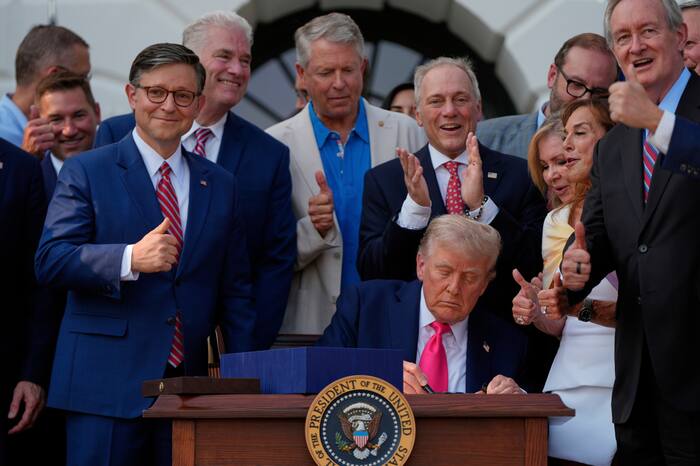
Trump’s ‘Big Beautiful Bill’ put new caps on student loans
President Donald Trump’s “Big Beautiful Bill” reduced the amount that new graduate students can borrow. Programs classified as professional degrees now face a federal loan ceiling of $200,000, while other graduate programs are capped at $100,000. Previously, graduate students could borrow federal loans up to the full cost of their degree.
For new borrowers, the changes also establish a lifetime federal borrowing limit of $257,500 and restrict how much parents can borrow to help pay for their children’s education.
Once the changes are fully implemented, more than 500,000 borrowers will need to find an additional $20,000 a year outside the federal loan system, estimated Jordan Matsudaira, director of the Postsecondary Education & Economics Research Center at American University. Students in costly fields such as medicine, law and dentistry, along with those living in expensive states, are expected to face the greatest impact, according to an analysis by the center.
The Trump administration says the new limits will curb “excessive borrowing” and push colleges to reassess their prices. Officials have described unlimited federal lending as one factor behind the rising cost of higher education. Since the caps took effect, at least 40 schools have reduced prices for some programs, according to the conservative American Enterprise Institute.
Critics counter that most colleges lack the financial flexibility to cut tuition. They also warn that tighter borrowing rules could create additional barriers, particularly for students from low-income families.
Colleges are stepping in to help
At South Carolina Student Loan, borrowing by graduate students has risen 400% this year as the organization introduced additional financing options. Some institutions are also becoming lenders themselves. The University of Kansas School of Law has approved eight loans so far, with more applications under review.
Steven Freedman, associate dean of admissions at the University of Kansas School of Law, said the loans are crucial to preserving access to legal education.
“Now, frankly, private banks get to choose who goes to law school,” he said.
At Lewis & Clark College, a private liberal arts institution in Portland, Oregon, the financial aid office has seen an increase in private borrowing. The school’s graduate program in education and counseling also launched a new need-based scholarship this fall in response to the loan restrictions.
Anastacia Dillon, the college’s associate vice president for financial aid, called the changes “really disruptive.”
At the University of Mount Saint Vincent in the Bronx, more first-year students are using private loans even as the school increases aid for those with financial need.
Private student lending expanded rapidly during the 1990s and early 2000s, when federal loan limits were in place. The market contracted after the federal Graduate PLUS program allowed students to borrow up to the full cost of attendance. Critics, however, say Graduate PLUS created other problems by enabling students to take on debt they could not afford to repay, contributing to high default rates.
Some organizations warned that the new caps could leave large numbers of borrowers unable to secure financing from traditional lenders. Yet students overall appear to be finding ways to pay for school, even as more turn to private loans, said Marc Schoonover, general manager of lender ELFI.
“What we’re hearing and seeing now is that the number of students who truly can’t find an option is a lot smaller than many initially feared,” Schoonover said during a media call organized by the National Council of Higher Education Resources.
Students struggle to understand changes
A legal dispute over which graduate programs would qualify as professional degrees — and thus receive higher borrowing limits — continued until just days before the new rules took effect. In the end, students pursuing graduate degrees in nursing, physical therapy and several other fields were allowed to qualify for higher federal loan amounts, at least temporarily, after a federal judge blocked part of a Trump administration rule that would have subjected them to lower limits.
The last-minute decision delayed software updates needed to process loans, said Kristina Ortiz Donohue, vice president for strategic enrollment and retention at the University of Mount Saint Vincent.
The uncertainty also delayed financial aid offers at colleges, Sallie Mae CEO Jon Witter said during an earnings call with investors. He said the peak borrowing season consequently stretched into October.
Dr. Robert Harrington, dean of Weill Cornell Medicine and Cornell University’s provost for medical affairs, said the school fielded dozens of calls from students and families seeking clarification.
Frabotta’s physician assistant program was ultimately classified as professional, making her eligible for up to $50,000 a year in federal loans. Still, worried that additional changes could follow, she chose to borrow only a portion of that amount through the federal program.
Before returning to school, Frabotta earned a bachelor’s degree from Boston College and worked as a medical assistant at a dermatology practice.
“This is what I want to do, so if this is the means of how I get there, then if I have to sacrifice at some point,” she said.
Madison Jessen, another first-year physician assistant student at Weill Cornell Medicine, said the uncertainty over the caps led her to spend most of her savings on her first semester. She said several younger friends who had planned to attend PA school changed course after the new limits took effect.
That is Harrington’s greatest concern.
“What we don’t want to see,” said Harrington, who was himself a first-generation college graduate, “is our programs just becoming the purview of people whose family can afford to pay that bill.”
____
The Associated Press’ education coverage receives financial support from multiple private foundations. AP is solely responsible for all content. Find AP’s standards for working with philanthropies, a list of supporters and funded coverage areas at AP.org.
——
Hollingsworth reported from Mission, Kansas.


