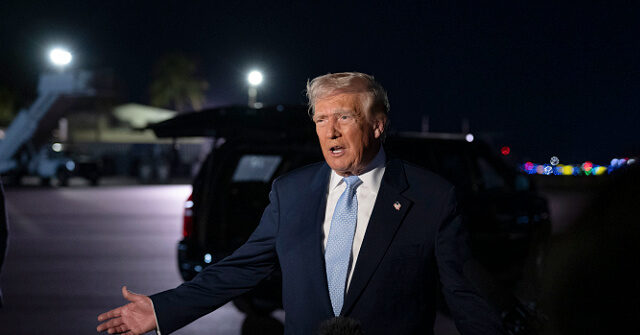

President Donald Trump said Thursday that he would soon determine whether to authorize another wave of major strikes against Iran, after senior White House officials held discussions on the next stage of the conflict.
Speaking from the Oval Office, Trump suggested the United States could carry out additional attacks to prevent Iran from restoring its nuclear weapons program. At the same time, his administration is considering whether a diplomatic agreement with Tehran could bring the confrontation to an end.
“Now we will make a decision,” Trump said, describing the choice before him as a question of whether further U.S. strikes were necessary to ensure Iran could not rebuild its nuclear capabilities.
Although he said he would prefer to avoid additional destruction, Trump made clear that he was willing to act. “I would rather not destroy the rest of the country if possible, but maybe I’ll have to,” he said. “You’ll know soon enough.”
He also pointed to expanded U.S. weapons production and the military’s preparedness for another operation. “If we have to do the rest of the Iran thing, we’re very much locked and loaded,” Trump said.
Trump spoke after meeting Thursday with his leading national security advisers in their first session on Iran since Tuesday’s midterm elections, Axios reported, citing two U.S. officials. Senior administration officials told Fox News that the White House also held meetings Wednesday and Thursday focused on the possibility of restarting military operations.
The administration is weighing several paths: launching a renewed and extensive military campaign, tightening economic pressure through sanctions and a naval blockade, or pursuing a negotiated agreement with Tehran. Before the elections, Trump had ruled out another major round of strikes.
The deliberations began only two days after Republicans recorded significant midterm defeats. Trump acknowledged that higher gasoline prices linked to the conflict with Iran had contributed to the losses, but he strongly defended the U.S.-Israeli operation, arguing that stopping Iran from obtaining nuclear weapons was worth the political consequences. He said he would approve the campaign again.
Vice President JD Vance has taken a different position, becoming one of the administration’s most prominent supporters of diplomacy over renewed attacks. In an extensive statement Wednesday, Vance attributed the Republican setback directly to the Iran conflict, saying voters who backed Trump in 2024 had turned away from the party because of the operation.
Diplomatic activity has accelerated as Washington considers its next military move. Qatar is leading efforts to broker an arrangement that could reopen the Strait of Hormuz and restart talks on Iran’s nuclear program. Iranian Foreign Minister Abbas Araghchi spoke Thursday with mediators from Qatar, Saudi Arabia, Turkey, the United Arab Emirates, Oman and Egypt.
The New York Times reported Thursday that Iran was examining specific proposals delivered through intermediaries after resisting negotiations for weeks. The report, citing five officials briefed on the discussions, said the contacts have involved two rounds of talks in Tehran, a third meeting in Doha and further conversations with Iranian officials in Armenia.
Tehran’s reported willingness to consider the proposals comes despite its insistence that Washington first satisfy seven demands. Those conditions include lifting sanctions, unfreezing Iranian assets, compensating Iran for wartime damage and ending the U.S. naval blockade. Washington has rejected several of the demands and continued to insist that Iran’s nuclear program must be permanently dismantled.
YOU MAY ALSO READ: Trump’s 250-Foot Triumphal Arch Clears Key Federal Panel
Even amid the dispute, Iran transmitted a nuclear proposal to the United States through Qatar on Thursday, Reuters reported, citing a senior Iranian official. The official said additional talks would depend on Washington agreeing to Tehran’s conditions, including sanctions relief and the termination of the blockade.
Mohsen Rezaei, secretary of Iran’s Supreme National Security Council and an influential participant in indirect talks with Washington, repeated Tehran’s uncompromising position Thursday after meeting Russian President Vladimir Putin in Moscow. Rezaei said Iran would not lift its restrictions on shipping through the Strait of Hormuz or return to negotiations until all seven conditions were met.
Behind closed doors, however, Rezaei has reportedly shown more openness to discussing Iran’s nuclear program than his public comments indicate. The Times, citing two Iranian officials and one American official, said those conversations also included Foreign Minister Abbas Araghchi and Parliament Speaker Mohammad Bagher Ghalibaf.
One of the most difficult issues is Iran’s supply of highly enriched uranium, which Trump has demanded be surrendered under any nuclear agreement. Iranian officials have rejected sending the material abroad, though earlier negotiations considered diluting it inside Iran while international inspectors monitored the process.
Qatari mediators are continuing to search for a compromise. Axios described a two-day framework under which Washington would first suspend its naval blockade and release some frozen Iranian funds. In return, Tehran would formally invite International Atomic Energy Agency inspectors to assess nuclear sites damaged during the conflict.
The framework would require the Strait of Hormuz to reopen on the second day, allowing broader negotiations over Iran’s enriched uranium stockpile to resume. Neither the United States nor Iran has said it will accept the proposal.
When asked Thursday about reports that Iranian negotiators were reviewing a new nuclear proposal, Trump said Tehran could not advance its nuclear program without U.S. consent.
“They’re not doing anything without our approval,” he said. “It doesn’t make a difference what they’re looking at. They’re not going to have a nuclear weapon.”
Trump further claimed that U.S. forces controlled “everything that we’ve wanted to control” in Iran, describing the American military position as “virtually an occupation.” He estimated that rebuilding the country after the conflict’s destruction could take 25 years.
Military preparations have continued even as negotiators pursue a diplomatic path. U.S. Central Command is completing plans for a possible return to large-scale combat, though a U.S. official cited in the report said the command had not received a new order from the White House.
The USS Theodore Roosevelt carrier strike group is also heading toward the Middle East, joining two other U.S. carrier groups already in the region. Its deployment could point to preparations for renewed attacks. The Roosevelt is scheduled to stop in Singapore Friday and is not expected to enter Central Command’s area of responsibility before mid-November.


