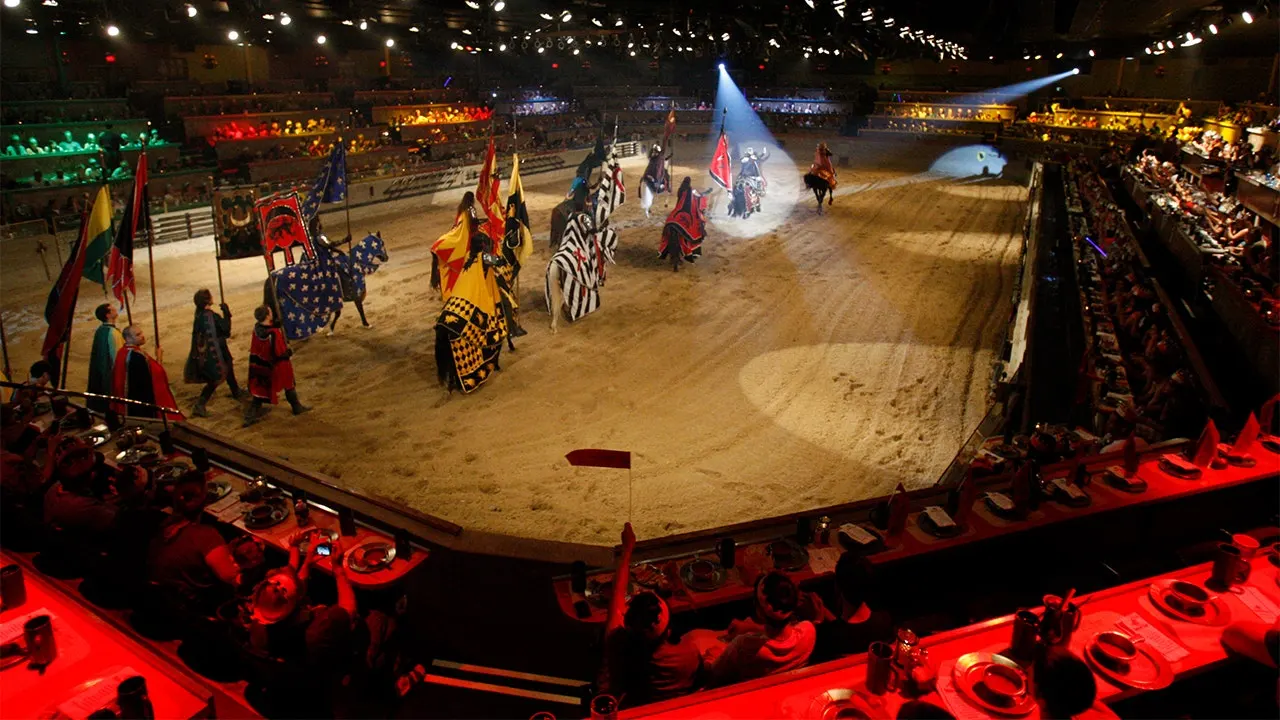

For 43 years, performers at Medieval Times Dinner & Tournament venues across North America have entertained audiences as jousting knights and elaborately dressed ladies on horseback.
Now, however, the company is facing legal challenges from former employees who accuse it of concealing a culture marked by alleged animal cruelty, sexual harassment, discrimination, bullying and retaliation against workers who reported misconduct.
During each performance, guests are served a meal inspired by medieval fare while cheering for armored knights as they compete on horseback and clash with swords.
Medieval Times opened its first venue in Kissimmee, Florida, near Orlando, in 1983. The company now employs more than 2,000 people at 10 “castles” across the United States and Canada.

William Elliot III, 35, an assistant head knight and former Las Vegas magician, makes his grand entrance as the red knight alongside fellow performers during a Medieval Times show in Buena Park on Friday, June 28, 2013. (Allen J. Schaben/Los Angeles Times via Getty Images)
The production celebrates the “chivalry” of its knights. Yet some former employees who worked alongside the performers say women in the cast faced a workplace culture tilted against them.
A former castle “queen” is suing the company, claiming the workplace was “rooted in gender discrimination and sexual harassment.”
Another former employee says she was fired after raising concerns about the treatment of the company’s horses.
Royal rivalry
A former cast member at the Buena Park, California, castle filed a civil lawsuit in June alleging a hostile workplace and widespread sexual harassment.
Kaitlyn Farrell joined Medieval Times as a “queen” five years before resigning in February 2024. She cited “intolerable” working conditions in a complaint filed in Orange County Superior Court.
Farrell described what she called a “two-tiered workplace culture” in which female cast members were treated as “a lesser class of employee.”
According to the lawsuit, unwanted advances toward women were “normalized,” while complaints of “gender-based misconduct” were met with “indifference” and routinely dismissed.
Farrell said she was asked to serve as a witness during a workplace harassment investigation involving another employee.
Her lawsuit claims that, afterward, she became the “target of open retaliation by the very employee she reported on.”
She alleges that management witnessed the conduct but failed to intervene.
In a separate incident, Farrell says a manager directed someone to “remove stitching” from her costumes. She characterized the action as “calculated sabotage” intended to cause wardrobe malfunctions during live performances.
After workers at the Buena Park venue unionized and Farrell took part in a February 2023 strike, she says she became the “primary target of an extreme, sexualized cyberbullying and doxxing campaign.”

Brandon Sanchez, who portrays a knight, protests outside Medieval Times in Buena Park, California, on Wednesday, March 8, 2023. Performers picketed the castle after beginning an unfair labor practice strike against management. (Jeff Gritchen/MediaNews Group/Orange County Register via Getty Images)
The lawsuit alleges that anonymous social media accounts showing “obvious indications” of involvement by employees or managers posted details about Farrell’s dating history, sexually derogatory captions and doctored images placing her face on the bodies of semi-nude cartoon characters in simulated sexual positions.
Farrell further alleges that the harassment turned into stalking when Medieval Times employees traveled to her second job at another theme park and attempted to intimidate her while she was working in front of guests.
After she filed formal complaints, an attorney representing Medieval Times sent a letter characterizing the cyberbullying and stalking allegations as “weird allegations,” according to the lawsuit.
“We look forward to proving these allegations in court,” Farrell’s attorney, Charles Ludd Jr., told News Outlet.
‘False claims’
Medieval Times did not respond to a request for comment regarding the lawsuit. Former employee Bill Elliot, however, described Farrell’s allegations as “false claims.”
Elliot worked as a knight at the same Medieval Times location before leaving in 2015 after 12 1/2 years. He told News Outlet by text that he had no complaints about the company.
“The company took care of us,” he said. “We had decent pay; full-time hours with overtime … full medical, dental and vision insurance; and 401K.”

William Elliot III, 35, an assistant head knight and former Las Vegas magician, prepares to toss a flower to an audience member while performing as the red knight at Medieval Times in Buena Park on Friday, June 28, 2013. (Allen J. Schaben/Los Angeles Times via Getty Images)
Elliot said he believes some people bringing claims against the company belong to “the-rich-need-to-pay-their-fair-share group” and are seeking a financial payout.
“They have no responsibility in running a company that employs thousands of people and no risk in doing it, but believe they deserve more of the profit,” he said.
“If it was such a toxic environment and company, they could have immediately removed themselves, but didn’t,” he added.
KEEP READING: Bomb Threats Hit More Planes Across Europe, Prompting Alerts
Elliot also said female cast members frequently sought attention from the knights and did whatever they could to receive it.
“Now, because those females didn’t get their way or what they wanted, they started making false claims and screaming ‘toxic masculinity’ or any other buzzwords to get attention.”
Animal-cruelty allegations
Farrell’s case is not the first lawsuit to raise allegations about conditions at the dinner theater company.
In a 2019 lawsuit, Bethany Regan described joining the Buena Park castle in 2013. Court documents say she was treated “less favorably” than male cast members during her employment.
Regan said she became increasingly troubled by the welfare of the horses used in performances and reported her concerns to management.
The lawsuit alleges that the head trainer had a “volatile temper” and unnecessarily whipped horses, leaving them with “large welts” across their bodies.
Regan also claimed that some horses were trained until they bled from their mouths and other parts of their bodies. According to her complaint, the animals were overworked and at times denied rest until they became dehydrated.
She alleged that one horse died as a result.
Regan said she had been warned that the head trainer was a close friend of the company’s owner and that reporting him could lead to “retaliation.” She raised the concerns despite that warning.
She also reported what she described as dangerous and unsafe working conditions for female performers.
After filing formal complaints, Regan alleges the company suspended her for “starting rumors” before eventually terminating her employment.
The case was settled in 2020, but the terms of the agreement were not disclosed.
Regan’s attorney did not respond to News Outlet’s request for comment.
Horses in the spotlight
Yvonne Barteau spent six years as principal trainer and director of entertainment operations at Arabian Nights Dinner Attraction, a horse-themed theater located minutes from a Medieval Times castle in Florida. The attraction operated from 1988 to 2014.
Barteau now operates Horses without Humans, a Florida horse rescue she founded after producing a documentary about theater horses in the United States.
Over the years, she worked with many Medieval Times performers as they moved among dinner theater jobs in the Orlando area, she told News Outlet.
Barteau said young performers sometimes became “way too into their role, like they’re really medieval warriors.” In her view, “they got too into the identity.”

Yvonne Barteau performs with her gray stallion, Papi, at Spirit of the Horse. (Courtesy of Cheri Prill/Stunning Steeds Photography)
That attitude, she said, sometimes led men to treat women in a “callous” manner—behavior that was not challenged as firmly as it should have been.
Dinner theater jobs “seemed to attract people like that. And then sometimes the upper management didn’t shut it down like they should have,” she said.
Barteau said she encountered “good people” during her time working with Medieval Times performers, as well as others who did not conduct themselves as well.
Regardless of the circumstances, she said, there is no justification for mistreating a horse.
“Anybody that works with horses, or works with something that has no voice of its own—children, horses, any animal—you have to be the voice,” she said.
At the same time, Barteau said some people unfamiliar with horses now assume that any performance involving an animal is inherently cruel.
She said that conclusion is simply wrong.
“They haven’t seen how some horses really do light up, and they do love to be out there performing,” she said. “They love the attention.”
Barteau has performed for years with a stallion named Papi.
“He’s an absolute theater horse—he’s a Brad Pitt.
“People see that horse, and they remember him, and it makes them love horses. And why wouldn’t we want that, you know, as horse lovers? Why would we want somebody else to fall in love with horses?”