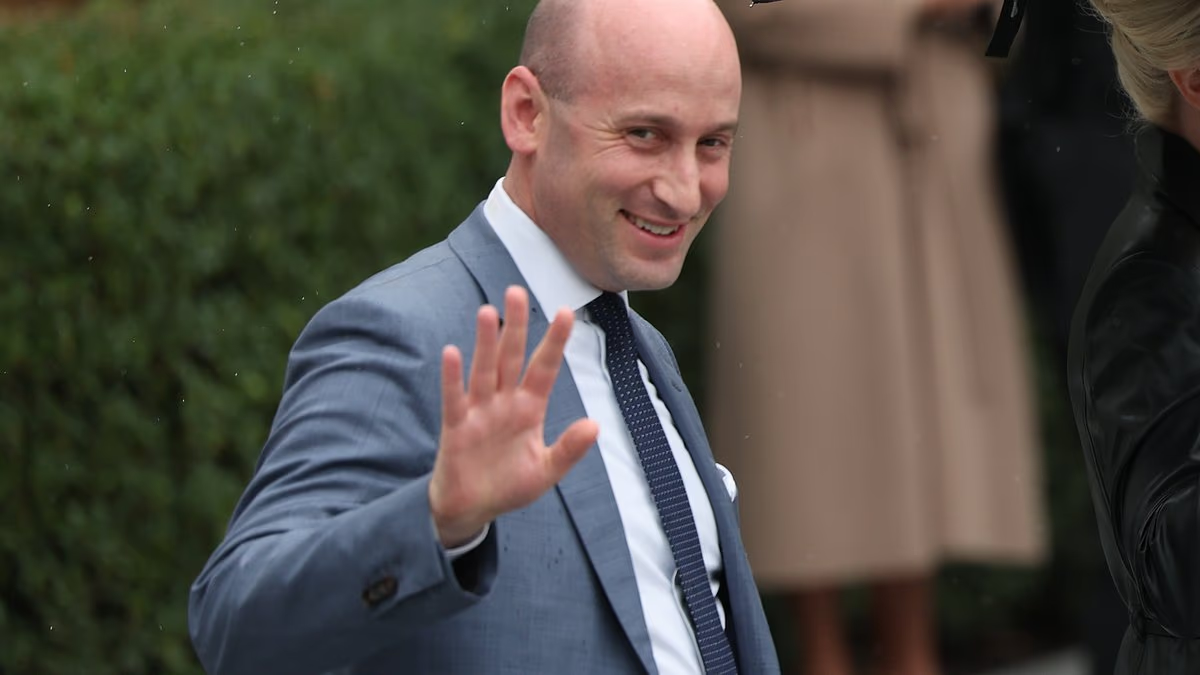

Stephen Miller, one of Donald Trump’s most loyal and controversial political allies, has been chosen as the next White House chief of staff after more than a decade at the center of the MAGA movement.
Trump announced the appointment on Friday, calling the 41-year-old Miller “one of my most trusted advisors.” He will succeed outgoing chief of staff Susie Wiles, 69, who was known inside the administration as the “Ice Maiden.”
To his liberal critics, Miller is a hardline conservative strategist with extraordinary influence over the president, particularly on immigration and law enforcement. His uncompromising positions have reportedly been so forceful that even Trump has privately suggested he can go “too far.”
In recent weeks, First Lady Melania Trump has reportedly voiced frustration over Miller’s rigid immigration agenda after some of her friends were arrested and deported.
Miller has also been identified by critics as a driving force behind some of Trump’s most divisive policies, including the family-separation program used during deportations in the president’s first term.
While liberals regard Miller with deep hostility, conservatives portray him as a disciplined political operator and one of Trump’s most dependable lieutenants throughout his decade-long dominance of Republican politics.
His new assignment comes with a formidable challenge: guiding Trump through what could be a lame-duck final stretch in the White House after Republicans suffered heavy losses in Tuesday’s midterm elections and forfeited control of both chambers of Congress.

Stephen Miller, one of Donald Trump’s most loyal and controversial political allies, has been named the new White House chief of staff after more than a decade in the MAGA movement

Miller has remained close to Trump throughout his decade at the center of American politics, building a formidable reputation among liberals as a hardline conservative strategist
Miller was born in Santa Monica, California, and grew up in a Jewish family. He has said his political transformation began during adolescence after reading Guns, Crime, and Freedom by NRA chief executive Wayne LaPierre.
As a high school student, Miller said he became increasingly alienated from the liberal views held by many of his classmates. He soon emerged as an outspoken advocate for conservative causes, including a campaign to restore the Pledge of Allegiance after it was temporarily removed from his school.
At Duke University, where he studied political science, Miller attracted attention through his newspaper column, Miller Time. He frequently used the platform to mock the university and criticize what he viewed as the liberal outlook of its faculty.
In 2006, he drew national attention on campus by defending members of Duke’s lacrosse team who had been accused of rape.
The case sparked intense debate after Crystal Mangum, a Black woman, alleged that three white players had sexually assaulted her at a team party.
As public condemnation of the players grew, Miller argued that they were being treated as guilty because of their race. He described the case as a “witch hunt” and made repeated media appearances supporting the accused students.
The players were eventually cleared, and Miller told The Athletic last year that defending them ranked among his proudest achievements.

Although liberals strongly oppose Miller’s hardline positions, conservatives credit him with helping steer the MAGA movement for more than a decade

Before joining Trump’s political operation, Miller worked for Alabama Senator Jeff Sessions, pictured with him in 2012
Miller’s involvement in the Duke lacrosse case became an early foundation for his political career. Many of the arguments he made at the time would later reappear in the rhetoric of the Trump administration.
In a 2006 column titled “Betrayal,” for example, Miller accused professors of trying to “indoctrinate students in their personal ideologies and prejudices.” The language closely echoes the Trump administration’s later attacks on universities.
After graduating from Duke, Miller entered Republican politics and worked for several members of Congress. His first major role was as press secretary to Minnesota Representative Michele Bachmann.
In 2009, he joined the staff of Alabama Senator Jeff Sessions. There, Miller helped develop his reputation as an immigration hardliner, pushing Sessions—already one of the Senate’s most conservative voices—to take an even tougher position on immigration reform.
KEEP READING: Knicks Defend Taylor Swift After Players Call Her Fakest Fan
When Sessions helped derail an immigration bill in 2013 that could have created a pathway to legal status for millions of undocumented immigrants, Miller was widely credited with helping defeat the legislation.
Among his efforts, Miller reportedly prepared a 23-page guide for lawmakers explaining how they could prevent the bill from advancing.
Miller’s years with Sessions, from 2009 through 2015, placed him at the heart of the Senate’s conservative movement. The pair were later credited with helping establish the populist political foundation on which Trump built his first presidential campaign.
But although Miller had risen quickly under Sessions, his political ambitions found their clearest outlet when Trump launched his long-shot White House bid and descended the golden escalator in 2015.

Miller has been portrayed as a key architect of many of Trump’s most polarizing policies

Miller was drawn to Trump’s blunt political style during the 2015 campaign and has remained at his side ever since
Miller was reportedly captivated by Trump’s aggressive, anti-establishment campaign and actively sought a role in the operation.
During Trump’s first administration, Miller became closely associated with the president’s most controversial policies. He also helped draft many of the speeches that shaped Trump’s public message in the White House.
Immigration was his central focus. Miller strongly supported the family-separation policy that removed children from parents who crossed into the United States illegally.
He was also a prominent advocate of Trump’s so-called “Muslim ban,” which restricted entry to the United States from several predominantly Muslim countries.
Miller faced renewed scrutiny during Trump’s first term when more than 100 members of Congress called for his resignation. The demands followed the release of emails that allegedly showed him sharing white nationalist material.
The Southern Poverty Law Center accused Miller of “open white nationalism,” but Trump declined to remove him from the administration.
After Trump lost the 2020 election, Miller founded America First Legal Foundation. He described the organization as a group for people who believed supporters of the America First agenda should use the courts to defend society and families against what he called unlawful actions by the left.
The organization operated as a conservative counterpart to the ACLU, pursuing lawsuits designed to challenge progressive policies and influence the legal landscape.
Miller remained in Trump’s inner circle during his political absence and quickly joined the former president’s 2024 campaign, where he played a major role in the successful comeback effort.

The incoming White House chief of staff with his wife, Katie, with whom he has four children
At a campaign rally in New York City, Miller sparked controversy by declaring: “America is for Americans and Americans only.” He was frequently seen as the force behind Trump’s increasingly severe immigration rhetoric.
Once Trump returned to office and moved rapidly to expand presidential authority, Miller used his political influence to pursue sweeping changes to the federal immigration system.
He assumed responsibility for implementing Trump’s mass-deportation pledge while also serving as deputy chief of staff and homeland security advisor.
Miller’s promotion to chief of staff raises fresh questions about the direction of Trump’s presidency. His appointment has fueled speculation that he could advocate even more aggressive measures as the administration seeks to define its legacy.
Trump himself acknowledged Miller’s forceful views early in his second term, saying he would like Miller to address the public but feared that he might “explain his true feelings.”
“But that might be going a little bit too far,” Trump added.


