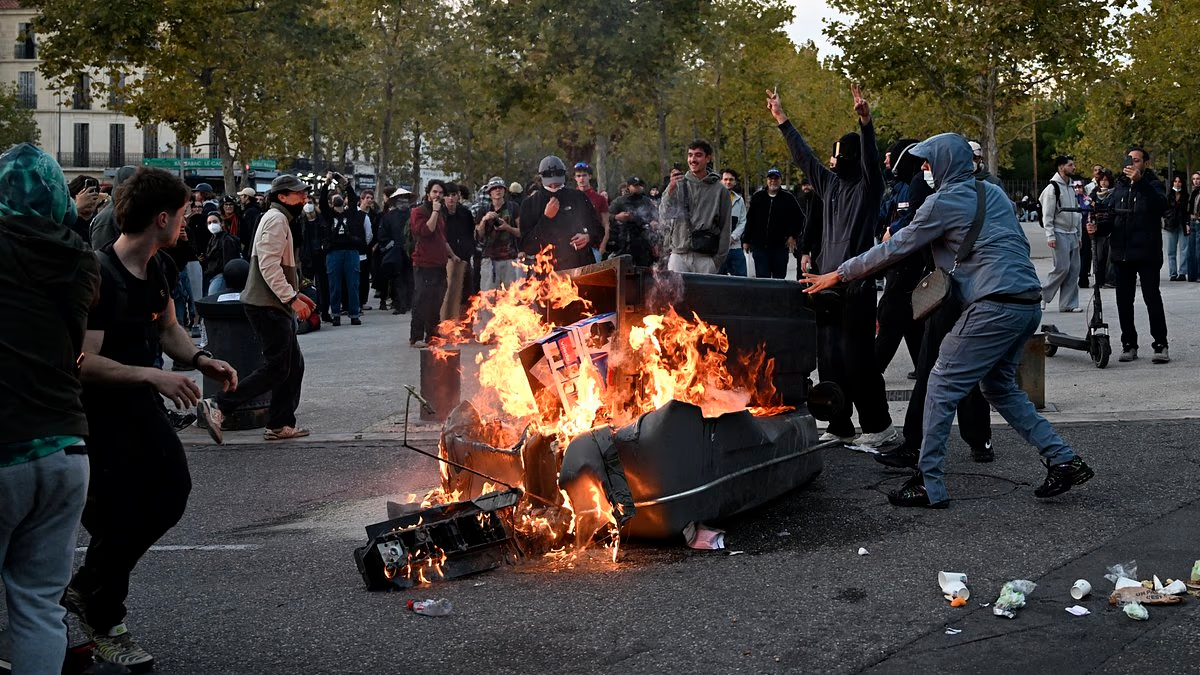

Shops have been damaged, fires started and clashes broken out between protesters and police across France, as an estimated 170,000 people took to the streets for a fourth consecutive weekend.
Videos from cities around the country showed demonstrators fighting with officers while flames lit up streets and public spaces.
The renewed unrest comes as France moves closer to presidential elections due in five months, with the far right increasingly convinced that the political climate could offer an opportunity to seize power.
Authorities had prepared for as many as 170,000 protesters nationwide, including 60,000 in Paris. However, the Interior Ministry recorded 7,000 demonstrators across the country by early afternoon—fewer than at the same point the previous week, suggesting participation may be declining.
The protests followed mass union demonstrations and strikes on Thursday, while teaching unions have pledged further walkouts next week.
Around 70,000 security personnel were deployed on Saturday, ready to respond rapidly after mass protests on October 17 descended into France’s worst riots in years.
Trade unions organised a march along a traditional route from Place de la République in central Paris to Place de la Nation in the east of the capital.
The Yellow Vests movement—whose protests shook Emmanuel Macron during the early years of his presidency nearly a decade ago—called a rival demonstration at Place de la Concorde, close to the president’s Élysée Palace and the lower house of parliament.
Officials banned the gathering, and a heavy police presence prevented protesters from approaching the area.

Thousands have confronted riot police across France for a fourth straight weekend in the latest expression of anger toward the government. Pictured: Protesters in Marseille

Riot officers deployed in large numbers as the demonstration moved through Paris

A protester kicks the window of a grocery store in Strasbourg on Saturday
About 100 people who arrived at the site were surrounded by officers. Benjamin Ball, one of the movement’s coordinators, and spokeswoman Azelma Sigaux were also arrested.
The latest unrest came as a new book claimed that Emmanuel Macron has access to a secret bunker outside Paris, where he could take shelter if rioters attacked the Élysée Palace.
Details of the refuge in the Paris suburbs appear in La Nouvelle Armée des Ombres (The New Army of Shadows), written by investigative journalists Pierre Gastineau, Antoine Izambard and Franck Renaud.
The authors say officials fear a National Rally victory for Marine Le Pen could trigger a ‘third round’ of protests, with radical left-wing activists, young people and rural militants taking to the streets to contest the result.
They further claim that a victory for hard-left leader Jean-Luc Mélenchon, who polling currently suggests could reach the presidential run-off, might lead to ‘passive resistance’ within the police force.
After interviewing senior sources, the authors say Paris police chief Patrice Faure has chaired a series of meetings examining the risk of an insurrection.
Meanwhile, France’s foreign intelligence service has rehearsed scenarios involving possible interference in the election.
In Paris, police officers reportedly spent an entire day working without smartphones to prepare for the possibility of a debilitating cyberattack.

French gendarmes in riot gear detain a protester during clashes at a demonstration in Lille

Riot police confront young people during a demonstration organised by French trade unions and Yellow Vests in Lille

Protesters stand beside a burning rubbish bin during a demonstration in Lille

Firefighters extinguish a blaze in Lille as a crowd gathers around them

A masked protester appears to throw a water bottle during Saturday’s unrest in Paris

Riot police clash with young people during protests held across France over the weekend
The claims follow a warning from a senior intelligence officer in April that major revolts were imminent in France.
Yet intelligence chiefs underestimated the disorder that erupted on October 17. Their forecast of 60,000 protesters fell far short of the half a million people who ultimately took to the streets.
The demonstrations are taking place less than six months before voters choose a new head of state to succeed centrist President Macron, with the hard right leading in opinion polls.
In Lyon, police used tear gas to disperse several hundred people who had blocked a road in the city centre during an unauthorised gathering.
‘The risk is exactly the same as on previous Saturdays,’ Interior Minister Laurent Nunez said, urging authorities ‘not to lower their guard’.
The latest wave of unrest began in late September, when students protested over conditions at their schools and universities. Teenagers and university students remain central to the movement.
‘Today is a date that helps maintain the pressure,’ said Sabine Kharbach, a spokeswoman for the Student Union. ‘Many young people are mobilising because the government’s response is still unsatisfactory.’
Police tactics have drawn criticism for being excessively forceful, with dozens of internal investigations opened into allegations of brutality against protesters.
Businesses in affected areas are also suffering. ‘This cannot continue, otherwise I think it will soon become a disaster,’ said Paris shop manager Jean Emile Moulinier, whose store is near the main protest route. He said few customers were willing to pass through security barricades on demonstration weekends.
In Paris and other cities, shops once again covered their windows with wooden shutters to guard against possible looting.
The government is searching for a way forward but faces tight constraints because France’s huge debt burden is already unsettling financial markets.
Prime Minister Sebastien Lecornu is scheduled to meet unions and representatives of employer groups on Monday to discuss pay and the rising cost of living.
Student and teacher organisations have meanwhile called a fresh strike for Tuesday, seeking greater education funding. They said they were ‘in a position of strength [and] the government in a position of weakness and starting to yield’.
Polling continues to place far-right candidate Marine Le Pen as the favourite to win the Élysée in 2027. Her leading challenger is currently not one of Macron’s former centrist allies, but hard-left leader Jean-Luc Mélenchon.
READ MORE: Emmanuel Macron has secret bunker outside Paris to hide in if rioters storm Élysée Palace, new book claims


