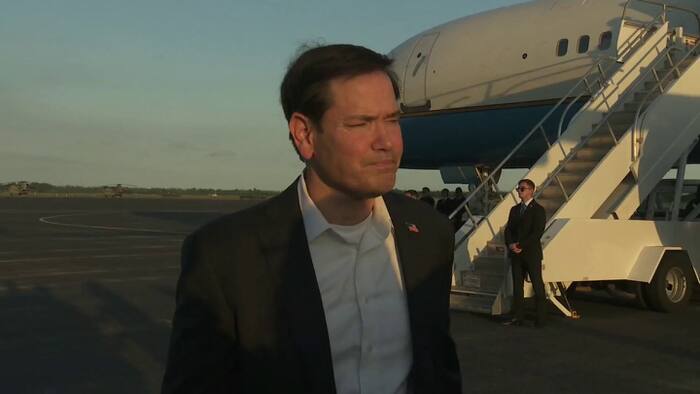


HOMESTEAD AIR RESERVE BASE, Fla. — Secretary of State Marco Rubio said Sunday that President Donald Trump ordered the war against Iran to protect the world from the country’s nuclear ambitions, even though the decision was not “necessarily popular.”
Rubio declined to directly address the Republican Party’s losses in Tuesday’s elections, which amounted to a sweeping rejection of Trump. Democrats took control of Congress as voters cited the unpopular Iran war, higher gasoline prices and broader economic pressures.
Asked about Vice President JD Vance’s social media post last week, in which he largely attributed the Republican defeats to the war, Rubio said Trump had recognized “a very real threat” and acted to prevent Iran from developing a nuclear weapon.
“He addressed it even though oftentimes the right thing to do for the country — confronting difficult challenges for the security of our country — doing it isn’t necessarily popular, but necessary,” Rubio told reporters in Florida before departing for a Group of 7 foreign ministers meeting in Paris.
The nation’s top diplomat mounted a forceful defense of the conflict, now more than eight months old, as voters blamed Trump’s policies for rising household costs. Energy prices increased after disruptions to shipping through the Strait of Hormuz, a vital waterway that handled one-fifth of global oil shipments before the war began.
Rubio and Vance strike different tones on the war
Rubio’s remarks contrasted with those of Vance, and the divide carries added political significance because both men are viewed as potential 2028 presidential candidates. In a “60 Minutes” interview broadcast Sunday, Trump was asked about possible successors and praised Rubio, saying, “I think Marco’s great.” He also said the Republican Party had a “tremendous bench” and suggested he might be better off staying out of the contest.
Trump said Sunday that Vance was correct in linking the war to the election results, but added that the vice president should also have argued that entering the conflict was the right decision.
“I can tell you if I had it to do again, this historically — for history — will go down as one of the best things we ever did,” Trump said. “Because if they ever had a nuclear weapon, they would blow up the world.”
Iran has long insisted that its nuclear program is intended for peaceful purposes. The International Atomic Energy Agency estimates that Iran possesses 440.9 kilograms, or 972 pounds, of uranium enriched to as much as 60% purity — below, but technically close to, the 90% level generally associated with weapons-grade material.
In the “60 Minutes” interview, Trump was asked whether he planned to intensify the war after the elections. “Well I’m not looking to. I don’t think there’s any reason to,” he replied.
Rubio says Iran negotiations are not near a breakthrough
With the administration yet to outline a clear path for ending the conflict, and tensions still high across the Middle East, mediators are working to restart negotiations between Washington and Tehran.
“I wouldn’t say we’re at the verge of a breakthrough,” Rubio said.
He repeated that Trump would prefer a diplomatic settlement, but said discussions had produced little progress because Iran’s demands were “simply not just unacceptable, but in some cases outrageous and ridiculous and really not realistic.”
Trump is scheduled to meet Qatar’s Prime Minister Sheikh Mohammed bin Abdulrahman Al Thani at the White House on Monday, according to the president’s official schedule.
The Associated Press reported that Iran was examining proposals from Qatar, the lead mediator, intended to resolve disagreements with the United States over Tehran’s nuclear program. Officials said Iran appeared unwilling to negotiate with the Trump administration on its nuclear activities unless Washington first accepted several conditions that Tehran wants included in any ceasefire agreement.
The demands include an end to the U.S. blockade of Iranian ports, the lifting of sanctions, the release of frozen Iranian assets, compensation for wartime damage and a halt to hostilities across the region, including Israeli military operations in Lebanon.
Although Rubio said no diplomatic breakthrough was imminent, Trump told CNN in a phone interview Sunday that renewed strikes would be “highly unlikely” if negotiations with Tehran continue to show progress and produce a “strong agreement.”
Trump nevertheless said the United States had identified infrastructure targets, including 38 bridges, that could be attacked if military operations resume.
The U.S. military has continued conducting limited strikes in Iran, including attacks on air-defense systems at least twice during the past week. On Saturday, American forces also fired on and disabled a commercial vessel that the United States said was attempting to break its naval blockade of Iranian ports.
Rubio acknowledged that the United States would respond defensively if necessary.
“If there’s a clear and present threat to shipping or to our forces in the region, we have a right to defend ourselves,” Rubio said.
___
Price reported from West Palm Beach, Fla.


