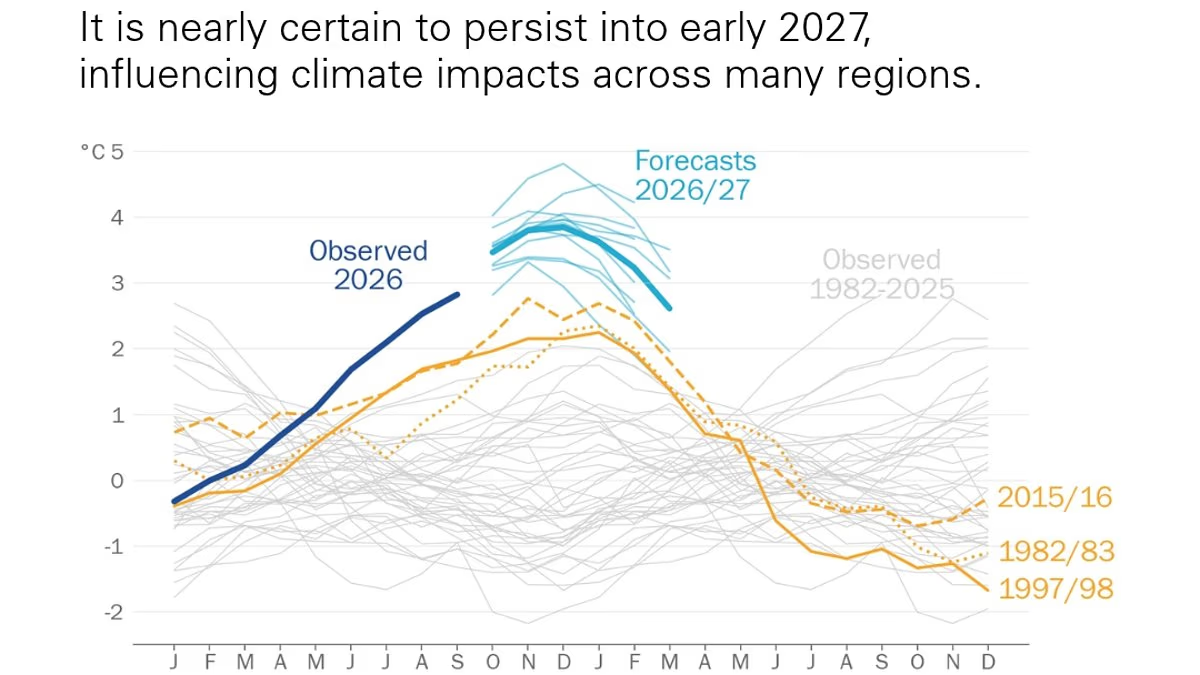

Super El Niño is “off the charts” and has already begun to “supercharge” weather patterns, experts at the World Meteorological Organization (WMO) have warned.
The WMO’s State of the Climate Update 2026 details how the powerful climate event has been associated with exceptional global temperatures, accelerating ice loss and rising sea levels.
Scientists say the most severe impacts may still lie ahead, with El Niño expected to drive further heat and extreme weather well into 2027.
“We have entered a new age of climate extremes,” said UN Secretary-General António Guterres.
“A supersized El Niño is colliding with a planet already superheated by manmade climate change.
“Climate records keep falling. The human costs keep rising. And those least responsible are suffering first and worst.
“Leaders must get serious by cutting emissions faster, accelerating a just transition from fossil fuels and delivering the finance and protection vulnerable countries need.”

WMO experts say Super El Niño is “off the charts” and has already begun to “supercharge” global weather patterns

Between January and September this year, the global average surface temperature was approximately 1.47°C above the pre-industrial average. That compares with full-year averages of 1.43°C in 2025 and 1.46°C in 2023, while remaining slightly below the 2024 record of 1.55°C
The report says each of the past 12 years has been the warmest on record, with the four most recent years occupying the top four positions.
From January through September this year, global average surface temperatures stood at about 1.47°C (2.64°F) above pre-industrial levels.
That is broadly comparable with the annual averages recorded in 2025, at 1.43°C (2.57°F), and 2023, at 1.46°C (2.62°F), although it remains just below the 2024 record of 1.55°C (2.79°F).
Scientists are concerned that temperatures could climb further before the year ends, driven in large part by the developing Super El Niño.
The warning extends beyond land temperatures. Researchers expect the oceans to reach record warmth this year, while global sea levels have also hit unprecedented levels.
Sea levels in June, July and August were the highest recorded since satellite altimetry began in 1993.
Experts say the rapid rise could be linked to changes associated with the strengthening El Niño, including rainfall shifting from land to the ocean across the western tropical Pacific.

Sea levels in June, July and August reached their highest points since the satellite altimetry record began in 1993

The report says summer heatwaves, drought and wildfires in Europe caused more than 30,000 excess deaths. Beachgoers sit on Moutchic beach in Lacanau, southwestern France, on July 24, 2026, as wildfire smoke rises in the background
YOU MIGHT ALSO LIKE: Prosecutor Accused of Sex With Inmates Faces New Charges
“El Niño and indeed the state of the global climate in 2026 gives new meaning to the phrase off the charts,” said WMO Secretary-General Celeste Saulo.
“El Niño doesn’t add new heat to the planet. It releases heat from the ocean, which is the warmest ever measured. There is simply more heat available to release.”
Ms Saulo said El Niño would act as a “risk multiplier” for extreme weather in the months ahead.
“Heatwaves, tropical cyclones, and rainstorms are intensifying faster than our historical baselines prepared us for,” she said.
“Hundreds of millions of people this year have been exposed to unbearable extreme heat, while the catastrophic ice and rock collapse and flash floods in Nepal highlighted the compound risks facing communities in fragile, warming high-mountain terrain.”
The consequences have been devastating for communities and economies. Flash floods in Nepal killed more than 1,300 people in August.
In Europe, summer heatwaves, drought and wildfires resulted in more than 30,000 excess deaths, according to the report.
An estimated 146.5 million people in India were exposed to extreme heat during an April 2026 heatwave, while tropical cyclones caused widespread destruction across several countries.

A Himalayan glacier collapse and catastrophic downstream flash flood in late August killed more than 1,300 people and severely affected Nepal’s economy
The report follows the release of a worrying map showing where Super El Niño’s deadly heat could claim the greatest number of lives.
Known as the El Niño Heat Mortality Tracker, the tool estimates that an additional 370,000 people could be at risk over the next six months.
Nigeria, India and Brazil are expected to experience the heaviest toll, together accounting for more than one-third of projected heat-related deaths by March.
The UK is also shown to be affected, with approximately 820 deaths already attributed to El Niño-related heat this summer.
Professor Michael Greenstone of the University of Chicago is a co-founder of the Climate Impact Lab, which created the tool.
“Our research puts new forecasting capabilities to work to answer one of the most urgent questions we face: where is extreme heat likely to cost lives?” he said.
“Being able to anticipate the deadly effects of extreme heat is a major step forward.
“It means we can identify where people face the greatest risks and give decision-makers a chance to act before lives are lost. The tracker provides this information for the Super El Niño we’re living through today.”