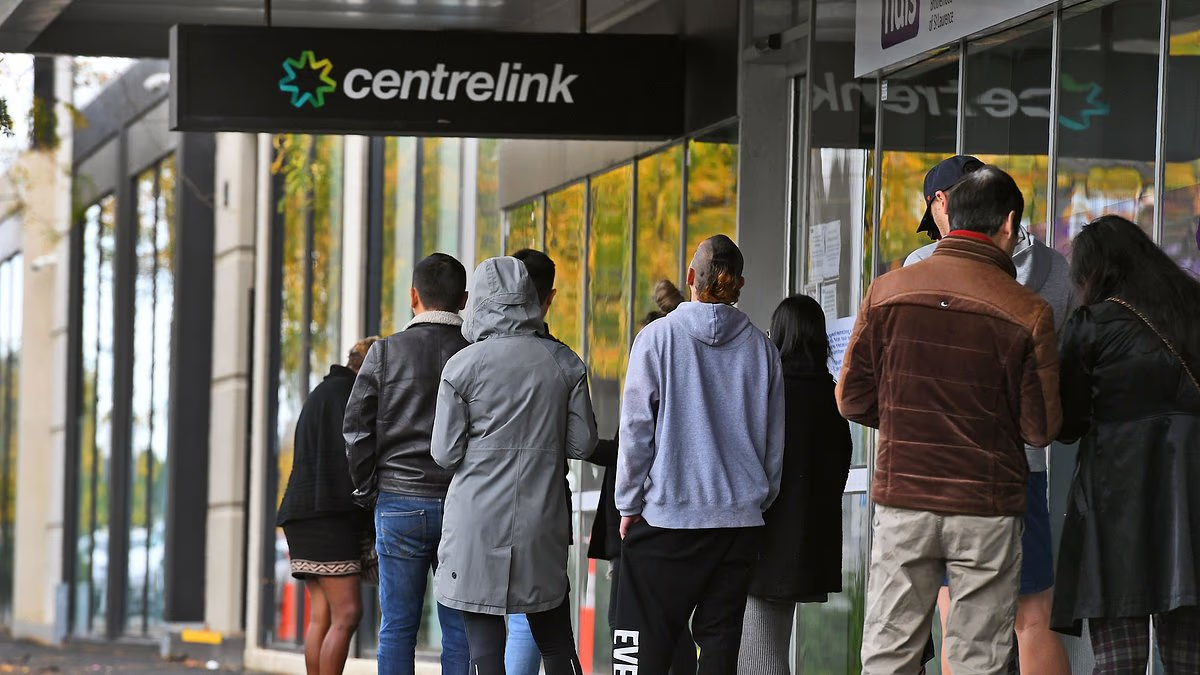

Australia’s unemployment rate has climbed to 4.9 per cent, its highest level in five years.
Australian Bureau of Statistics figures released on Thursday showed employment fell by about 44,000 people in October, while the number of unemployed rose by approximately 18,000.
Economists had broadly anticipated that the unemployment rate would hold at 4.7 per cent.
The Coalition seized on the result, with shadow housing minister Andrew Bragg calling an unemployment rate nearing five per cent “very worrying”.
“This is the consequence of running economic policy in a way where we’ve seen a reduction in private investment … we’ve seen inflation not being properly addressed,” he told reporters in Canberra on Thursday.
The Liberal senator also criticised Treasurer Jim Chalmers’ economic policies, arguing the government’s May budget had weakened confidence throughout the economy.
“We’ve seen this bizarre, Frankenstein-like surgery on the housing system that has smashed confidence across the economy,” Bragg said.
The worsening labour market comes as Australian workers face broader uncertainty, with economic growth slowing, major employers cutting or moving white-collar positions overseas and businesses expanding their use of artificial intelligence.

The Coalition blamed Jim Chalmers (pictured) and the May budget for weakening economic growth
Offshoring was once most closely associated with manufacturing and call-centre jobs, but it is increasingly affecting professional fields including marketing, finance, technology and cybersecurity.
The shift towards remote work during the pandemic demonstrated that many office-based roles could be performed from almost anywhere, accelerating the use of overseas workforces by Australian companies.
Large employers including Bunnings and Qantas have recently announced restructures involving offshore work. Recruiters say jobseekers are also regularly competing with hundreds of applicants for a single position.
The latest figures follow a series of high-profile corporate layoffs and retailers being placed into administration.
Historic department store David Jones entered administration this month, while fashion retailer General Pants followed on Thursday.
Tammie Ballis, a recruitment specialist who runs Sydney-based Realistic Careers, said jobseekers were being pressured from several directions as businesses reduced costs, recruitment slowed and competition for available roles intensified.
“We are seeing a perfect storm in the job market right now,” Ballis told Our News Outlet.
“Overpopulation, businesses downsizing, businesses leaving Australia, artificial intelligence and a weak economy are all making it harder for people to find work.”

The unemployment figures come amid a series of prominent retail collapses and job losses (stock image)

Recruiters say jobseekers are increasingly competing with hundreds of applicants for a single vacancy (stock image)
Dr Cassandra Goldie, chief executive of social services peak body the Australian Council of Social Service, warned that rising unemployment could cause lasting harm to households.
“Since interest rates started to rise in 2022, around a quarter of a million people have been pushed out of paid work,” Goldie said.
“We have been warning for some time that interest rate hikes would lead to devastating human consequences.”
Goldie said projections for unemployment to increase further in the coming years raised concerns that Australia could experience a more severe downturn than currently forecast.
“Unemployment is projected by the RBA to rise to 5.1 per cent by the end of 2028, but at this point that forecast looks quite optimistic,” she said.
“Australia is staring down a materially sharper downturn and at worst a recession.”