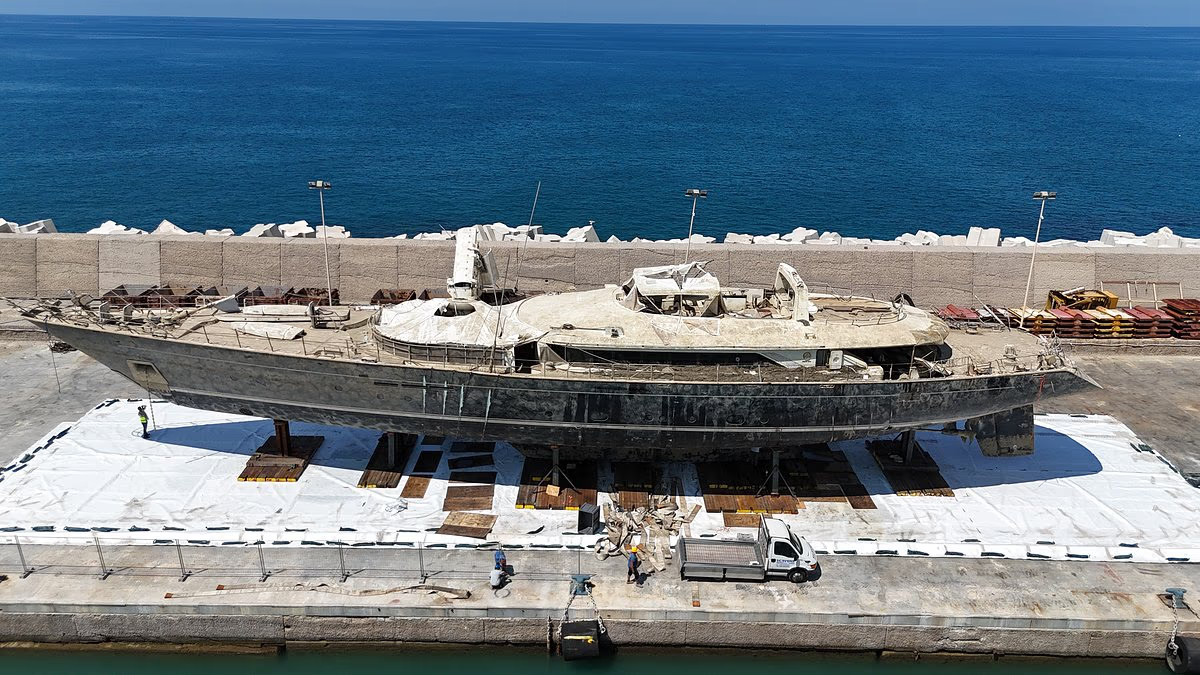

The crew of the superyacht Bayesian did not know the vessel was vulnerable to powerful winds before it sank, investigators have concluded.
British technology billionaire Mike Lynch, 59, and his 18-year-old daughter Hannah were among seven people who died when the luxury yacht sank off Sicily in winds reaching 80mph.
The storm, classified as a “downburst”, pushed the Bayesian on to its side within 15 seconds. The 186ft vessel sank just 16 minutes later in August 2024.
The 90-page report by the UK Marine Accident Investigation Branch (MAIB) does not assign blame for the disaster.
Instead, investigators said the yacht’s crew had not been made aware of its weaknesses in extreme winds.
The findings are expected to differ sharply from those of an Italian investigation. Leaks reported by local media suggest that inquiry could conclude next month that the crew, rather than shortcomings in the yacht’s design, was responsible.
The Bayesian, valued at more than £30million and known for its 237ft mast, was carrying 22 passengers and crew when it capsized near the fishing village of Porticello.
Mr Lynch had been using the yacht partly to celebrate his acquittal on fraud charges connected to Hewlett-Packard’s 2011 purchase of his software company, Autonomy. His daughter had recently completed her A-levels and been offered a place to study English at Oxford University.

New images have been released of the Bayesian superyacht after the wreckage of the vessel was recovered during a salvage mission

Brilliant student Hannah Lynch, 18, died alongside five others when the luxury vessel went down off the coast of Sicily in 80mph winds
The other victims were Britons Jonathan Bloomer, 70, chairman of Morgan Stanley International, and his wife Judy, 71; American lawyer Chris Morvillo, 59, who worked for Clifford Chance, and his wife Neda, 57; and Recaldo Thomas, 59, the yacht’s Canadian-Antiguan chef.
Fifteen people, including Mr Lynch’s wife Angela Bacares, were rescued.
The MAIB report said official weather forecasts for the area were broadly accurate but failed to convey the possible severity and impact of the forecast thunderstorms.
Investigators found that the Bayesian was susceptible to strong winds but had never been properly assessed while anchored with its sails lowered and its retractable keel raised.
They also concluded that the crew had not received an adequate warning about the risk.
Lead investigator David Robertson told a press briefing on Wednesday: “The forecast did not mention the possibility of violent winds, crew training had not covered the risk and the guidance did not address it.
“Taken together, those factors limited the crew’s ability to identify the developing danger and respond in time.”
The report said the Bayesian’s “vulnerabilities” in high winds were “unknown to either the owner or the crew” because they had not been recorded in the Stability Information Book carried on board.
The booklet serves as an operating manual, setting out the yacht’s physical limitations, but did not include weaknesses in its design.
Instead, it offered only “generic instructions”, limiting its value in helping the crew prepare for a storm while the yacht was anchored, investigators said.
“These vulnerabilities were not identified. Consequently, these vulnerabilities were also unknown to either the owner or the crew of Bayesian,” they added.


Seven people including tech billionaire Mike Lynch and his daughter Hannah died when the Bayesian sank in a freak storm in 2024

New Zealand citizen James Cutfield, 51, was the captain of the Bayesian
At around 4am, winds reached 80mph, causing the Bayesian to heel 90 degrees before it sank.
“People, furniture and loose items fell across the deck,” the report said. Several passengers and crew members were injured by falling objects or as they were thrown against them.
Some guests used drawers as makeshift ladders, climbing along interior walls from the lower decks to the wheelhouse before jumping into the sea.
The report found that none of the Bayesian’s life rafts automatically floated free and inflated as the yacht went down, meaning the crew had to release them manually.
MAIB principal inspector Simon Graves said: “The crew were responding to the situation in front of them. The weather forecasts for that day indicated generally reasonable conditions with a chance of thunderstorms, but none described the weather they ultimately encountered.”
He added: “Unfortunately, they were overtaken by events and by the speed of the knockdown.
“They went from calm conditions to a violent storm and then being knocked over in a very short period, leaving them with little time to react. Once the vessel had been knocked down, they activated the emergency rescue beacon and released the life raft.
“They managed to get some guests off the vessel and into the life raft, giving them the best possible chance of survival.”
The MAIB’s conclusions are likely to conflict with the findings of Italy’s separate investigation.
Earlier this month, a file reportedly sent to Italian prosecutors concluded that the Bayesian was “well-built, safe and designed to withstand a weather event such as the one that struck the vessel on the night it sank”.
While the MAIB described the storm as an extreme event, Italian experts reportedly called it “little more than a squall” and blamed “human incompetence” for the deaths. Sicilian prosecutors have said the yacht’s keel should have been lowered and that the weather was “manageable”.
Mr Graves said it was reasonable for the British and Italian investigations to reach different conclusions because they were “entirely separate” and had different objectives.
Bayesian captain James Cutfield, a New Zealander, British chief engineer Tim Parker Eaton and British deckhand Matthew Griffiths, who was on watch on the night of the sinking, are under investigation in Italy. They could face charges of multiple manslaughter and causing a disaster, offences that each carry a maximum prison sentence of 15 years.
A survivor who escaped with her one-year-old daughter is suing the crew for damages.
According to court papers seen by The Sun, Charlotte Golunski and her partner James Emslie allege that no alarm was sounded as the yacht capsized. Ms Golunski says the crew failed to warn passengers, give her daughter a safety briefing or explain how to reach the life jackets.
She also claims the order to abandon ship was not given “until it was too late” and that the emergency lighting failed. “For two seconds I lost my daughter in the sea then quickly hugged her amid the fury of the waves,” Ms Golunski previously told Italian media.
The MAIB recommended that industry guidance address the risk of yachts being knocked down by high winds when their sails are lowered. It also called on the Maritime and Coastguard Agency to review guidance on extreme-weather downbursts.
Rob Loder, the UK’s chief inspector of marine accidents, said: “Our investigation found that Bayesian had an unrecognised vulnerability to high winds because the yacht had never been assessed at anchor with its sails down. The extreme winds that night were also not explicitly forecast, leaving the crew without warning of the danger.
“MAIB has published an industry safety flyer and a report containing recommendations on vessel design standards, crew training and the way rare but severe weather events are represented in forecasts. I urge everyone involved, including regulators, training providers and weather services, to read the report and act on it so that a tragedy like this is not repeated.”
UK inquests are examining the deaths of Mr Lynch, his daughter and Mr and Mrs Bloomer. The Maritime and Coastguard Agency is also investigating the yacht’s sinking.


