
The EU turned up the pressure on Andy Burnham today as he prepared to offer a series of concessions aimed at making trade with the bloc smoother.
The Prime Minister and several Cabinet ministers are in Brussels to finalise a “closer partnership”, which they say could strengthen the economy and reduce household costs.
The proposed agreement has already prompted concern over the UK accepting EU food rules, making financial contributions and allowing around 100,000 European people in their 20s to enter the country each year under a youth mobility scheme.
But EU officials warned this morning that none of the arrangements will be implemented unless Mr Burnham agrees to demands for EU students to pay lower tuition fees.
The bloc has set a six-month deadline for resolving the issue, with the rest of the package potentially delayed until an agreement is reached. Allowing EU students to pay domestic fees could cost the UK taxpayer hundreds of millions of pounds annually.
Kemi Badenoch and Nigel Farage have both condemned the deal, which they fear could eventually pave the way for Labour to seek full re-entry into the EU.
The agreement is also expected to contain penalty clauses that could leave the UK facing billions of pounds in costs if a future government takes office and withdraws from it.

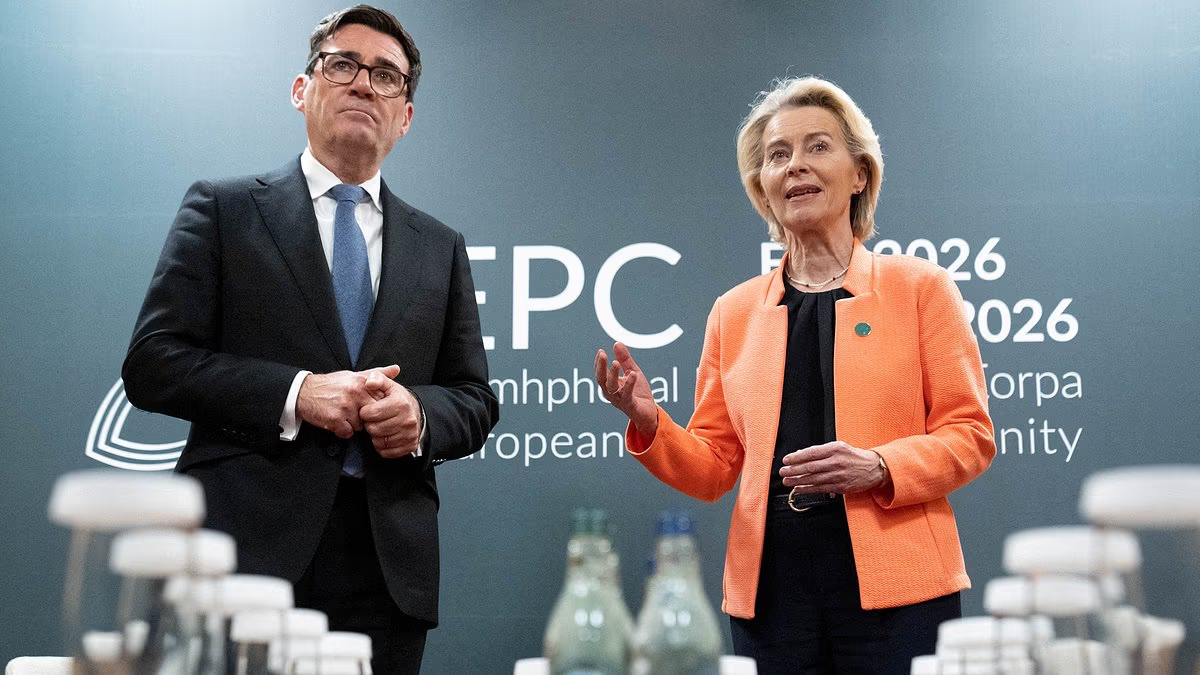
Andy Burnham and several Cabinet ministers are in Brussels to finalise a “closer partnership”, which they say could boost the economy and lower household costs

The Prime Minister is due to meet EU chief Ursula von der Leyen in Brussels this morning to finalise the “reset” package
The ministers attending the summit include Chancellor John Healey, Deputy Prime Minister Louise Haigh, Business Secretary Jonathan Reynolds, Europe minister Hamish Falconer and Environment Secretary Angela Eagle.
Mr Burnham indicated this morning that the package had effectively been agreed, despite Downing Street insisting last night that negotiations were still “going down to the wire”.
Much of the deal had been prepared under Keir Starmer, but Mr Burnham appears to have offered more substantial compromises than those previously under consideration.
The UK had initially argued that a youth mobility scheme should be limited to 50,000 EU nationals a year. That figure now appears likely to double.
NEXT UP: Thomas Markle Found Competent to Face Child Pornography Charges, Report Says
Since Brexit, EU students studying in the UK have generally faced international tuition fees ranging from £11,400 to £38,000 a year for undergraduate courses. British students, by contrast, pay the lower domestic rate of £9,790 annually.
The official said: “We have given ourselves six months to resolve this issue, and we have been in discussions with the UK.
“I think our position has been clear: this is an issue that needs to be addressed. Since Brexit, the number of students from both sides studying in the other’s territory has fallen, particularly the number of EU students coming to the UK.
“We believe this has weakened the relationship, and we want to address it.
“So we have given ourselves six months to find a solution. As for the other agreements, we hope they will enter into force quickly, but they have been negotiated in parallel and should also be implemented in a balanced way. That is our expectation, and we believe it will be met.”
The Prime Minister is due to meet EU chief Ursula von der Leyen in Brussels this morning after travelling to the Belgian capital from Berlin last night.
Mr Burnham said he was continuing to seek agreement on a new “Channel Action Plan” designed to improve cooperation on tackling illegal migration.
Sources said the plan could ultimately involve the UK joining a new EU initiative to send rejected asylum seekers to Rwanda, reviving a Conservative proposal abandoned by Labour.
The Prime Minister said: “The test for this summit is simple: does it make life better for people in Britain?
“That is what I will deliver in Brussels today – cutting costs, keeping prices down in supermarkets and creating opportunities for young people.
“Britain and Europe share values, interests and a global neighbourhood. In a more dangerous world, we are stronger together.
“A closer partnership with Europe is good for working people, good for Britain and good for Europe.”


