
When a masked intruder appeared at the foot of their bed in the middle of the night, retired medical professor Brian Whiting and his wife, Marlene, both in their 80s, must have assumed a burglar had entered their home.
But the man who threatened to “hurt” Mrs Whiting unless her husband complied with his demands was not there to steal valuables. Brian MacKinnon wanted something far more personal: a signed “confession” from the professor.
He wanted Professor Whiting to admit that, decades earlier, when he was dean of Glasgow University’s medical faculty, he had appeared on television and lied by saying MacKinnon was dismissed because he had failed his exams.
The terrifying confrontation, which took place at the couple’s sandstone villa in an affluent Glasgow neighbourhood during the early hours of September 29, 2025, was outlined by a prosecutor last week. It marked the sinister conclusion to a story that had first stunned the world 30 years earlier.
In the spring of 1993, MacKinnon carried out an audacious and seemingly impossible deception.
Unable to accept that his hopes of becoming a doctor had ended after he was expelled from medical school, the 29-year-old reinvented himself as a 16-year-old called “Brandon Lee” and successfully talked his way back into his former school, Bearsden Academy.
He claimed to be the son of a Canadian zoologist whose wife, a famous opera singer, had died in a road crash. He forged references from supposed tutors and applied to join the school’s fifth form, saying he had been sent to Glasgow to live with his grandmother.
In reality, he was about to turn 30 and was living elsewhere in the city with his recently widowed mother, May.

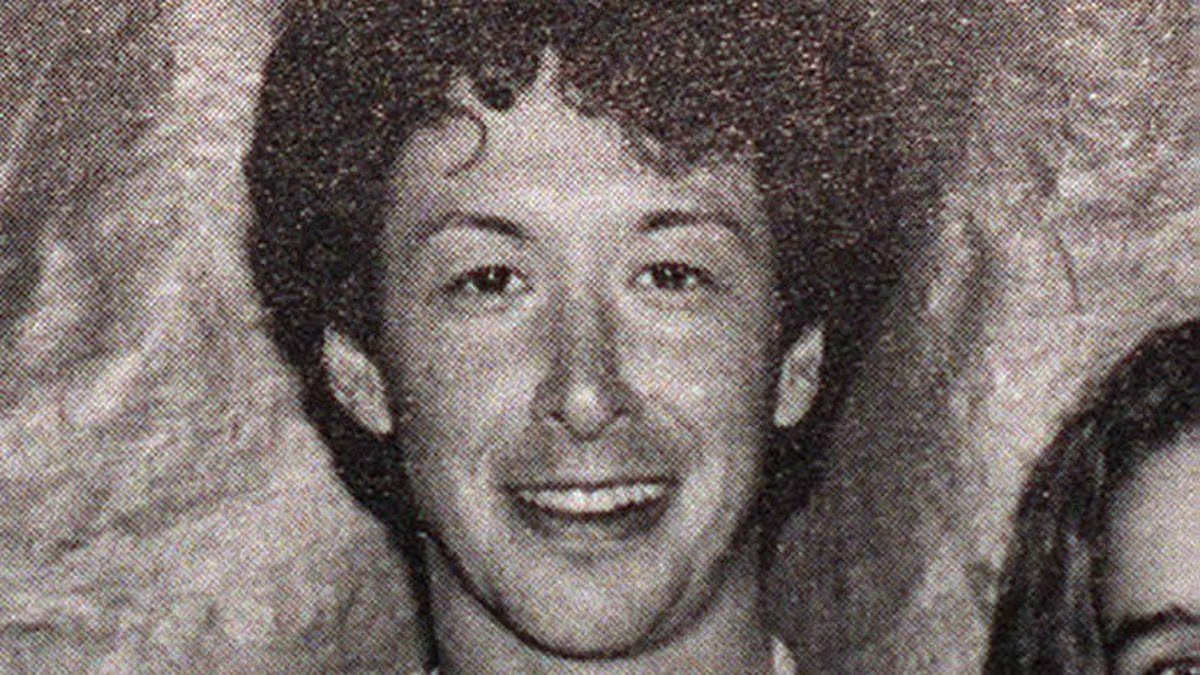
Brian MacKinnon, also known as Brandon Lee, pictured in a school photograph, posed as a student

MacKinnon, now 58, pictured in Glasgow after returning to Bearsden Academy in East Dunbartonshire as a student in 1993
He took the first name Brandon from a character in the television series Beverly Hills, 90210, while the surname came from one of his favourite actors, Christopher Lee.
MacKinnon had permed his hair, shaved his eyebrows and mastered a Canadian accent. Even so, he later recalled feeling certain that one of his former teachers would recognise him when he returned for an interview at the school he had left 13 years earlier.
But the school’s deputy rector was impressed by the polished new overseas student and his glowing references from a supposed home tutor named “Marsha Hunt” — the name of a model who had once dated Mick Jagger. He welcomed MacKinnon and overlooked the fact that he had “forgotten” to bring a birth certificate.
So began the elaborate deception. The sophisticated and athletic “Brandon” won the admiration of classmates half his age and secured the five A grades he needed to resume his medical studies at Dundee University.
“The striking of a peculiar dual balance between naive boyishness and maturity, aloofness and reserve, seemed to come easy to me, aided as I was by my light frame and a clear, wrinkle-free complexion,” he later wrote.
There were occasional lapses when he momentarily forgot that he was supposed to be 16. On one occasion, he puzzled a classmate by saying he remembered Elvis Presley’s death in 1977, when he would have been a baby. On another, he nearly answered to his own name when a different Brian MacKinnon was called during the morning register.
Although he suspected some pupils knew he was older than he claimed — they nicknamed him “30-something” — his deception was not confirmed until after he had left the school in 1995.
Exactly how the truth emerged remains unclear. But it appears that, while holidaying in Tenerife with three teenage girls he had befriended at school, MacKinnon, by then 32, was seen by one of them with his passport, which revealed his real age.
After returning home, the girl told her mother, who reported him to Bearsden Academy.
Within days, the astonishing story of the “Peter Pan” schoolboy was making headlines. Dundee University expelled MacKinnon for deception.
While some condemned his fraud, others treated him as an anti-hero who had revelled in embarrassing the school staff he had deceived.

MacKinnon posed as a schoolboy at the age of 32 in an attempt to return to medical school after failing

Medical student MacKinnon failed his exams before posing as a 17-year-old to return to school
For MacKinnon, however, being exposed as an imposter was devastating. Driven by deeply rooted psychological forces, he had long believed he was destined for greatness in medicine. Now that ambition appeared to be beyond reach.
His rambling autobiography, Rhesus Negative, published in 2016 when he was 53, offers an insight into the source of his ambitions.
They appear to have been fuelled partly by a desire to impress his father, Donnie, a fire-engine driver, and by what MacKinnon described as the “cold rage” he felt after cancer specialists failed to detect the throat tumour that killed him.
He also believed his mother’s medical knowledge had been undervalued during her career as a nurse.
After his deception was uncovered and he disappeared from public view, his resentment towards the medical establishment and the figures he blamed for ruining his career continued to grow.
For several years, MacKinnon and his mother moved between homes in England. He also travelled frequently to Germany, where he was reported in 1998 to be recruiting followers for a doomsday cult.
Following his mother’s death in 2008, he settled in a bleak council flat in Milngavie, East Dunbartonshire, around two miles from the school he had deceived. Apparently unwilling to take jobs he regarded as beneath his intelligence, he has since lived on welfare payments.
Although local residents knew about his past, they reportedly held no animosity towards him and tried to make friends, according to a local woman who spoke this week.
But the shaven-headed MacKinnon rarely spoke to his neighbours and appeared to have very few friends.
A young man living in the flat opposite said he had seen only one visitor. The man stayed for several days before an argument late one night ended with MacKinnon angrily chasing him down the path and into the street.
When Our News Outlet contacted MacKinnon’s sister, Dawn Rennie, who lives in Inverclyde, she said she had “not spoken to him in 35 years”.
How, then, did he spend the years after his school deception was exposed?
According to people who saw him, his life revolved around studying medical books in the library. He apparently continued to believe that, even in later life, he could obtain the medical qualifications he felt had been taken from him.
His autobiography makes clear that the person he held chiefly responsible for destroying his career was Professor Sir Roderick “Roddy” MacSween, one of Scotland’s leading physicians of his era, whom MacKinnon encountered at Glasgow University medical school.
The extraordinary accusations MacKinnon directs at the respected pathologist in his disturbing memoir are too extreme to repeat. Among them is the bizarre claim that MacSween plotted to have MacKinnon and his parents killed.
Why, then, did he later target Professor Whiting, who had long since retired? MacKinnon appears to have regarded the former dean as another person responsible for derailing his life — a process he says began when he was 17 and left Bearsden Academy for the first time to attend Glasgow University’s medical school.
YOU MIGHT ALSO LIKE: NFL Insider Dianna Russini Reportedly Writing Tell-All Book After Mike Vrabel Affair Allegations
According to MacKinnon’s account, he contracted a near-fatal case of glandular fever within days of beginning the course in 1980 and was forced to take a year away from his studies.
He maintains that, had he been given enough time, he could have returned and completed the course. He has described himself as a genius with “an IQ of 161 at the age of ten”.
Instead, MacKinnon claims, university officials labelled him a “failure” and conspired to expel him.
When the Peter Pan scandal broke, Professor Whiting offered a different account in a television interview. He said MacKinnon had been “asked to leave after he’d been given every possible chance of succeeding”.
Asked about the school deception, Whiting said MacKinnon’s conduct was inappropriate for someone hoping to become a medical professional and suggested Dundee University would be unwise to give him another opportunity.
In his book, MacKinnon describes the fury he felt as his former dean publicly condemned him: “Whiting’s untrammelled micro-expressions spoke of a vicious, unscrupulous character whose primary instincts were to dissemble and lie.”
It is therefore striking that, on September 27 last year — the night before he broke into Professor Whiting’s home — MacKinnon watched a recording of that interview on television.
The footage appeared in a repeat broadcast of My Old School, the Bafta-winning documentary about his notorious deception, directed by Jono McLeod, the husband of Graham Norton.
MacKinnon agreed to be interviewed for the film, which was first released in 2022. However, he refused to allow his face to be shown.
Was that because he was already considering stalking his former dean, and possibly others he had fixated on, while avoiding recognition?
The answer, along with other questions surrounding the case, may emerge on December 8, when MacKinnon — now 63, and held on remand at Barlinnie prison since his arrest 14 months ago — is due to return to Glasgow High Court.
Judge Lady Anwar has warned him that he faces “a significant custodial sentence”.
Reportedly suffering from a condition that causes spasms, MacKinnon appeared frail last week as he was brought into court in a wheelchair.
Yet just over a year earlier, while Professor Whiting was in his study and his wife was in the garden, MacKinnon had entered their home undetected and hidden there for nine hours before confronting them at 1.30am.
Wearing a mask, cap and dark clothing, he ordered the couple not to switch on the light, prosecutor Eilidh Robertson told the court.
When 83-year-old Mrs Whiting sat up, he warned her to lie down or he would “really hurt her”.
He accused the professor and two unnamed colleagues of “ruining his life” and being responsible for the deaths of his parents. He then produced two documents he had prepared in advance.

Former Dean of the Faculty of Medicine Professor Brian Whiting speaking about MacKinnon in 1995
The documents had been written to look as though they came from the former dean. They claimed he had “succumbed to intolerable pressure to make a misleading statement about Brian Lachlan MacKinnon”.
The statement described “a conspiracy” to falsify the facts and exclude “incandescently bright” students such as MacKinnon from Glasgow University’s medical school.
MacKinnon told the couple that “a network of spies” was monitoring them. If Professor Whiting did not sign and release the statements, he claimed, both would be killed and their families harmed. He then ordered the couple to let him leave the house.
But as Mrs Whiting escorted him downstairs, he inexplicably removed his mask, allowing her to see his face and later identify him.
The court also heard that MacKinnon had abandoned a bag 12 miles from his home. Inside were a stun gun, a knuckle-duster, pornographic DVDs, medical syringes and gloves.
Professor Whiting later told Our News Outlet that he had not heard from MacKinnon for 30 years. His wife said the intrusion had shattered their peaceful retirement and come “absolutely out of the blue”.
That raises questions about the decision to make the documentary that reignited MacKinnon’s anger, particularly because it presented him as an honourable and well-intentioned figure.
Mr McLeod declined to comment when approached by Our News Outlet this week.
One of the few Black pupils at Bearsden Academy recalled in the film how MacKinnon befriended him while he was being racially abused by other students.
The documentary also includes grainy footage of the school’s late rector, Norman MacLeod — no relation to the filmmaker — praising the 30-year-old man who had deceived him after “Brandon” played Lieutenant Joseph Cable in an end-of-term production of South Pacific.
“What did we see tonight? Confidence, maturity!” the headmaster declared in a speech after the performance — words whose irony would later haunt him.
“Now, Brandon Lee, I’m delighted to say, he behaves and acts as though he has been a pupil at Bearsden Academy from the beginning, and we are delighted to have him!”
MacKinnon’s co-star, Val Andrew, now in her mid-40s, appeared to feel very differently.
Until the filmmakers approached her, she had forgotten that her role as Liat required her to passionately kiss “Brandon”. She had never realised that he was twice her age.
“That’s so weird,” she says in the documentary as she watches the scene again, visibly uncomfortable. “I haven’t got words. I feel a bit, er… icky.”
In his autobiography, MacKinnon writes disturbingly that performing the romantic scene reminded him of a girl with “glorious green eyes” whom he had loved and lost at Glasgow University.
It would be revealing to know how Ms Andrew, who has since moved to New Zealand, views the encounter now that MacKinnon’s darker side has emerged. She declined to comment when contacted.
Others who shared classrooms with the celebrated “Brandon Lee” were once eager to recall their memories for the documentary and discuss their involvement on social media. Since MacKinnon’s arrest, however, they too have fallen silent.
With the seemingly ageless schoolboy now in custody and the disturbing side of his personality exposed, those who once marvelled at his audacity no longer appear to find it amusing.
READ MORE: Failed student who posed as schoolboy threatened to kill professor


