

Eighty years after the Holocaust, German Chancellor Friedrich Merz has said the country’s responsibility for the Nazi genocide also applies to immigrants arriving from Islamic countries.
Speaking at an official reception for Germany’s Maccabiah Jewish sports delegation in Berlin on Nov. 6, Merz said, “The historical responsibility of our country applies just as much to those who come here to Germany from Islamic countries, and anyone who fails to abide by this must leave our country.”
Merz made the comments after a basketball coach told him that athletes were afraid of being assaulted while wearing red Maccabi warm-up jackets marked with the Star of David in German cities.
According to the German Press Agency, or dpa, Merz invoked former President Richard von Weizsäcker’s 1985 address to the Bundestag. Von Weizsäcker said young Germans were not responsible for Nazi crimes, but were responsible for how those crimes would be remembered and addressed in history. Merz called that principle “set in stone” and said that, “given the current circumstances,” it also applies to immigrants arriving in Germany, citing recent antisemitic incidents involving Muslim immigrants.
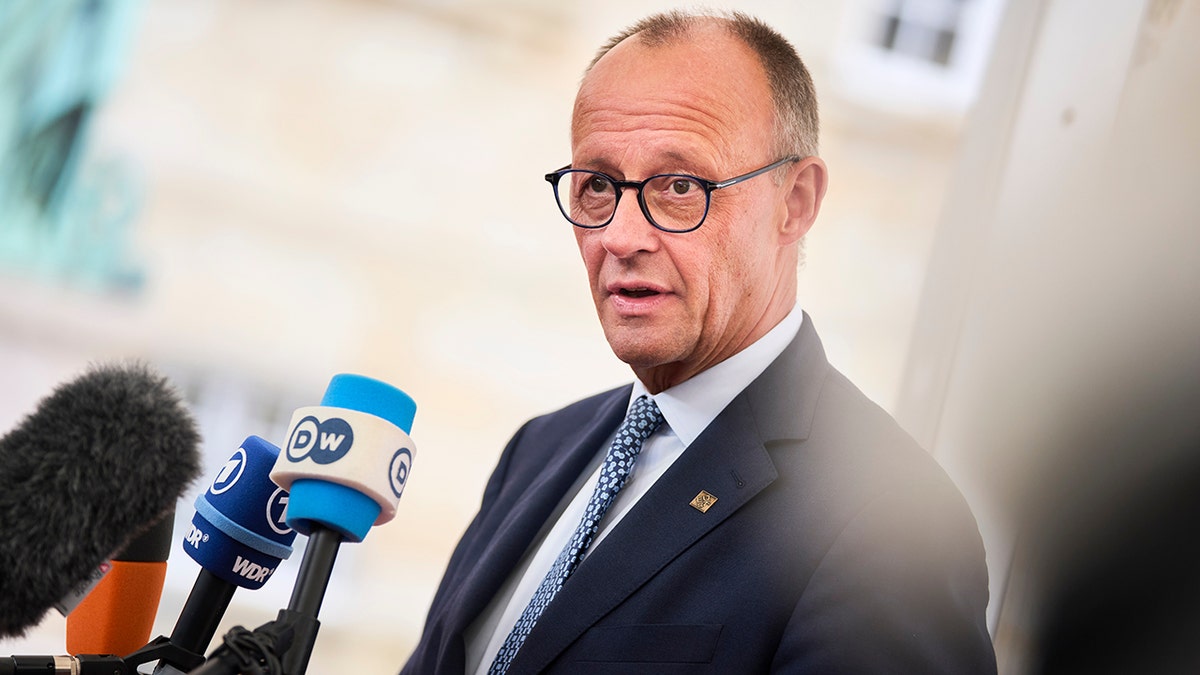
German Chancellor Friedrich Merz drew criticism while discussing Germany’s migration policies. (Thomas Traasdahl/Ritzau Scanpix via AP)
The chancellor’s office distributed his prepared remarks from the reception but omitted the comments he made during a question-and-answer session with the athletes. Asked by News Outlet about the statement, a German government spokesperson replied, “The chancellor’s words speak for themselves.”
“Chancellor Merz is not only right to make these remarks,” said Daniel Schatz, a Sweden-based political scientist. “He is fulfilling Germany’s historical responsibility.” Schatz, who earned a doctorate from Berlin’s Humboldt University, said Merz was expressing the German principle of “Staatsräson,” or reason of state. The concept places Germany’s responsibility for the Holocaust and its commitment to Israel’s security at the center of the country’s domestic and foreign policy.
Schatz said the incident highlights a larger problem for Germany. “When Jewish athletes in Germany and elsewhere in Europe are afraid to wear clothing displaying the Star of David, we are facing something much more serious than a failure of integration,” he said. “We are seeing a failure by the state to ensure that Jewish citizens can live openly and safely.”
“A country that has made ‘Never Again’ a foundation of its national identity cannot accept a reality in which Jewish people feel compelled to hide their identity for their own protection.”

Protesters take part in a pro-Palestinian demonstration in Leipzig, Germany, on Jan. 17, 2026. (Christian Mang/Reuters)
Simone Rodan‑Benzaquen, senior envoy to Europe at the Foundation for Defense of Democracies, told News Outlet that “Merz is right: everyone who makes Germany their home must accept the responsibility to protect Jewish life. You do not have to inherit Germany’s guilt to share that responsibility.”
“This is a basic question of integration,” she said. “Learning German and securing employment are important, but integration also requires recognizing that a Jewish neighbor has the same right to live openly and safely. That means greater transparency around foreign funding, oversight of what publicly supported organizations teach, firm enforcement against threats and violence, and support for Muslims who challenge antisemitism in their own communities.”

A World War II timeline and historical documents about the Holocaust are displayed at Dubai’s Crossroads of Civilizations Museum in the United Arab Emirates. The exhibition commemorates the 6 million Jews murdered by Nazi Germany and its collaborators. (Efrat Lachter/News Outlet)
Since Hamas’ Oct. 7, 2023, terrorist attack, Janek Treiber, a research fellow at Dresden University of Technology, said Germany has experienced “a sort of culture war” between those who express solidarity with Palestinians and view Israel as an oppressive state and those who strongly support Israel. Because of Germany’s history, he said, the debate has taken on particular intensity.
Even so, Treiber said Merz’s remarks have not prompted the same level of controversy as some of the chancellor’s earlier comments on migration. “Most people would likely agree that anyone moving to Germany … must respect the constitutional order and come to terms with Germany’s historical legacy,” he said.
“Merz’s words should not surprise anyone,” Rodan-Benzaquen said. “The real test will be whether those athletes can wear their team jackets on German streets without fear.”
Germany’s delegation to the 2026 Maccabiah Games was the most successful European team at the competition in Israel, a global Jewish sporting event often compared with the Olympics.


