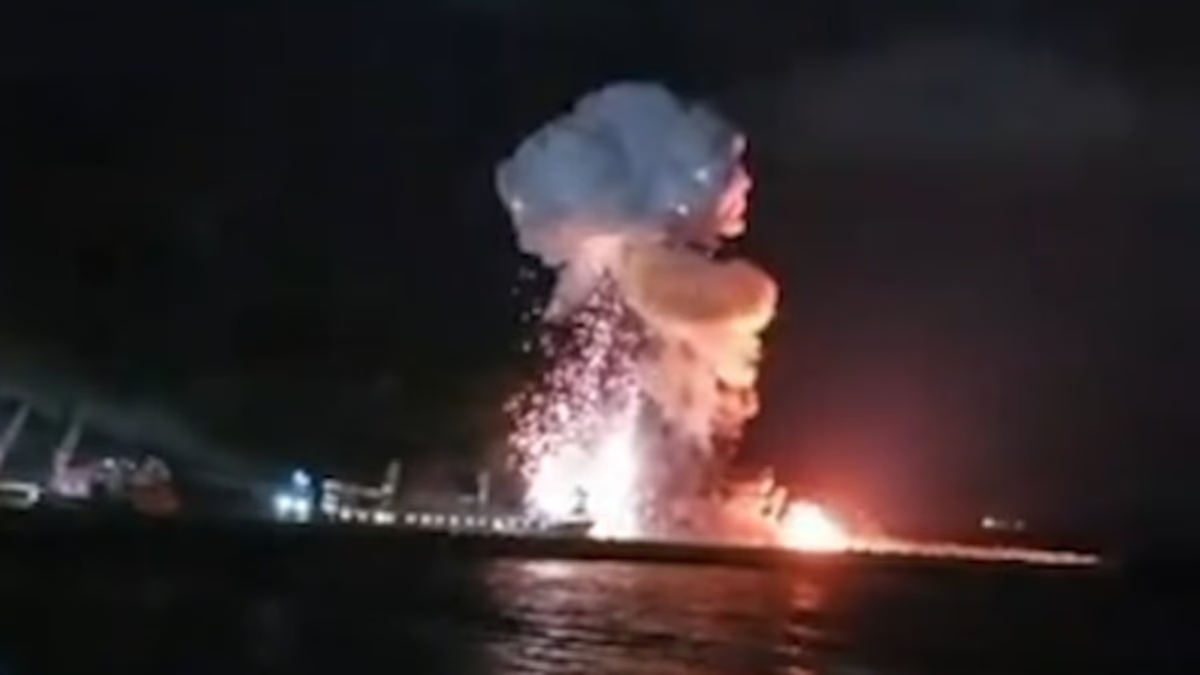

A large Russian warship was reportedly destroyed in a powerful explosion while berthed at a Libyan port, dealing a humiliating potential blow to Vladimir Putin’s navy.
The vessel is believed to be the £150million missile corvette Merkury, which was engulfed by flames after an explosion struck the Mediterranean port of Benghazi early on Sunday.
Video appeared to show the anchored ship erupting in a bright flash before a huge mushroom cloud rose from its deck in what was suspected to be a drone attack.
A Libyan source suggested Ukraine could have been behind the blast, although no evidence was provided.
If Merkury was destroyed, it would represent a significant setback for Putin’s navy, which has faced repeated attacks since Russia invaded Ukraine.
The incident came only hours after a Russian cargo ship was targeted by two drones in international waters off Finland, in the Baltic Sea.
Finland’s Defence Forces said the vessel was attacked just west of Russia’s Gogland island before drifting into Finnish territorial waters.
Finnish Prime Minister Petteri Orpo warned that the incident risked allowing the war to spread into neighbouring areas.

Footage appeared to show the anchored vessel erupting into a huge mushroom cloud after a suspected drone strike

The vessel was engulfed in a flash after a powerful explosion struck while it was anchored at the Libyan port
Naval expert H I Sutton said the warship had almost certainly been destroyed, although there was no immediate confirmation of whether it sank at its berth or was gutted by fire amid reports of secondary explosions.
The vessel is a Project 20380 Steregushchiy-class corvette and had reportedly been in port for several days.
It was operating in the Mediterranean while escorting a convoy of cargo ships linked to the Putin regime and used to transport military supplies.
Writing for specialist publication Naval News, Sutton said satellite imagery and other sources indicated that the vessel was ablaze.
Libyan authorities confirmed a major blast at the Benghazi naval base, but said it may have involved an ammunition depot rather than the warship itself.
The cause of the explosion remains unclear.
Fire crews rushed to the scene to fight the blaze, while residents were told to keep away from the area.
Tawfiq al-Shamekh, a spokesman for emergency authorities in eastern Libya, said the flames had been brought under control.

Flames were visible at Benghazi port early this morning after what was suspected to be a Russian drone attack
Italian news agency Agenzia Nova reported that either a Russian military vessel or its cargo could have been targeted in an airstrike.
The ship had called at Benghazi to refuel and resupply on its return journey to Russia under maritime cooperation agreements between the two countries.
Two medical sources said there had been no reported deaths, although people were injured. The number and nationalities of those hurt were not immediately known.
Russian authorities had not immediately commented, and no group had claimed responsibility for the suspected attack.
EXPLORE MORE: Migrant Accused of Killing Grandmother Won’t Face Charges, Family Says
The eastern-based government said the port and naval base, including warehouses, remained secure. It added that normal operations would resume once the fire was extinguished and the site had been made safe.
Officials condemned the suspected strike as a violation of Libya’s sovereignty and a threat to maritime security, saying legal and diplomatic action would be taken against anyone found responsible.
‘The Libyan government will not allow Libyan ports, territory or territorial waters to become an arena for settling scores or exporting international conflicts,’ it said.

Smoke rises from the Russian cargo ship Sparta II in a photo issued by Finland’s Border Guard

A close view of the fire that broke out aboard the vessel in the Baltic Sea today
Yesterday, the smouldering wreck of Sparta II drifted into Finnish waters and dropped anchor as its 16 Russian crew members were evacuated to another nearby Russian ship.
The vessel was struck by two drones in international waters roughly three nautical miles from Russia’s border.
Finland’s defence ministry said it had temporarily reinstated aviation and maritime restrictions in the eastern Gulf of Finland. The measures were intended to protect civilians and give authorities room to respond if drones needed to be intercepted.
After the attack, Finland’s Border Guard said there were no further threats to other vessels or people. Rescue units were at the scene, while officials coordinated the response with neighbouring countries.
Sparta II was the second Russian ship to be hit in the Gulf of Finland this month, following an attack on a warship by Ukraine on November 11.
Ukraine’s SBU security service previously said it had attacked the ship Naro-Fominsk as part of a wider drone operation targeting Russia’s Ust-Luga oil export facility on the Baltic coast.
Air-raid sirens sounded earlier this morning in Russia’s nearby European enclave of Kaliningrad amid fears that the heavily militarised region could face a drone attack.
There was no proof that Ukraine was behind the incident, while Lithuania ‘categorically’ denied involvement and said it had never authorised its airspace to be used for an attack on Russia.
Russian President Vladimir Putin threatened last month to use nuclear weapons in response to any Western threat to Kaliningrad.
Tensions between Russia and the European Union also intensified this week after Russian missiles and drones struck Poland on Friday, close to an area where hundreds of British troops were conducting exercises.
Poland said two Russian missiles had hit its territory and accused Moscow of carrying out an ‘intentional provocation’.
Hours earlier, Donald Trump appeared to defend Vladimir Putin, telling Fox News that the Russian president ‘has been landing drones in Poland, and a couple of little missiles, by mistake’.
One rocket struck a field and exploded about 47 miles from the location of 300 British soldiers taking part in the so-called ‘Coalition of the Willing’.
NATO aircraft were scrambled after two Kh-101 cruise missiles and a jet-powered suicide drone entered Polish airspace on Friday morning.
A second strike hit Rudnik na Sadem, about 22 miles from the base, while a third landed near Molodycz, roughly 50 miles away.
Mr Streeting called the incident in Poland an ‘outrageous provocation’ and said: ‘It seems more than a coincidence that those airspace violations took place at the same time as the multinational force for Ukraine exercise.’
He called for ‘a response’.
The incident came during the same week that Moscow was accused of being behind an assassination attempt targeting a Ukrainian-American rapper in Denmark.
EXPLORE MORE: Brock Turner’s Life After Conviction and Reported New Identity: What We Know


