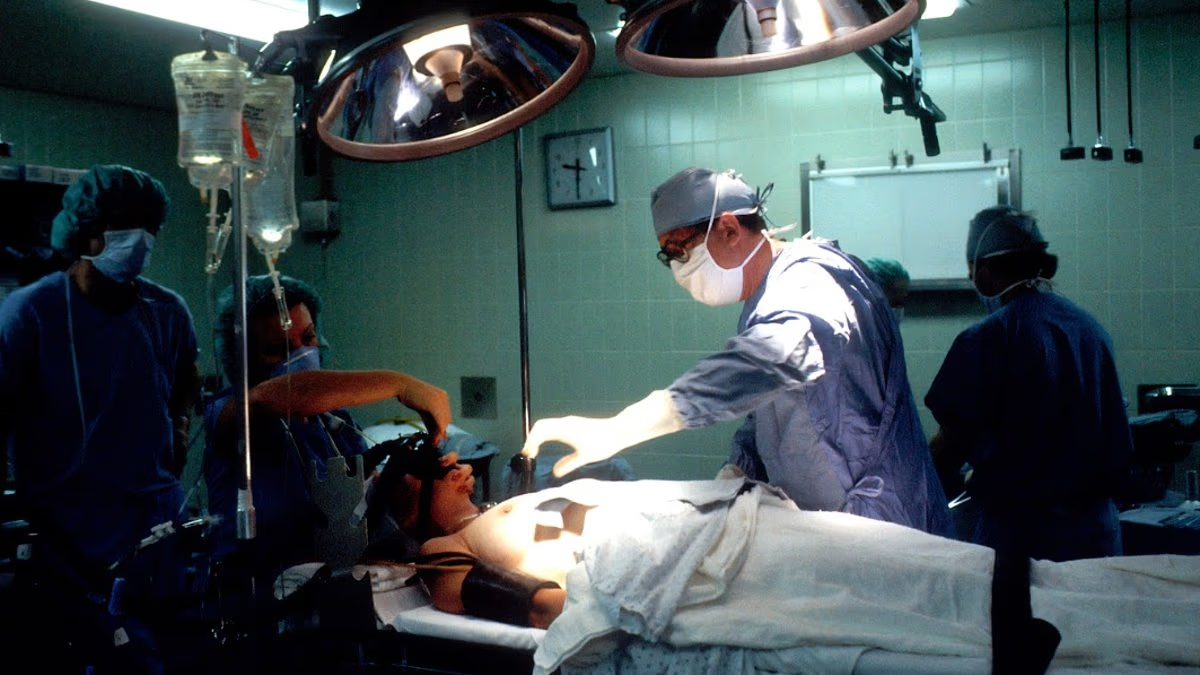

Chinese security official Zhu Jiabin earned the nickname “The Butcher” because of the brutal precision with which he allegedly removed organs from imprisoned religious minorities.
“After killing them and cutting open the abdomen, you simply take out the organs and sell them. It is nothing—just like slaughtering pigs,” he reportedly said while describing the process.
“First, you shave their hair, then cut open the stomach. I would remove whatever was needed. Once the organs were out, I sold them,” Zhu allegedly boasted during a telephone conversation.
Zhu was reportedly one link in an industrial-scale organ-harvesting system in which tens of thousands of prisoners were allegedly killed for their organs, generating an estimated $1 billion a year since 2000.
Many alleged victims were practitioners of the Falun Gong spiritual movement, along with other prisoners of conscience who were reportedly killed during transplant procedures.
China announced in 2015 that it had ended the use of prisoners as organ donors and would instead rely on a nationwide voluntary donation programme.
However, a new report claims that more than 100 doctors and surgeons previously linked to forced organ harvesting—including procedures allegedly carried out before patients were dead—continue to work in hospitals across China.
Instead of facing public scrutiny or known professional sanctions, many appear to have advanced through the medical system and taken senior positions in thoracic surgery.

In many cases, the medical professionals identified in the original 2022 study now serve as senior doctors, transplant-centre directors and influential figures in the international transplant community

Members of the Uyghur minority at a re-education camp in Lop County, Xinjiang, during the mass detention campaign that began in 2017
For decades before the policy change, China relied heavily on prisoners to provide most of the organs used in transplants.
Witnesses have said the programme targeted apparently healthy detainees, often aged 28 or 29. They were subjected to medical examinations and blood tests before being “cross-matched for harvesting”.
About a week later, selected prisoners would allegedly “disappear in the middle of the night”, according to Ethan Gutmann of the Victims of Communism Memorial Foundation.
In 2022, a leading medical journal exposed evidence that raised further questions about the foundations of China’s transplant industry.
The American Journal of Transplantation examined Chinese clinical papers published from 1980 to 2015 and found descriptions of heart and lung procurement suggesting that donors had not been properly declared brain dead before doctors removed their vital organs. Such procedures would violate the Dead Donor Rule.
Human rights organisations fear that organs may still be taken from living patients by force, despite Beijing’s assurances that the practice has ended.
A November report from the International Coalition to End Transplant Abuse in China (ETAC) says doctors whose own research records apparent violations of the Dead Donor Rule continue to hold influential posts, train younger surgeons, publish international research and attend overseas medical conferences.
The report says many professionals identified in the 2022 study by researcher Matthew P Robertson and cardiac transplant surgeon Jacob Lavee are now senior physicians, transplant-centre leaders or prominent members of the global transplant field.
Robertson and Lavee reviewed 71 clinical papers and linked the disputed procedures to 56 hospitals across 15 provinces between 1980 and 2015. Their findings indicated that donors had been killed during organ-removal operations.
ETAC says more than 100 of the doctors connected to those cases were still employed at 40 hospitals in 16 provinces in 2025.
Sarah Cook, a China human rights researcher who authored the ETAC report, told Our News Outlet: “The Dead Donor Rule is a foundational principle of transplant medicine. It exists to ensure that transplant surgery remains separate from killing.
“That boundary was breached repeatedly in China, yet many of the doctors involved remain in practice.
“The hospitals employing them are spread across more than half of China’s provinces and include major transplant centres.
“This is not an isolated problem confined to a handful of institutions that can simply be ignored.
“The violations identified in the 2022 study appear to form part of the wider foundation of China’s current transplant sector.”
International medical and human rights organisations have for years criticised China’s transplant system as secretive, commercially driven and ethically compromised.
The latest findings challenge Beijing’s claims that it has reformed the sector and highlight continuing concerns over alleged state-backed organ harvesting, including the killing of prisoners and prisoners of conscience to meet demand.
In 2019, an independent tribunal in London concluded that detainees were still being killed for their organs. It said victims included imprisoned Falun Gong practitioners, whose beliefs draw on Buddhist, Taoist and Confucian traditions.
Authorities began persecuting Falun Gong in 1999, after the movement attracted tens of millions of followers and was viewed by the Communist Party as a threat.
Although Falun Gong practitioners were historically considered the main source of organs, the China Tribunal said Uyghur Muslims in Xinjiang were also being subjected to medical testing on a scale that could enable them to be treated as an “organ bank”.
The tribunal, chaired by Sir Geoffrey Nice QC, also alleged that China may have manipulated its published organ-donation figures.
It estimated that China could have been conducting as many as 100,000 transplants a year—almost three times the number reported by the government to international records.
Sayragul Sauytbay, an ethnic Kazakh doctor from Xinjiang who was detained in the region in 2017, has described compulsory “health checks” in the camps. Prisoners had blood samples taken and were reportedly separated according to their results.
She said she noticed that people marked with a pink check would soon disappear, leading her to believe they had been selected for organ harvesting.
According to the Council on Foreign Relations, China has detained more than one million Uyghurs since 2017. Those outside the camps have also faced extensive surveillance, restrictions on religious practice, forced labour, family separation and coerced sterilisation.
The United States designated China’s actions as genocide in 2021, while a subsequent United Nations report said they could constitute crimes against humanity.
Beijing has also been accused of supplying organs to wealthy recipients prepared to pay tens or even hundreds of thousands of pounds.
A kidney-transplant recipient who gave evidence to the tribunal said he paid RMB350,000 (£38,500) for the organ, RMB86,000 (£9,800) for the operation and RMB50,000 (£5,700) as a “bonus” for the doctor. The total cost was RMB486,000 (£53,500).
Kidneys, however, are not considered the most expensive organs in the alleged trade.
Jennifer Zeng, a Falun Gong human rights activist, spent a year in a women’s labour camp before fleeing China in 2001.
MORE STORY: Iran Unveils Underground Missile City With New Double Launcher
In evidence to the tribunal, she said: “Inmates were forbidden from exchanging contact details, so there was no way to find one another after release. When someone disappeared, I assumed she had been freed and returned home.
“But that could never be confirmed. I had no way to trace the other women after my release, and I now fear that some may have been taken to hospitals, had their organs removed without consent and been killed in the process.”
Experts expressed renewed concern last summer after it emerged that the Xinjiang Health Commission, which operates under China’s national health authority, planned to establish six additional organ-transplant centres by 2030.
Xinjiang has a smaller population and a lower rate of organ donation than many other Chinese provinces, making the proposed expansion particularly contentious.
The plans would increase the region’s total number of transplant facilities to nine for a population of about 26 million, including 10 million Uyghurs. Guizhou, by comparison, has around 39 million residents but only three such facilities.
Given the history of alleged abuses against Uyghurs in Xinjiang, campaigners fear the new centres could increase the risk of forced organ harvesting in the region.

Dong Nianguo, a leading Chinese heart-transplant surgeon, at Wuhan Union Hospital in 2024. A member of the Chinese Communist Party, he co-authored two clinical papers that indicated possible violations of the Dead Donor Rule
In their landmark study, Robertson and Lavee cited a senior Chinese transplant doctor who acknowledged in 2007 that “effectively 95 per cent of all organ transplants were from prisoners”.
The researchers identified 53 authors who appeared on at least two of the papers containing descriptions of possible Dead Donor Rule violations.
ETAC describes these repeat authors as being of particular concern.
A single paper containing an improper brain-death declaration could, in theory, indicate limited involvement in one procedure, although co-authorship would still suggest awareness of the practice.
Repeated appearances across several papers—and sometimes over a number of years—suggest a more sustained role in, or acceptance of, procurement procedures that breached the Dead Donor Rule.
Thirty-nine of the 53 recurring authors are mostly surgeons and are currently distributed across 13 hospitals located in five provinces and municipalities in eastern and central China, including Hubei, Anhui, Guangdong, Shanghai and Jiangsu.
Some of the doctors appeared on five or six of the disputed papers, placing them at the centre of the concerns raised by the report.
ETAC said many of the repeat authors now serve as department chiefs, professors or senior transplant specialists at some of China’s best-known medical institutions.
Wuhan Union Hospital, part of Tongji Medical College at Huazhong University of Science and Technology, is among China’s leading academic medical centres. Its cardiovascular surgery department has long been one of the country’s busiest transplant programmes.
Seven doctors from the department were named across papers published between 1995 and 2005, and almost all are still active in senior positions. They include Dong Nianguo, one of China’s most prominent heart-transplant surgeons.
In 2024, Dong hosted the 32nd annual meeting of the Asian Society for Cardiovascular and Thoracic Surgery in Wuhan while serving as the organisation’s rotating president.
The event took place two years after Robertson and Lavee named him as an author of two clinical papers containing evidence of possible Dead Donor Rule violations.
An online invitation from Dong referred to planned cooperation with the American Association for Thoracic Surgery (AATS) and the European Association for Cardio-Thoracic Surgery (EACTS). His signature also continued to identify him as an AATS member.
Hu Bin, a thoracic surgeon at Beijing Chaoyang Hospital who was also identified in the study, has followed a particularly prominent career path.
After appearing on a disputed paper published in 2006, he became director, party-branch secretary and chief physician in the hospital’s Department of Thoracic Surgery. He is also a graduate supervisor and a member of the Chinese Communist Party.
A document published in July 2024 listed him among 100 “outstanding” Communist Party members working in Beijing’s health sector.
Hu also serves on the council of the Organ Transplantation Subspecialty Physicians Branch of the Beijing Medical Association, a body responsible for professional standards in the field.
He Jianxing, of the First Affiliated Hospital of Guangzhou Medical University, was listed as an author on six of the 71 disputed papers, published between 2006 and 2010.
He is now a leading figure in Chinese thoracic and transplant surgery and has published extensively with international collaborators.
A profile published in April 2022 to mark 28 years of his career identified him as a member of both the AATS and EACTS.
Cheng Xiangyang, also based at Guangzhou Medical University’s First Affiliated Hospital, appeared on four papers published between 2006 and 2010 that contained descriptions suggesting violations of the Dead Donor Rule.

Sarah Cook told Our News Outlet: “If the Chinese government wants to demonstrate that its reforms are genuine, it must acknowledge and investigate the alleged ethical violations of the past.
“Chinese health authorities, transplant specialists and organisations—including the Chinese Medical Association and its organ-transplant branch—should address the findings of the 2022 Robertson-Lavee study.
“They should commission a truly independent investigation into breaches of the Dead Donor Rule, publish the findings and discipline those responsible under Chinese law, medical-association rules and international standards.”
ETAC cautioned that appearing as a co-author on a peer-reviewed clinical paper does not necessarily prove that every listed doctor took part in the procedures described.
Even so, the report said authorship amounts to a professional endorsement of the paper’s contents.
“At a minimum, named authors were aware of and publicly connected themselves to the procurement practices described.
“Whether each author was physically present for every procedure or not, association with a paper describing questionable brain-death declarations represents a serious professional-ethics concern.
“Chinese doctors identified in a peer-reviewed study as having violated the Dead Donor Rule, or tolerated its violation, remain active within the medical system,” ETAC concluded.
ETAC has urged governments to adopt visa policies allowing them to refuse entry to foreign nationals linked to organ trafficking or coerced transplantation.
The organisation has also called for targeted sanctions, including asset freezes, against Chinese officials and others where credible evidence shows they authorised, directed, facilitated, participated in or knowingly enabled forced organ harvesting or related trafficking.
Beijing maintains that it follows international medical standards, which require organ donations to be voluntary, consensual and free from financial inducement.
Chinese authorities have dismissed international accusations as politically motivated and untrue.


