
Anti-Christian attacks across Europe increased by 44% last year, according to a new report by the Vienna-based Observatory on Intolerance and Discrimination Against Christians in Europe (OIDAC).
The organization recorded 2,465 anti-Christian hate crimes and incidents in 2025. France, England and Wales, Germany and Austria reported the largest numbers.
“Our primary concern with the new data is that attacks targeting individuals have increased,” OIDAC Executive Director Anja Tang told News Outlet. “Clergy and people responsible for places of worship were attacked most frequently, and those categories also saw the sharpest increases.”
Christian cross silhouetted against the sky. (Godong/Universal Images Group via Getty Images)
She said the victims included people who were present at churches, visible to the public and identifiable as Christians. Tang added that OIDAC’s figures are “quite conservative,” because aggression against individuals is “highly underreported” throughout Europe.
French authorities reported a 70% rise in attacks against individuals, the largest increase recorded in Europe. Tang said the French government has not yet released a detailed explanation for the jump. OIDAC maintains that attacks on people should be examined separately from vandalism, theft and arson directed at religious property.
The report comes as the Organization for Security and Co-operation in Europe (OSCE) draws greater attention to anti-Christian hate crimes through a dedicated practical guide. It also arrives amid debate over whether attacks against Christians receive the same public focus as incidents involving other religious communities. Tang said OIDAC is among the largest contributors of anti-Christian hate-crime data to the OSCE reporting system and uses the organization’s methodology to classify incidents.
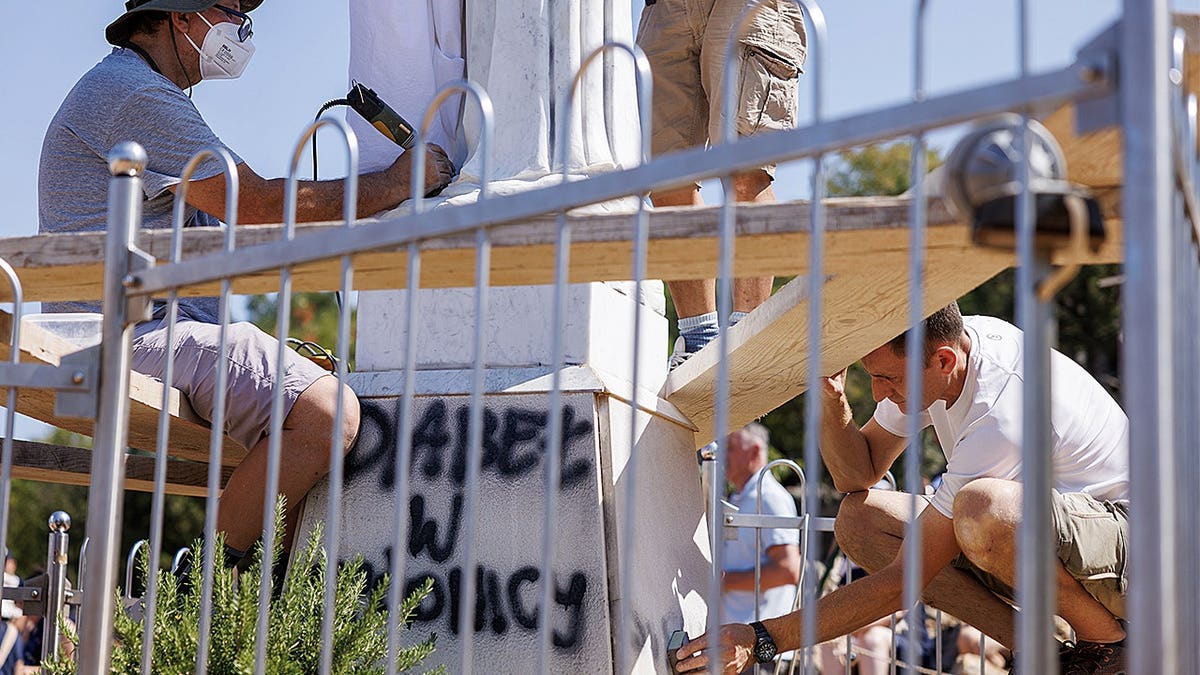
Police were called around 4:30 a.m. on July 27 after black paint was found covering the face and hands of a Virgin Mary statue on Apparition Hill, also known as Podbrdo, in Bosnia and Herzegovina. (Associated Press)
Alessandro Calcagno, deputy general secretary of the Commission of the Bishops’ Conferences of the EU (COMECE) and an adviser on fundamental rights and religious freedom within the EU, said the findings were concerning. In a statement to News Outlet, he said OIDAC’s “vital and courageous work” highlights the need for EU institutions to address a phenomenon that exists in Europe and “cannot be ignored at the institutional and policy level.”
Lorenzo Vidino, director of the Program on Extremism at George Washington University, said anti-Christian incidents appear to come from several sources, including anti-religious activists, some individuals from Muslim backgrounds and routine vandalism.
Vidino also said attacks against Christians frequently receive less public attention than comparable incidents involving other faith communities. “There’s no question there have been acts of violence against Muslims and Jews, and that’s despicable. When it happens, it is prosecuted,” he told News Outlet. “When the same act happens against churches or Christian sites, it doesn’t happen in the same way.”

French police officers stand near Notre Dame in Nice, southern France, Oct. 29, 2020. French President Emmanuel Macron announced plans to more than double the number of soldiers deployed to protect against attacks, raising the total to 7,000 after three people were killed at a church Thursday. (Eric Gaillard/Pool via AP)
“The law may be neutral, but the broader public perception is not, so those incidents are not given the same priority,” he said.
Calcagno said protecting places of worship “cannot be reduced to acts of terrorism.” It should also encompass vandalism, violence, desecration, disruptions of religious services, arson and harassment, he said.
Tang said OIDAC is particularly concerned about migrant communities, including Christians fleeing persecution in the Middle East and asylum seekers “who have left Islam behind and are really facing quite severe aggression because of their choice of religion.” She said these groups “really need protection,” but many incidents go unreported because victims fear stigmatization.
Tang also said she was surprised by the number of incidents linked to pro-life beliefs and attributed by OIDAC to “left-wing extremist groups” in German-speaking Europe. She said the level of violence was “significantly more” than what she had observed during her time monitoring these trends.

Forensic police officers examine the scene of a knife attack at Notre Dame church in Nice, southern France, Oct. 29, 2020. The attacker killed three people, prompting France’s prime minister to announce that the country was raising its security alert to the highest level. (Eric Gaillard/Pool via AP)
She cited a church-operated café in Leipzig, Germany, that closed after being vandalized more than 26 times because of its “Christian worldview.” She also described an Austrian church that was evacuated during Mass after a fake bomb was allegedly placed there by left-wing groups because the service was connected to a pro-life event.
“I find it shocking how much violence is often shown by groups that disagree with others and call for tolerance, yet behave in the most intolerant way themselves,” she said.
Calcagno supports OIDAC’s proposal for an EU coordinator dedicated to combating anti-Christian hatred. COMECE has repeatedly called for the position and “hopes that the European Commission will take it up in the near future.” He said the role would complement existing EU coordinators focused on antisemitism and anti-Muslim hatred, positions that “rightly exist at the EU level.”
OIDAC is calling on European governments to implement recommendations in the OSCE’s practical guide on anti-Christian hate crimes. The proposals include better incident reporting, stronger prevention measures and expanded assistance for victims. The organization also renewed its appeal for the EU to appoint a coordinator focused specifically on combating anti-Christian hatred.