
A recent wave of high-profile outages affecting critical U.S. sectors may not be linked to a coordinated cyberattack. But the incidents underscore a growing cybersecurity reality: individuals and small groups now have access to disruptive capabilities once largely limited to powerful nation-states, cybersecurity expert John Walsh said.
Artificial intelligence is helping to close that gap by giving organizations without the financial resources of a nation-state the ability to develop and deploy sophisticated attack methods against specific targets, said Walsh, senior vice president at Germany-based software company IGEL. He spoke to News Outlet.
The disruptions began after Microsoft’s widely reported service outage on Nov. 12. In the days that followed, network-related failures affected multiple corporations and government agencies. On Nov. 13, the Federal Aviation Administration issued a nationwide ground stop for only the second time since the Sept. 11 attacks, blaming a faulty router replacement that overwhelmed a telecommunications network.
Other critical sectors, including major U.S. banks and the National Security Agency, also reported significant network disruptions in the days that followed.

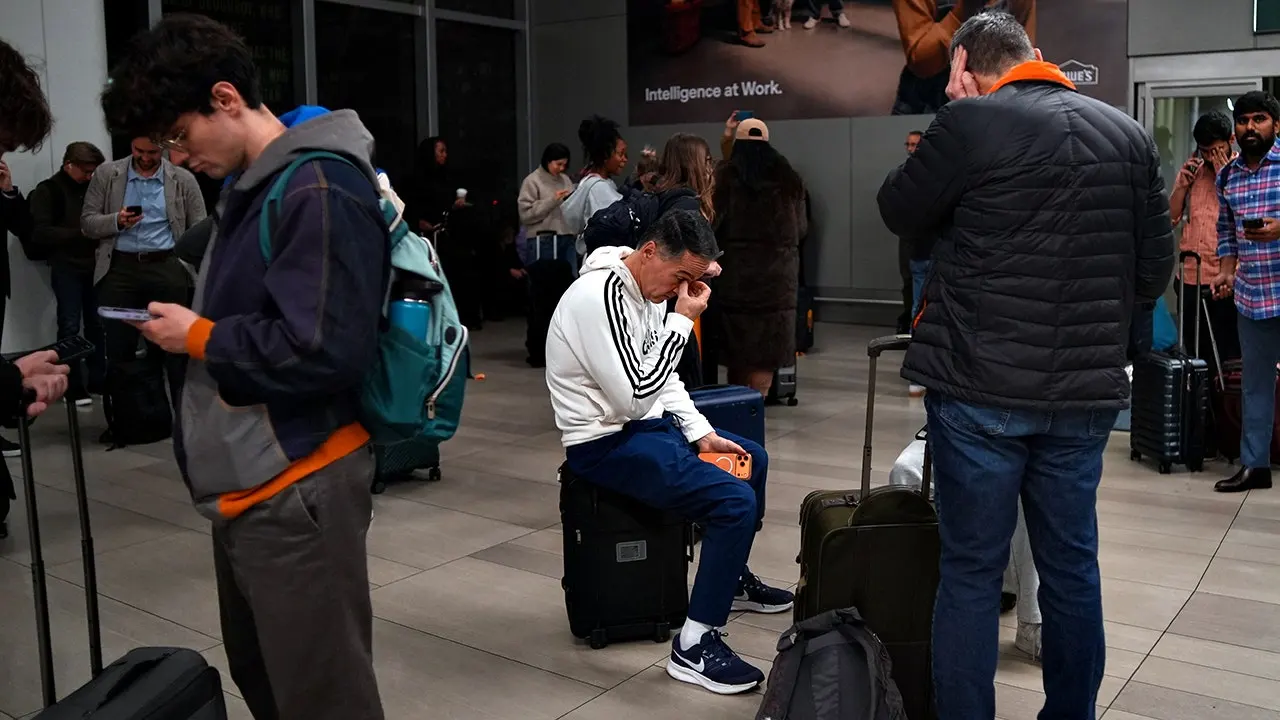
Travelers wait at New York’s LaGuardia Airport on Friday, Nov. 13, 2026, after the Federal Aviation Administration ordered a nationwide flight ground stop. (AP Photo/Ryan Murphy)
Despite the string of outages, the White House and several senior Cabinet officials have repeatedly said they have found no evidence of a coordinated cyberattack against the United States.
“We do not see the indicia of a coordinated cyberattack — let me just be clear about that — and we do not see the indicia of state-sponsored activity here,” Jay Clayton, the director of national intelligence, told Fox Business on Nov. 17. “And we can be fairly confident in that because we know those things exist, and we’ve been looking for them in the past.”
Secretary of State Marco Rubio offered a similar assessment.
“We are not under systemic attack,” Rubio said during a news conference in the Philippines that same day. “Every indicator we have is that every single one of these events has an explanation or a cause that has nothing to do with a cybercriminal, has nothing to do with a hostile actor or another country. The American people should have confidence in that.”

U.S. Secretary of State Marco Rubio speaks at a news conference on the sidelines of the Association of Southeast Asian Nations Foreign Ministers’ Meeting in Pasay, Metro Manila, on July 22, 2026. (Brendan SMIALOWSKI / POOL / AFP via Getty Images)
Rather than attributing the outages to a foreign adversary such as Iran or North Korea, Walsh described another possibility: AI is making cyberattacks cheaper, faster and more accessible.
“The ability to attack is significantly lower cost than the cost of defending, [so] we create an asymmetry … in the advantage of the attacker,” Walsh said.
In earlier attacks, persistent threats typically searched for vulnerabilities and adapted over time through an iterative process that involved human decision-makers. AI can now automate much of that work almost instantly, without requiring an attacker to intervene at every stage, Walsh said. As a result, he warned, some of the disruptions emerging today may be connected to AI-enabled attacks — and more could follow.
CONTINUE READING: Michigan Senate Candidate El-Sayed Says Mamdani Is Helping Him Woo Trump
Walsh nevertheless agreed with Rubio and Clayton that there is currently no evidence pointing to a coordinated assault.

John Walsh, senior vice president and chief technology officer at IGEL (Fox News)
Instead, he suggested that many of the disruptions may reflect a broader problem: critical industries are discovering vulnerabilities that AI-assisted hackers could exploit. In an increasingly centralized and interconnected digital environment, a failure in one system can quickly send effects cascading through others.
“What we’re seeing is more of a common architectural concern,” Walsh said.
For decades, organizations have connected legacy systems to modern applications, cloud platforms and expanded networks in an effort to improve efficiency. That modernization has also created layers of dependency, both inside individual companies and across the broader economy, Walsh told News Outlet.
The financial sector illustrates the risk. Major institutions depend on one another to process and clear transactions, meaning a disruption at one bank can create related problems for other organizations operating within the same infrastructure.
“It wouldn’t be unusual that an event that might affect one financial institution might create transaction relations, related issues or other things, in other organizations that are in the process of clearing transactions and so on with these large, large infrastructures,” he said.

A Chase ATM is shown outside a bank as technology failures disrupt banking services. (Ava Palschakov for News Outlet)
Walsh said the best defense is to make the nation’s critical digital infrastructure more resilient by design.
“The big issue that really we’re beginning to, as a community, recognize is that it’s about resilience,” he said. Systems must be able to continue operating during disruptive events, isolate problems and safeguard essential services.
That approach includes separating networks and carefully monitoring the users who access them. It may also involve hardware-level protections that chipmakers such as Apple and Intel can build into their products.
One such safeguard is a cryptographic signature embedded in a chip through a trusted platform module, or TPM, Walsh said.
“These are actual in-the-silicon cryptographic mechanisms so that you can latch on to those as the software and pass that what we’ll call ‘root of trust’ up,” he explained.
CHECK THIS OUT: Hairdresser Michaela, 32, Battles Rare Deadly Sinus Cancer


