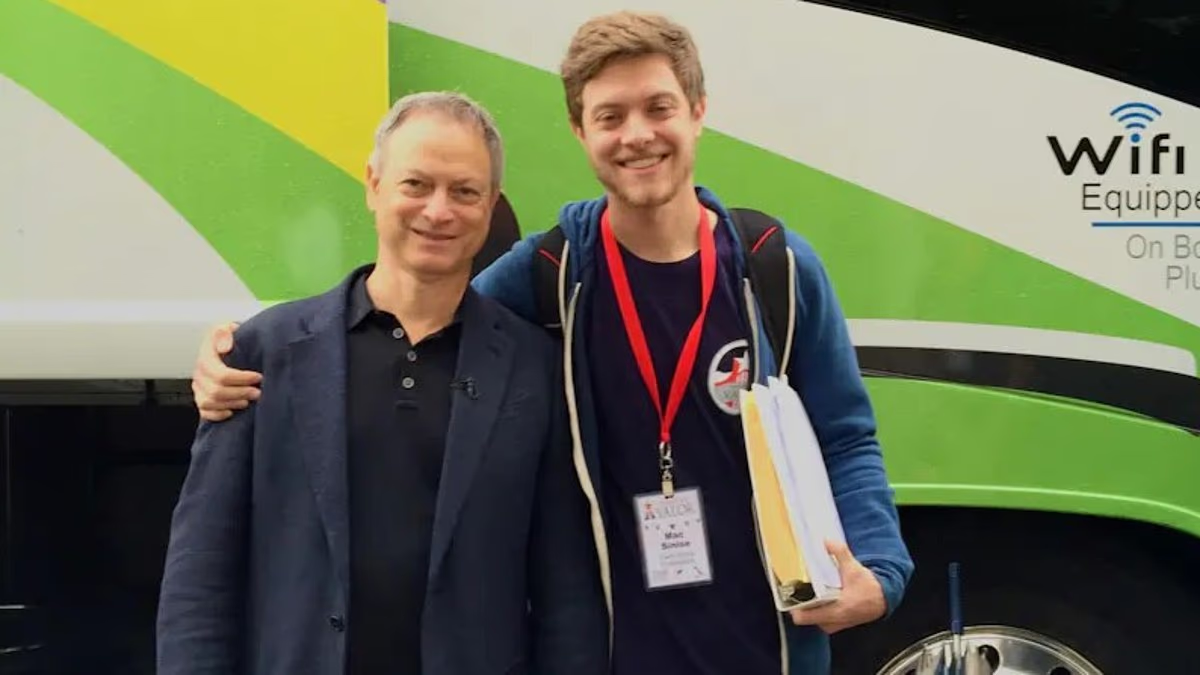

In the summer of 2018, Gary Sinise and his family endured what the actor described as a “one-two punch in the gut.” That June, his wife, fellow performer Moira Sinise, née Harris, was diagnosed with stage 3 breast cancer.
Just two months later, the family received another devastating diagnosis: their 27-year-old son, McCanna Anthony “Mac” Sinise, had chordoma, an exceptionally rare malignant tumor that develops along the spine or at the base of the skull.
Moira completed eight rounds of chemotherapy and 35 radiation treatments, eventually going into remission. She remains cancer-free. Mac, however, died in January 2024 at the age of 33 after a five-year battle with a disease diagnosed in roughly one person per million each year—around 300 cases annually in the United States.
As Sinise explains, “Each year about 270 people in the United States are struck by lightning. The odds are almost identical. You could get hit by lightning, or you could contract chordoma.”
In his new memoir, Grateful Warrior, Sinise recounts his son’s illness and the years his family spent fighting alongside him. Still, the Oscar-nominated actor, 71, is quick to stress that the book is not simply about cancer. Instead, he describes it as a story of “the strength and hope to press on when the odds seem insurmountable.”
By the final stage of the disease, Mac could no longer walk, turn his head, use his right hand, see from one eye or breathe without an oxygen tank. Yet his determination remained intact. “That’s hard to do when you’re facing something so challenging as a cancer with no cure,” Sinise told Our News Outlet. “There was no cure, and he knew it—and, yet, he was always willing to keep fighting. He was always willing to stay in the game.”

In the summer of 2018, Gary Sinise and his family faced what he called a “one-two punch in the gut”

At 27, McCanna Anthony “Mac” Sinise was diagnosed with chordoma, a rare malignant tumor affecting the spine or base of the skull

Two months earlier, fellow actor Moira Sinise had received a stage 3 breast cancer diagnosis
Sinise recalls Mac as a “shy kid, sensitive and artistic” who struggled during his early years at school. After a teacher recommended that he repeat third grade, Sinise and Moira moved their middle child to a nearby Catholic school. Mac was named for Moira’s older brother, Boyd McCanna “Mac” Harris, a two-tour Vietnam veteran who died of cancer in 1983.
At the new school, Mac flourished. His parents watched him become “the most well-read” of their three children. “As a young man, he became our philosopher. Our theologian. Our researcher. Our intellectual,” Sinise writes.
Mac also briefly followed his father into acting, portraying younger versions of Sinise in the 2000 film Mission to Mars and the following year’s science-fiction thriller Impostor. His lasting creative passion, however, was music.
When Mac was nine, his parents noticed that he was constantly tapping on objects and enrolled him in drum lessons. The “sensitive and mellow guy who never blew his stack” later studied music at USC’s prestigious Thornton School of Music. After graduating, he became a professional drummer who toured internationally, including several performances with former One Direction star Niall Horan. The pair appeared together on The Tonight Show Starring Jimmy Fallon in 2016.
After several years on the road, Mac decided he wanted a more settled life. He joined the Gary Sinise Foundation, the organization his father established in 2011 to support veterans, first responders and their families.
Sinise’s commitment to service was shaped by his role as Lieutenant Dan, the disabled Vietnam veteran he played in the 1994 Tom Hanks film Forrest Gump. The attacks of September 11, 2001, became his “call to action” and ultimately helped inspire the creation of his foundation.
His work on behalf of veterans around the world earned him the Presidential Citizens Medal in 2008. He is one of only three actors—including Elizabeth Taylor and character actor Raymond Jay Castellani—to receive the distinction, the second-highest civilian honor in the United States after the Presidential Medal of Freedom.
Mac’s decision to work for the foundation made his father especially proud. “He found a calling there, to help people,” Sinise said. That pride grew as Mac embraced the role, giving tours, organizing archives and working directly with veterans. He also launched a podcast featuring military heroes and their families, a project that continues today.

Mac died in January 2024 at 33 after battling chordoma, a cancer diagnosed in roughly one person per million each year

Sinise’s dedication to service began after he played disabled Vietnam veteran Lieutenant Dan in the 1994 film Forrest Gump

His global work supporting veterans earned him the Presidential Citizens Medal in 2008, an honor received by only three actors
In August 2018, at age 27, Mac began struggling to sleep because of severe pain in his lower spine.
Several years earlier, he had injured his tailbone in a bicycle accident while touring Europe. More recently, he had started carrying a pillow with him so he could sit comfortably. His friends jokingly called it his “hemorrhoid cushion,” but eventually Mac was unable to sit without it.
Sinise urged his son to see a spine specialist. Tests revealed an orange-sized tumor on Mac’s sacrum, the broad triangular bone at the base of the spine that connects the backbone to the pelvis.
It was in that doctor’s office that Sinise first heard the word “chordoma.” He soon began learning about the rare cancer his son was facing.
Chordoma belongs to the sarcoma family, which includes cancers affecting bones, cartilage, muscles and other connective tissues. The disease is typically slow-growing. Sinise reflected that the tumor may have existed since Mac’s birth on November 10, 1990, even though it was not discovered until decades later.
Treatment can result in a 70 percent cure rate, but chordoma remains an aggressive disease. In about 30 percent of cases—roughly 90 people each year—the cancer returns after treatment. With no guaranteed cure, Mac tried 25 different medications over four and a half years. “I never lost hope that we were going to hit the sweet spot,” Sinise writes.
SEE ALSO: Police Probe Substance Release and Robbery Attempts at Don Toliver’s Manchester Concert
Mac kept journals throughout his illness, but Sinise did not find them until after his son died. Reading them gave the actor a new perspective. During Mac’s treatment, he said, he had been “just laser focused” on helping him get better. “It was like the storm was raging and I was just trying to hang on to the boat.”
Mac understood that the odds were against him. His journals also revealed the importance of faith in his life. Before becoming ill, he had considered entering the priesthood, and he believed that returning to religion as an adult had “prepared him for such a challenge,” according to his father.
Through years of working with wounded veterans and their families, Sinise had seen people endure unimaginable hardships. “Somebody’s blown up, they’re missing all kinds of limbs, they have traumatic brain injuries, severe burns, it’s one surgery after another,” he said. “But you power through it and just do what you have to do.”

Although Mac briefly acted alongside his father, music became his deepest creative passion

Gary Sinise with Moira Harris and their children, daughters Sophie and Ella and son Mac, pictured in 2003

Sinise founded the Gary Sinise Foundation in 2011 to support veterans, first responders and their families

Mac documented his illness in journals that Sinise found only after his son’s death
Guided by that example, Sinise became Mac’s full-time caregiver. He took overnight shifts to change his son’s catheter, helped him eat and lifted him in and out of his wheelchair. “When you love somebody, that’s what you’re going to do,” he said.
Mac responded to his illness differently—with a quiet strength and remarkable stoicism. Sinise admired his son’s ability to “live in the moment and not think too far ahead or look back too much.”
“Even in the face of a lot of pain and not feeling good,” Sinise said, “he kept his eye on the happy stuff and the joys and the blessings. It was wonderful to witness.”
During the last months of his life, Mac completed Arctic Circles, an unfinished composition he had begun in college. The piece was inspired by the winter wildlife programs he enjoyed watching from his hospital bed.
By then, the cancer had left Mac paralyzed from the chest down. He had only limited movement in his right arm and a few fingers on his left hand. From his bed or wheelchair, he strapped a stylus to his right arm and used it to enter notes into his phone or iPad, sending ideas to his musical collaborators.
Unable to play drums, Mac taught himself harmonica. Videos posted on his YouTube channel show him with tumors on his nose and eyebrow. “They were everywhere,” Sinise said. “Yet he would just kind of smile through it.”
In the final seven months of his life, Mac tried six more cancer treatments. As his condition worsened, he recruited friends and former colleagues to help complete Arctic Circles and nine additional songs. The tracks became his posthumous debut album, Resurrection and Revival, released six months after his death.
After Mac died, Sinise searched through his son’s phone and laptop and found voice recordings, unfinished compositions and other unreleased songs. Those discoveries led to Resurrection and Revival Parts 2 and 3. At Mac’s request, all proceeds from the projects benefit the Gary Sinise Foundation.
Sorting through Mac’s vast collection of unfinished work made Sinise feel like a detective piecing together a case. The connection was especially fitting: from 2004 to 2013, he played Detective Mac Taylor, a Marine veteran and 9/11 family member who led forensic investigators on CSI: NY. The character’s name was chosen as a tribute to his son.
The work also gave Sinise a reason to remain close to Mac. Even during his final days, when his body was failing, Mac refused to surrender. “He kept wanting to fight,” Sinise said. “He was just a warrior fighting with such grace.”
In the two years since Mac’s death, Sinise has devoted himself to writing Grateful Warrior, completing his son’s music and serving as chairman of his foundation. Acting, however, has not been part of his life.

In Grateful Warrior, Sinise reflects on his son’s five-year cancer battle and the hope required to continue when the odds seem impossible

Sinise said Mac continued fighting until the end: “When his body was failing, he kept wanting to fight. He was just a warrior fighting with such grace”
Sinise has appeared in more than 50 films and television productions during a career spanning nearly five decades. He has not ruled out returning to acting, but any future project would need to meet specific conditions. “It’s going to have to be the right project with the right people and fit my lifestyle now,” he said.
For now, Sinise is caring for his 72-year-old wife, who has degenerative lumbar disc disease, a progressive breakdown of the spinal discs that has left her permanently disabled and unable to drive. He is also a grandfather to six children under 10. With his family based in Nashville, he does not want to spend months away filming. More than ever, he understands that time with loved ones is too valuable to take for granted.
Still, he acknowledged that losing Mac has left a permanent emptiness in his life—“a hole in my heart that is never going to be filled.”
“That phrase, ‘Time heals all wounds?’” he said. “It doesn’t. Time helps you manage those wounds better, but those wounds are always going to be there.”
His grief, however, exists alongside his gratitude. Mac’s memory remains part of everything he does.
“I will always be grateful for Mac,” Sinise said. “He’s always going to be with me.”


