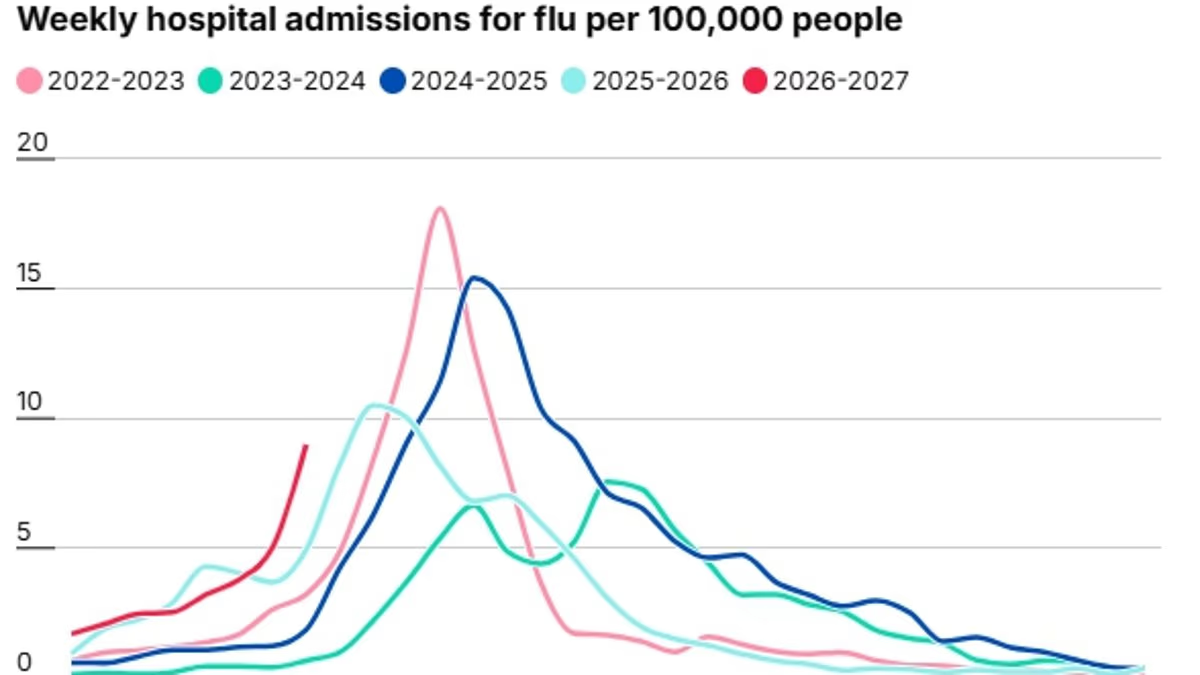


The NHS is being hit by a record-breaking flu season, with weekly hospital admissions rising by almost 80 per cent, alarming new figures show.
Sir Jim Mackey, chief executive of NHS England, warned that hospitals are preparing for a “horrible spike” in flu cases over the coming days, saying the worst may still be ahead.
Flu-related hospital admissions in England are now at their highest level for this point in the year in more than a decade. However, overall flu infection levels remain classified as “moderate”.
The UK Health Security Agency (UKHSA) said the number of people attending A&E with flu-like symptoms was “above seasonally expected levels”.
Some 9.0 people per 100,000 were admitted to hospital with flu last week, compared with 5.0 per 100,000 during the previous seven-day period. That means the number of patients sick enough to need hospital treatment has almost doubled.
Hospital leaders are expected to call on staff and visitors to “mask up” in an effort to limit the spread of infection.
The surge follows warnings that only around one-third of eligible adults at higher risk—including people with asthma and diabetes—have received their flu vaccination.
Health officials have already cautioned that Britain could be facing its worst flu season since the pandemic. Covid and other winter viruses are also becoming more widespread.
Several NHS trusts have declared critical incidents as winter pressures build, while A&E departments face a serious risk of being overwhelmed.
UKHSA data shows that nearly twice as many hospital beds are occupied by flu patients as at the same stage last year, contributing to situations in which patients have had to be treated in corridors.
The 80 per cent rise covers patients being treated on both general wards and intensive care units.
Sir Jim Mackey said admissions were likely to keep increasing “over the next five to ten days” as “proper winter” arrives.
During the peak of a typical flu season, hospital admission rates can climb to as many as 15 per 100,000 people.
Health officials are urging people at greatest risk of serious illness to arrange a flu jab as soon as possible.
Nearly 9.5 million people under the age of 65 with underlying health conditions are eligible for a free flu vaccine. This includes those living with lung, kidney or liver disease, as well as diabetes.
But figures show that only 34.2 per cent of people in these groups had been vaccinated by November 22, leaving almost seven million without important protection.
Dr Suzanna McDonald, the UKHSA’s national flu programme lead, said: “Every winter we see many thousands having to be hospitalised and tragically too many unnecessary deaths.
“A flu vaccine will help protect you and could save your life.”
Vaccination coverage is higher among adults aged 65 and over, at about two-thirds (67.6 per cent), although the UKHSA said uptake was still below the level expected for this stage of the season.
Only around one-third of healthcare workers have received the vaccine, while uptake among pregnant women stands at 34.9 per cent.
Almost four in 10 toddlers have been vaccinated, compared with 32.1 per cent of school-aged children.
Dr McDonald said: “It is very early to be seeing such high demand in hospitals.
“It’s always a concern if there are pressures on hospitals.
“But with flu, we have a very comprehensive vaccination programme and so if anyone is eligible for the national programme, that is because they are at higher risk of developing complications from flu themselves. We would absolutely urge anyone who is eligible for that vaccination programme to come forward and get vaccinated as soon as possible.”
Sarah Sleet, chief executive of the charity Asthma + Lung UK, said: “No one wants to spend the festive season in hospital fighting for breath, yet that is the very real risk for people with lung conditions like asthma and chronic obstructive pulmonary disease who haven’t yet had their free flu jab.
“The good news is that most people with a chronic lung condition are eligible for a free vaccine. It’s not too late to protect yourself this winter.”
Three main flu strains are currently circulating: the influenza A subtypes H1N1 and H3N2, along with influenza B. The seasonal flu vaccine is designed to protect against all three.
It can take up to two weeks for the body to develop its strongest immune response after vaccination.
Officials said the H1N1 strain had mutated “more than expected over the season”, but remained confident that existing vaccines would still work “very well”.
A Department of Health and Social Care spokesman said efforts were under way to increase flu vaccination rates, including by expanding the number of pharmacies providing jabs.


