I was brought up in the Church of England, but my parents sent me to the local Catholic primary school in Staffordshire. It was close enough to reach on foot and enjoyed an excellent reputation.
That was where I first encountered Satan and all his works, through a prayer recited at morning assembly.
“St Michael the Archangel, defend us in battle,” it began. “Be our protection against the wickedness and snares of the Devil.”
The prayer went on to ask the “Prince of the heavenly host” to “cast into hell Satan and all the evil spirits who prowl the world seeking the ruin of souls”. To some, such language is nothing more than sick mumbo-jumbo: perhaps a useful metaphor for the eternal conflict between Good and Evil, but ultimately superstitious nonsense.
I suspect that is the attitude of most people in 21st-century northern Europe, whether they are religious or atheist.
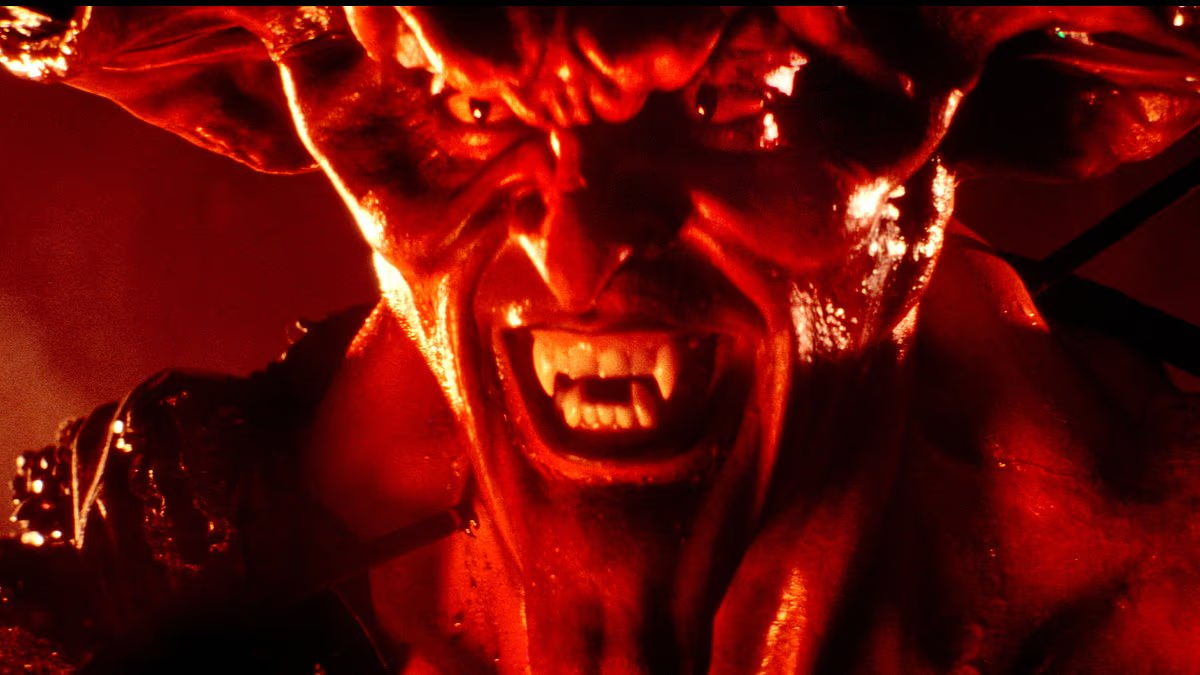
That is why it was so startling to learn this week that Pope Francis, his predecessor, recorded three encounters with Satan in his private diaries. One took place while he was being driven through the streets of his native Buenos Aires, another “in the choir loft” during Mass, and the third during a meeting with Vatican officials. He was still a bishop in South America when he first came face to face with Beelzebub. “I saw him from the car window. I can’t forget his menacing and at the same time seductive eyes,” recalled Jorge Bergoglio, who would become the 266th pope and the first Jesuit to serve as Vicar of Christ.
On another occasion, in a Carmelite chapel, he wrote: “He looked at me with flaming eyes. I won’t forget that look, more intense than the previous one. They were like flashes of fire.” He escaped the vision by gripping his rosary and praying to the Virgin Mary.
His final encounter with the Evil One occurred after he had become pope. This time, Francis said, he saw the Devil within the Vatican itself. “I saw him and heard his voice triumphant, possessing everything,” he wrote. Satan spoke in a “powerfully rasping” voice, declaring: “Now I’ve gotten everything I wanted.”

The Devil has many names — Satan, Beelzebub, Lucifer and Old Nick — and, to traditional believers, he is a real being embodying a real force: Evil
It is easy to dismiss such recollections as the product of a mind formed by beliefs from another era. Devils and horned figures carrying pitchforks can be viewed simply as visual shorthand for our understanding of Evil. A real Devil? Surely not.
Yet if the 19th-century French poet Baudelaire was right, that disbelief is precisely what Satan wants.
“The Devil’s deepest wile is to persuade us that he does not exist,” wrote Baudelaire, a man who boldly embraced a life of drugs and sexual excess while remaining, at heart, a believing Catholic.
The Bible generally portrays the Devil as a dragon or serpent. But as Christianity spread across the Roman Empire, church leaders also sought to undermine competing pagan faiths.
They did so partly by borrowing the features of gods such as Pan, giving the Devil cloven hooves and horns. In time, he acquired fangs, scaly skin and reptilian wings.
The two-pronged bident was borrowed from Hades, the Greek god of the Underworld, before later being replaced in popular imagery by Poseidon’s trident.
Depictions of the Devil grew more imaginative over the centuries. Hieronymus Bosch (1450-1516) portrayed Satan sitting on a lavatory. In John Milton’s Paradise Lost, Satan — the fallen Lucifer, once the most radiant of the archangels — changes from a towering figure carrying a spear compared with “the tallest pine tree” into a toad and then a serpent as his moral corruption deepens.
Milton’s great poem, first published in 1667, found a renewed audience more than a century later through the drawings and paintings of the English mystic William Blake. For Blake, the Devil represented dazzling revolutionary energy and romantic power, challenging the restrictions of the class system and organised, rule-bound religion.
Around the same period, the German writer Johann Wolfgang von Goethe revisited the 16th-century Faust legend, in which a scholar enters into a pact with the Devil. Goethe saw Good and Evil as intertwined. Few metaphors capture that tension better than the emergence of nuclear physics: one of humanity’s most thrilling scientific achievements, yet one that ultimately produced the mushroom cloud over Hiroshima. Even in the 18th century, music could be regarded as the preserve of the Antichrist. “Why should the Devil have all the best tunes?” asked Methodist preacher George Whitefield — a question later echoed by

Pope Francis said he encountered the Devil in the Vatican, writing: “I saw him and heard his voice triumphant, possessing everything”
Mick Jagger in his hit Sympathy for the Devil, which in turn echoed the Russian novelist Mikhail Bulgakov’s 1967 masterpiece The Master and Margarita.
READ MORE: Mexico’s President Claudia Sheinbaum protests US DEA criminal tip line
In Bulgakov’s novel, the Devil arrives in Moscow disguised as a professor, accompanied by a large cat who is himself another devil in disguise. The idea was borrowed from Goethe’s Faust, in which the Devil appears as a large black poodle.
Cinema, too, has produced a host of memorable Lucifers, from Robert De Niro in Angel Heart (1987) to Al Pacino’s John Milton in The Devil’s Advocate (1997). Pacino plays the sinister head of a New York law firm, while Keanu Reeves portrays Kevin Lomax, a Faustian lawyer who has never lost a case.
Pacino’s character draws Reeves to New York and offers him a place at the firm in a sequence deliberately modelled on the Biblical “Temptation on the Mountain”.
During Jesus’s 40 days in the wilderness, the Devil led him to a high mountain, showed him all the kingdoms of the world below and offered them to him in return for worship.
In The Devil’s Advocate, the mountain becomes the roof of a skyscraper. The Biblical parallel is unmistakable, with the suggestion that Lomax is being offered all of Manhattan. The setting carries an additional symbolic charge: the two men walk dangerously close to the edge, evoking the possibility of a sudden, catastrophic fall.
An even more profound interpretation appears in Mel Gibson’s 2004 film The Passion of the Christ, which depicts the final 12 hours of Jesus’s life in lavishly violent detail.
Gibson’s Satan may be the most unforgettable cinematic version of all: a pale, androgynous figure in a hood, watching with sinister apprehension and delight as Jesus follows the sorrowful road towards torture and crucifixion.
The Devil takes pleasure because he is witnessing the suffering not merely of a man but of God in human form. Yet he is also apprehensive, knowing better than anyone that Jesus is his greatest adversary and that Christ’s death frees humanity from sin, representing the ultimate defeat of the powers of Hell.
That is orthodox Christian belief and lies at the heart of Gibson’s particular form of Catholicism. Yet, mysteriously, and in a way no one has ever fully explained, the Devil retains power despite Christ’s victory over Evil on the cross. That power is said to continue until the Final Judgment, when everything is gathered up: the blessed are received into Paradise, while Satan, his rebellious angels and the damned are consigned to Hell.
You may find this Christian “mythology” impossible to believe, but for two thousand years it has shaped the human imagination — first in the Holy Land, then across Europe and eventually throughout the world.
Some readers may be surprised to learn that even in the supposedly broad-minded Church of England, every diocese has at least one exorcist, and usually several. They remain available to cast out Devils, or spirits of Evil, through prayer and holy water.
Reason would suggest that cases described as demonic possession arise when someone is psychologically distressed. What is being “exorcised”, on this view, is unhappiness or mental illness, not an external entity — still less the Devil or his followers.

The big screen has produced many memorable Lucifers, including Al Pacino’s John Milton in 1997’s The Devil’s Advocate
Nevertheless, anyone who has participated in an exorcism will tell you that groans can sometimes be heard coming from beyond the person being treated. Furniture may appear to move, suggesting a poltergeist, or holy water may hiss as though it has struck something beyond the visible world.
Pope Francis’s diaries offer a striking reminder that, although the rational mind resists superstition, many people believe Evil can be tangible and real — embodied in the figure, or story, of the Devil.
Within living memory, most notably during the darkest years of the Third Reich, Himmler and his SS death cult were believed to practise an actual form of Satanism. At that time, ancient stories of the Devil may have seemed less fanciful than they had during the Enlightenment.
Many would argue that evil spirits still roam the world seeking the ruin of souls. Conservative Christians often distrusted Pope Francis for appearing too progressive and modern, and for seeming willing to overturn cherished traditions, including the old Mass of the Council of Trent.
His diary, however, reveals a deeply traditional Catholic, shaped by the faith practised by Italian immigrant families such as his in South America. It is a timely reminder of what is at stake in the cultural conflicts confronting the world today.
Whatever name we give him — Satan, Beelzebub, Lucifer or Old Nick — traditional believers regard the Devil as a real being who embodies a real force: Evil.
I am thankful never to have seen those flaming eyes or heard that rasping voice. But when I look at what is unfolding around the world — in global politics, in the upheaval of social conventions and institutions, in the erosion of historical memory, in the casual abandonment of rules-based life and the disruption of morality — I have no doubt that the Devil walks.


