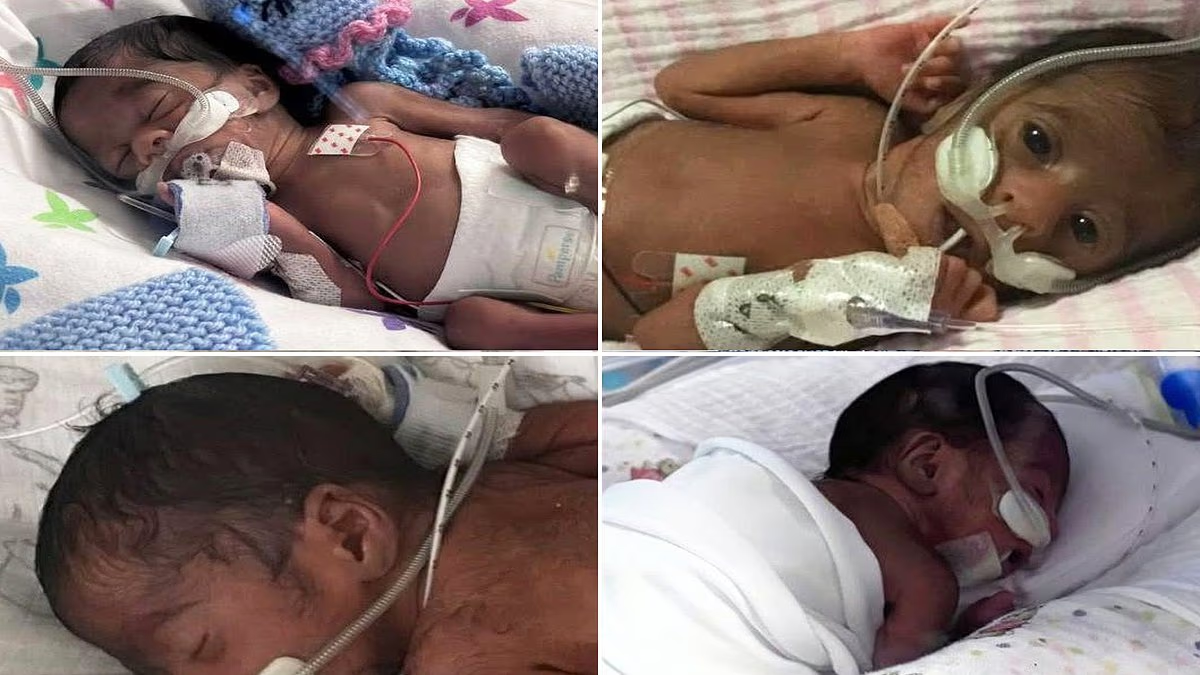

A specialist team of 30 clinicians, known as the “quad squad”, helped deliver a couple’s four babies in Wales just weeks after they discovered they were expecting quadruplets.
Glenna Alphonse and her partner, John Poul Josh, were stunned when doctors revealed during an early scan that they were expecting not one baby, but four.
Glenna was so shocked that she initially insisted the doctors must have made a mistake. The scan was repeated “several times” at Princess of Wales Hospital in Bridgend to confirm the unexpected result.
“At first, I argued with them, saying ‘it’s not quadruplets’,” the surprised mother told BBC Wales.
“But they did the scan a couple of times and brought in experienced colleagues, and it was true. It gave us a big shock.”
The couple were referred to Dr Bryan Beattie, Wales’ lead consultant for foetal medicine, at the University Hospital of Wales (UHW) in Cardiff. He oversaw the high-risk pregnancy and helped them prepare for the challenges ahead.
Dr Beattie also began bringing together a specialist medical team, which became known as the “quad squad”, to care for Glenna and plan the delivery.
John Poul said the consultant arranged counselling for the couple, describing the support as “very helpful”.
“At first we were scared,” he said. “But we met Dr Beattie and he gave us very good support. He explained that the team would give us good care and told us not to worry about anything.”

Glenna Alphonse and John Poul Josh were stunned when doctors told them they were expecting four babies. Pictured: One of the quadruplets

Glenna initially believed the doctors had made a mistake, prompting them to repeat the scan several times. Pictured: One of the quadruplets

The two boys and two girls were born weighing between 1lb 10.3oz (745g) and 2lb 9.6oz (1.18kg) following a pregnancy estimated to occur once in 700,000. Pictured: One of the quadruplets

The parents chose names beginning with “N”, the only letter shared by both of their first names. Pictured: One of the quadruplets
Just as the couple were coming to terms with the prospect of becoming one of only a small number of families in the UK to welcome quadruplets each year, Glenna was rushed to hospital at 22 weeks pregnant.
A routine scan, carried out three days before a planned baby shower and gender-reveal celebration, showed that she could go into labour dangerously early.
“The scan found that the cervix was close to opening. We had to cancel everything,” she said.
Glenna was admitted to UHW, where doctors inserted a cervical stitch, or cerclage, in an effort to prolong the pregnancy and give the babies more time to develop.
She remained in hospital for the following five weeks as the specialist team closely monitored her condition. Dr Beattie praised her patience throughout the difficult period.
Describing Glenna as “a brilliant part of the team”, he said she accepted “everything that we suggested in the best interest of the babies” despite being “very, very uncomfortable”.
At the same time, the quad squad prepared a detailed birth plan. The babies would either be delivered by a planned caesarean section or through an emergency procedure if complications developed.
A dedicated backup rota of doctors, nurses and other medical staff was organised, while an operating theatre was reserved for the complex delivery. Some members of staff extended their shifts or returned from home to assist with the births.
However, Glenna went into labour naturally when the babies were 27 weeks old.
The team immediately put its plan into action, coordinating the delivery in what Consultant Neonatologist Dr Rachel Hayward described as resembling a “military operation”.
The two boys and two girls were born weighing between 1lb 10.3oz (745g) and 2lb 9.6oz (1.18kg), following a pregnancy estimated to occur once in 700,000.
Five neonatal staff members were assigned to each baby to monitor their condition and support their care.
Several staff stayed beyond the end of their shifts, while others returned from home to provide additional help. John Poul paid tribute to the team, saying they had “given 200% for us”.
Glenna said the pressure before the delivery had been immense, but the moment she saw her babies, that struggle disappeared.
“It was totally, fully worth it,” she said. John Poul agreed, saying: “There was only happiness.”
The quadruplets are now receiving specialist neonatal treatment after being transferred to Singleton Hospital in Swansea, closer to the family’s home.
The parents have chosen names beginning with “N” for all four babies because it is the only letter their first names have in common.


